Education Under British Raj (After 1857
Education Under British Raj (After 1857
📌 Table of Contents
- 🔍 Post-1857 Context & The General Council of Education
- 🗳️ Hunter Commission (1882): Focus on Primary Education
- Background & Objectives
- Key Recommendations
- 🎓 Raleigh Commission (1902): Reforming Universities
- 📜 Indian Universities Act (1904): Tightening Control
- 🏛️ Sadler University Commission (1917): Structural Overhaul
- Calcutta University & Beyond
- Core Recommendations & Implementation
- ⏳ Sargent Plan of Education (1944): The 40-Year Vision
1. 🔍 Post-1857 Context
- The Shift: After the 1857 Revolt, administrative power moved from the East India Company to the British Crown 👑.
- The Gap: It was felt that the Wood’s Despatch (1854) was not being implemented properly.
- General Council of Education: Formed in London to push for educational reassessment. Lord Ripon (Viceroy 1880–84) was tasked to look into the state of Indian education 💂.
2. 🗳️ Hunter Commission (1882)
The first major commission appointed by Lord Ripon to look into the state of education.
📝 Recommendations:
- Primary Education First: Responsibility should be handed over to local bodies (District Boards & Municipal Councils) 🏘️.
- Mother Tongue: The medium of instruction at the primary level should be the vernacular language 🗣️.
- Indianization: Curricula should be based on local needs (subjects like agriculture, arithmetic, and geography) 🌾.
- Private Sector in Secondary Ed: The government should gradually withdraw from secondary schools and hand them to private enterprises via grant-in-aids 💰.
- Inclusivity:
- Supported expansion into backward areas and tribal regions 🏹.
- Special curriculum for women's education 👩🎓.
- Special focus on Muslim education and backward classes.
- Teacher Training: Established "Normal Schools" for training educators 👨🏫.
- separate dedicated funds for urban and rural primary education should be used for only one purse.
3. 🎓 Raleigh Commission (1902)
Appointed by Lord Curzon to investigate the condition and prospects of Indian Universities.
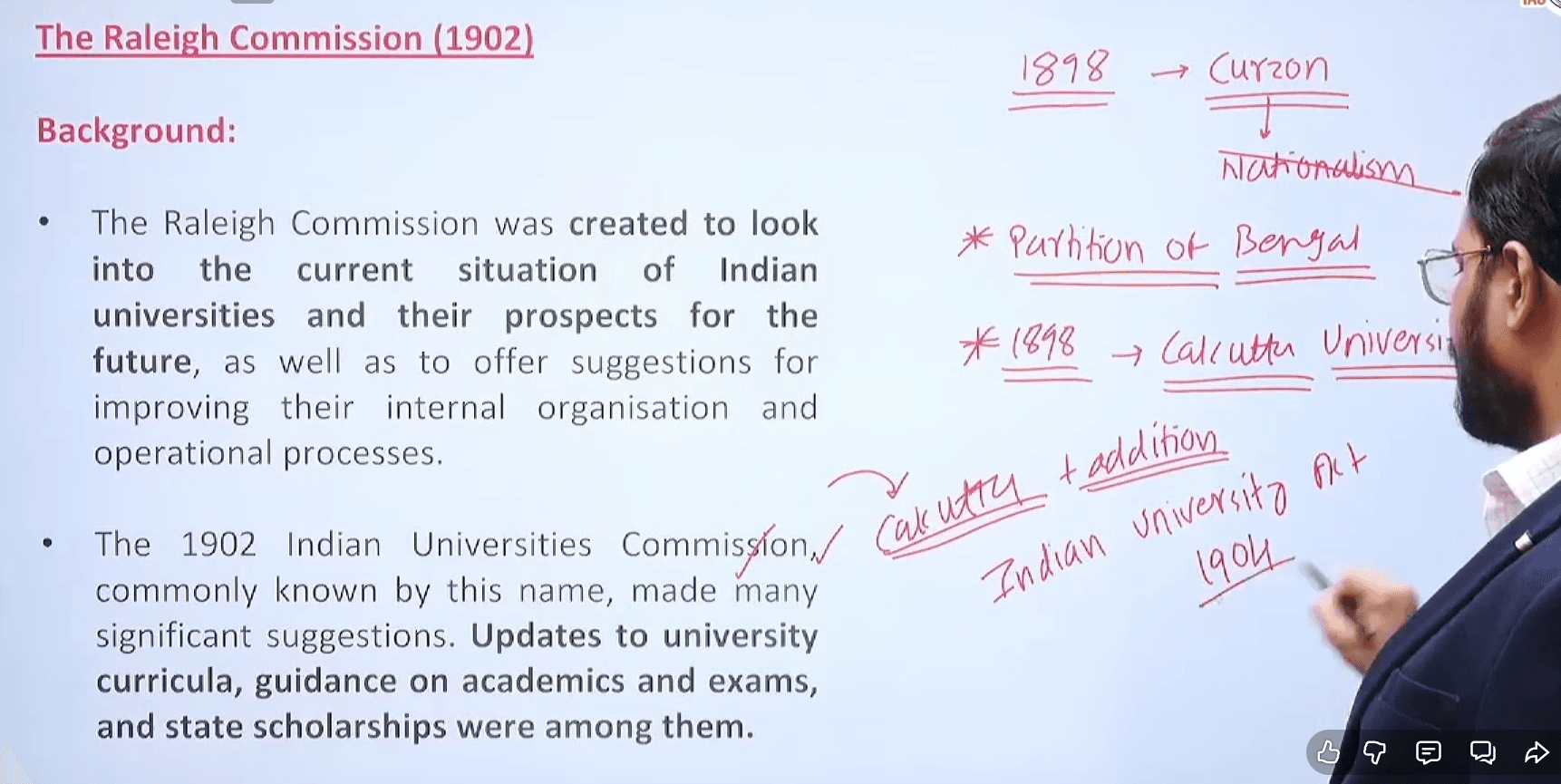
📝 Recommendations:
- Focus on Research: Universities should prioritize education and high-level research over just conducting exams 🧪.
- Government Control: Lowered the number of university fellows and mandated that the majority be appointed by the government 💂.
- Veto Power: The government gained the power to approve or veto university senate regulations 🚫.
- Grants: A five-year grant of 5 lakh rupees was proposed for advancement, but requirements for private college affiliation were tightened ⛓️.
4. 📜 Indian Universities Act (1904)
This Act was passed based on the Raleigh Commission’s findings, despite significant student protest.
- Fellows Limit: Fixed between 50 and 100 fellows per university 👥.
- Elected Fellows: Limited to 20 for big cities (Bombay, Madras, Calcutta) and 15 for others.
- Territorial Boundaries: The Governor-General was given the power to define the territorial limits of a university 🗺️.
5. 🏛️ Sadler University Commission (1917)
Originally appointed to study Calcutta University, but its findings applied to the entire Indian system.
📝 Key Recommendations:
- 12-Year School Course: Students should enter university only after an intermediate stage (not just matriculation) ⏳.
- 3-Year Degree: Proposed a standardized three-year degree program 🎓.
- Secondary Boards: Established separate boards to control secondary and intermediate education.
- Unitary Universities: Advocated for centralized, residential-teaching autonomous bodies rather than scattered affiliated colleges 🏘️.
- Professional Education: Prioritized scientific, technological, and teacher training for women 👩🔬.
- Freedom: Urged the government to stop "meddling" in academic matters 🕊️.
🛠️ Implementation (1916–1921):
- New Universities: Seven new universities established, including Mysore, Patna, Benaras (BHU), Aligarh (AMU), Dacca, Lucknow, and Osmania 🏛️.
- Administrative Reforms: Positions of full-time Vice-Chancellors and Professors were created, improving internal administration.
6. ⏳ Sargent Plan of Education (1944)
Devised by Sir John Philip Sargent, the educational adviser to the government.
- The Goal: To achieve universal literacy in India within 40 years 📈.
- Free & Compulsory: Aimed for free education for all children between ages 6–11 🧒.
- Structure: Focused on establishing elementary and high schools with no fees in public institutions.
- Leveling Up: Sought to replace the stark distinction between elementary and higher education, aiming for a more fluid educational path ⬆️.
💡 Study Tip: For UPSC Mains, remember that the Hunter Commission focused on Primary/Mass Education, while the Raleigh Commission and 1904 Act were seen as political tools to control nationalist sentiment in Universities. ✍️✨
