✊ Quit India Movement (1942)
✊ Quit India Movement (1942)
Core Context
The Quit India Movement, also known as the August Kranti, was the final massive civil disobedience movement launched by Mahatma Gandhi. It was characterized by the slogan "Do or Die" and represented a shift toward a more aggressive stance for immediate independence.
📑 Table of Contents
- 🌍 Background & Launch
- ⚖️ Internal Debate & Controversies
- 📜 Gandhi’s General Instructions
- 🏹 Ten Duties of the People
- 🧨 Reasons for the Movement
- 📉 Phases of the Movement
- 🏛️ Parallel Governments
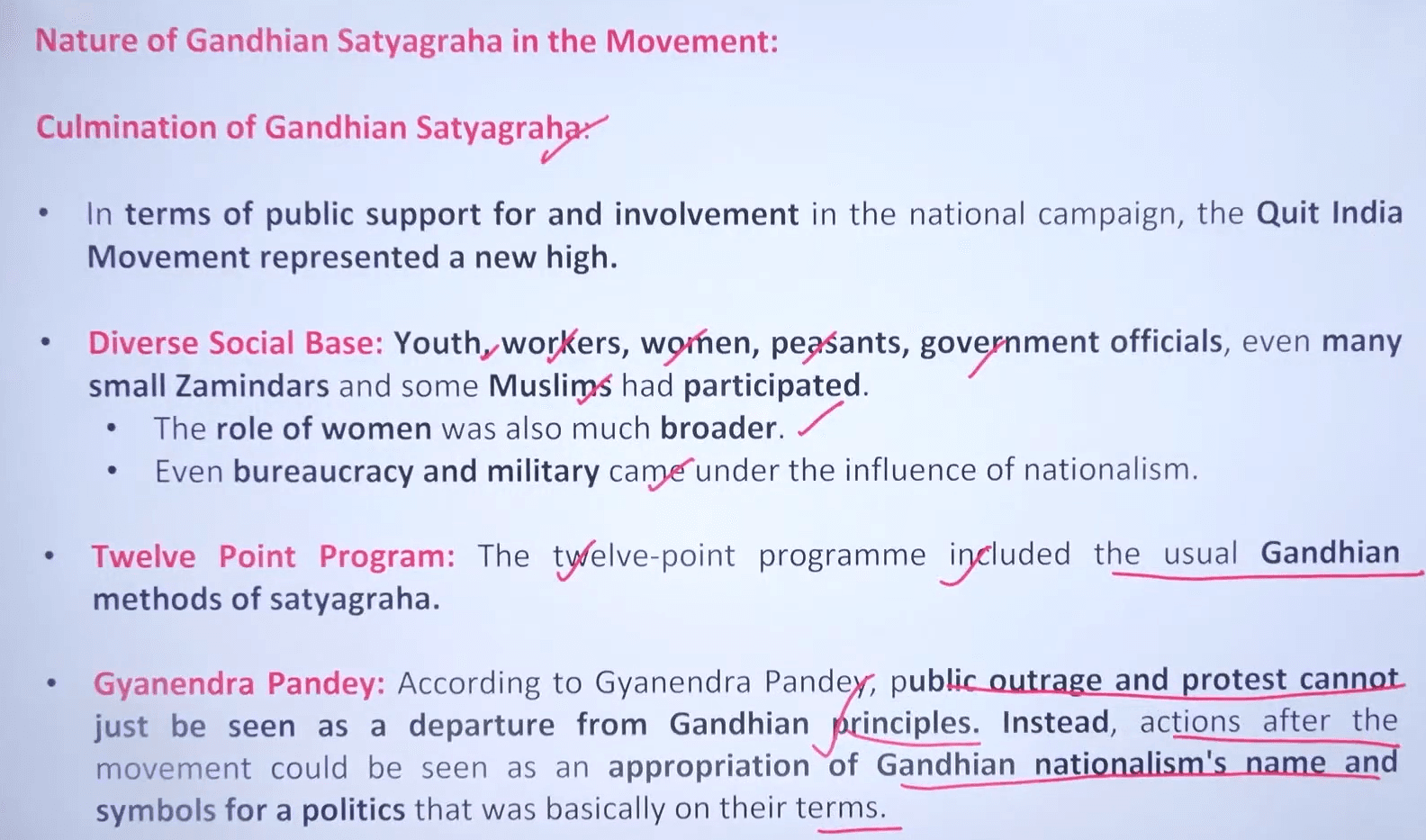
- 👥 Extent of Mass Participation
- 👮 Government Repression & Gandhi's Fast
- ✨ Impact & Historiography
🌍 Background & Launch
- Cripps Failure: Gandhi rejected the Cripps Proposal, calling it a "post-dated cheque on a crashing bank." 🏦💸
- Resolution:
- Wardha (14 July 1942): The Congress Working Committee (CWC) adopted the resolution for complete independence.
- Ratification: Ratified at Gowalia Tank, Bombay on August 8, 1942. 📍
- The Mandate:
- Immediate end to British rule.
- Sanction of a mass non-violent struggle.
- Commitment to defend India against Fascism and imperialism.
- Key Slogans: "Quit India", "Bharat Chodo", and Gandhi's famous ultimatum: "Do or Die". ✊🔥
- also called as August movement
⚖️ Internal Debate & Controversies
- Exit: C. Rajagopalachari quit the Congress over the decision to launch the movement. 🚪
- Skeptics: Jawaharlal Nehru and Maulana Azad were apprehensive and critical of the call initially but backed Gandhi until the end.
- Supporters: Sardar Patel, Rajendra Prasad, and Anugrah Narayan Sinha gave enthusiastic support from the start. ✅
📜 Gandhi’s General Instructions
Gandhi gave specific guidelines to different sectors of society to undermine British authority:
- 🏢 Government Servants: Do not resign your job, but openly proclaim loyalty to the Indian National Congress (INC).
- 💂 Soldiers: Stay in the army but refrain from firing on your own compatriots.
- 🚜 Peasants: Pay rent only if the landlords are anti-government; refuse if they are pro-government.
- 🎓 Students: Can leave studies if they are confident enough to commit to the movement.
- 🤴 Princes: Support the people of your state and accept their sovereignty.
- 🏰 People of Princely States: Support your ruler only if they are anti-government.
🏹 Ten Duties of the People (Nov 8, 1942)
Congress instructed citizens to perform these duties 'without any risk':
- 🚫 No transactions with British business or government.
- 🚩 Exhibit the tricolour flag at every home/window.
- 📽️ Boycott movies (as tax goes to the "tyrant government").
- ⚖️ Do not enter British Courts.
- 🛍️ No purchase of foreign goods.
- 💰 Withdraw money from Government Banks.
- 💂 Boycott servants of the British Government.
- 🚪 Leave cities and move to villages.
- 🌾 Grain should remain with the peasants.
- ❌ Do not transact business if asked to go to court.
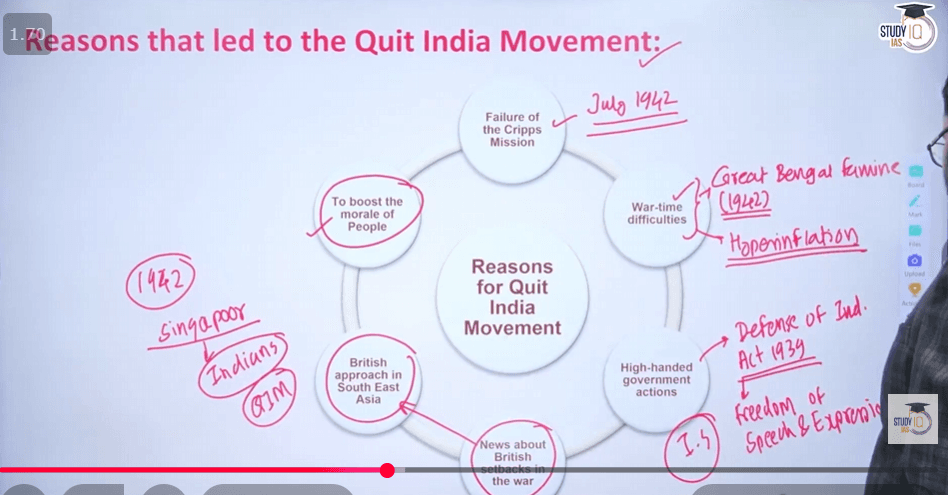
🧨 Reasons for the Movement
- Failure of Cripps Mission: Proved British insincerity.
- War-time Hardships: High prices and scarcity of essential goods. 📉
- Morale Boost: Need to revive the spirit of the people after setbacks.
- Japanese Threat: Fear of Japanese invasion and British high-handedness in South East Asia (scorched earth policy). 🇯🇵⚔️
📉 Phases of the Movement
1️⃣ Government Response (Aug 9, 1942)
- Top leaders (Gandhi, Nehru, etc.) were arrested in a pre-dawn sweep (Operation Zero Hour). 👮♂️⛓️
- Aruna Asaf Ali (relatively unknown then) presided over the AICC session and hoisted the flag.
- Congress organizations (CWC, AICC, PCC) were declared unlawful.
2️⃣ First Phase: Spontaneous Protests 📢Aug to dec 1942
- Public attacked symbols of authority (Police stations, Post offices, Railways).
- Communication lines (telegraph/telephone) were destroyed. ✂️📞
- Students and workers went on massive strikes.
- workers went to strike.
3️⃣ Second Phase: Underground Activity 🕵️♂️Dec 1942 to 1945
- Leaders like Jayaprakash Narayan(Gorela war at nepal bihar boder) , Ram Manohar Lohia, and Usha Mehta(congress Radio) went underground.
- Congress Radio: Operated secretly to disseminate news and instructions. 📻📡
- Collection of arms, ammunition, and funds for sabotage.
Third phase🏛️ Parallel Governments
In some areas, the British authority completely collapsed, and "Parallel Governments" were formed:
| Place | Leadership | Key Features |
|---|---|---|
| Ballia (UP) | Chittu Pandey 1942 | Released Congress leaders; lasted for a week. |
| Tamluk (Bengal) | Jatiya Sarkardec 1942 to sep 1944 | Sanctioned grants to schools; paddy distribution to the poor. |
| Satara (Mah.) | Prati Sarkar1943 to 1945 | Nana Patil & Y.B. Chavan. Organized village libraries, Nyayadan Mandals, and "Gandhi marriages." 💍📚 |
👥 Extent of Mass Participation
- 🌟 Students: Remained in the forefront of the struggle.
- 👩 Women: High involvement, especially school and college girls.
- 🏭 Workers: Massive strikes in Ahmedabad, Bombay, and Jamshedpur.
- 🚩 Muslims: Helped by giving shelter to underground activists.
- 🚫 Non-Participants:
- Communist Party of India (CPI): Did not join (due to Russia joining the Allies).
- Muslim League: Opposed the movement.(divide and quit india and lekar rahege and ladkar lage pakistan)
- Hindu Mahasabha: Boycotted the movement. 1942 (sawarkar chairperson) (shama parsad mukharji .. was writing letter to British about the movement)
- Princely States: Generally showed a low-key response.
👮 Government Repression & Gandhi's Fast
- Repression: Over 100,000 arrests, mass fines, and public flogging. Military used machines guns in some areas. 🔫
- Battleship Plan: British considered taking Gandhi to Yemen or South Africa on a battleship but dropped it for fear of a massive revolt. 🚢
- Gandhi's Fast (Feb 1943): Gandhi undertook a 21-day fast in jail to condemn government violence.
- Result: Raised public morale, heightened anti-British sentiment, and exposed government high-handedness. 🧘♂️✨
✨ Impact & Historiography
Impact and Significance
- Unity: Kept the Congress party united during the leadership vacuum.
- Loyalty: British loyalty among officials and soldiers suffered a heavy blow. 📉
- Final Call: It made the demand for independence "non-negotiable" and the center-stage issue.
🖋️ Historiographical Views
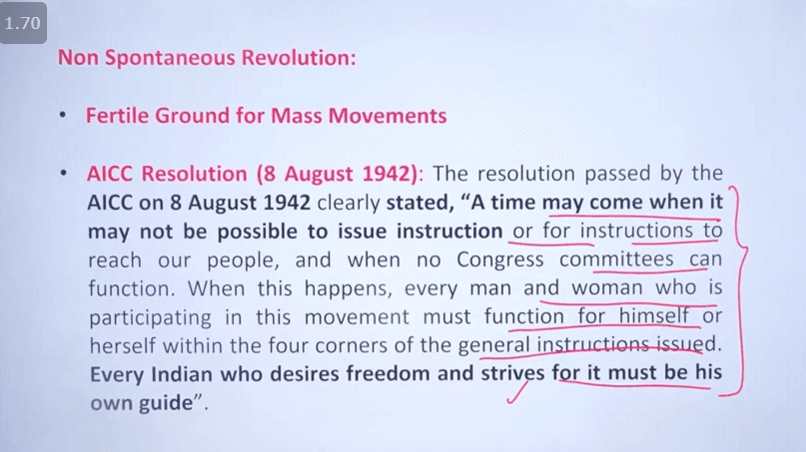
- Spontaneous Revolution: F.G. Hutchins and Sumit Sarkar argue it was spontaneous because leaders were in jail.
- Non-Spontaneous: Proved by the "Deoli Plan" (JP) and the "Twelve-Point Programme" drafted before arrests. 📑
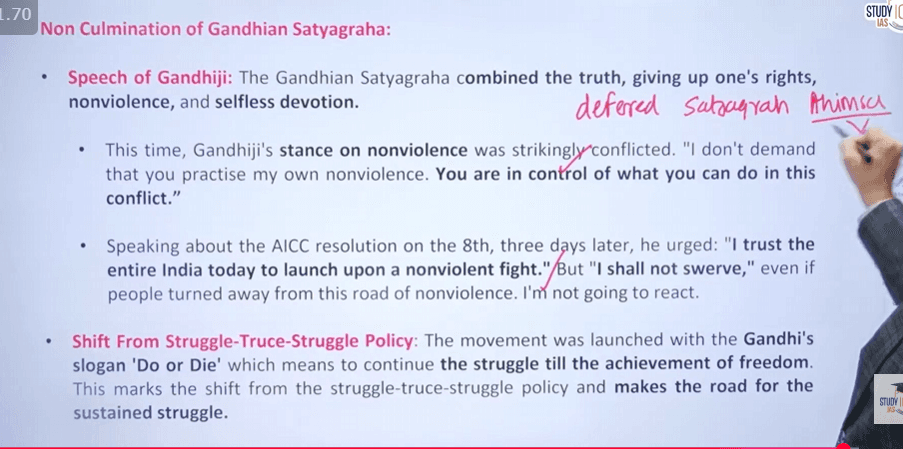
- Nature of Non-violence: Gandhi's stance was conflicted. He didn't condemn the violence of the masses as he had in Chauri Chaura, saying "I don't demand that you practise my own non-violence." ⚖️
- Viceroy Linlithgow: Admitted it was "by far the most serious rebellion since 1857." 💂♂️🔥\
- vacuum in leadership
