29) History of Communalism
History of Communalism
📌 Table of Contents
- 🔍 Understanding Communalism: Definition & Nature
- 📉 Socio-Economic Roots of Division
- 🇬🇧 The British "Divide and Rule" Strategy
- Phase 1: Pre-1870s Repression
- Phase 2: Post-1870s Patronage
- The "Why" and "How" of British Policy
- 🚩 Side-Effects of Militant Nationalism
- 🕉️ The Rise of the Hindu Mahasabha
- Evolution from 1909 to 1921
- Key Leadership & Early Agendas
- 📖 Savarkar and the Ideology of Hindutva
- 🤝 Political Friction & Surprising Coalitions
- Strained Relations with the INC
- Alliances with the Muslim League (1941-1943)
- 🧐 Historiography: Expert Perspectives
1. 🔍 Understanding Communalism: Definition & Nature
- Politicized Identity: It is a form of politics that seeks to unify a community around a religious identity 🕍.
- Hostile Opposition: It doesn't just promote one’s own religion but defines it in hostile opposition to another community ⚔️.
- Fixed Identity: It views religious identity as "fundamental and fixed," leaving no room for shared secular or class interests 🧩.
- Conflict Promotion: It acts as an ideology specifically designed to trigger and sustain conflict between religious groups 🧨.
2. 📉 Socio-Economic Roots of Division
The "backwardness" of certain sections provided fertile ground for communalism:
- Intellectual Lag: Muslim intellectuals were slower to absorb modern Western scientific ideas compared to their Hindu counterparts 🧪.
- Education Gap: The proportion of educated individuals was significantly lower among Muslims 🎓.
- Economic Stagnation: Muslims lagged behind in the growth of modern trade, industry, and the emerging middle class 🏭.
- Job Scarcity: Educated Muslims found very few opportunities in business, leading to intense competition for limited Government Jobs 💼, which the British exploited.
3. 🇬🇧 The British "Divide and Rule" Strategy
The British played a "double game" to ensure the Empire's survival.
🔄 The Great Shift (The 1870s Pivot)
- Pre-1870s (The Stick 🪵): Following the 1857 Revolt and Wahabi Movement, the British viewed Muslims as the primary rebels. They used repression, discrimination, and promoted English education to undermine traditional Persian/Arabic learning.
- Post-1870s (The Carrot 🥕): As the National Congress (INC) grew, the British switched sides. They offered concessions, reservations, and favors to Muslims to use them as a "counter-weight" against nationalist forces. They used figures like Sir Syed Ahmed Khan to pull Muslims away from the Congress 🚩.
🧠 British Motives & Implementation
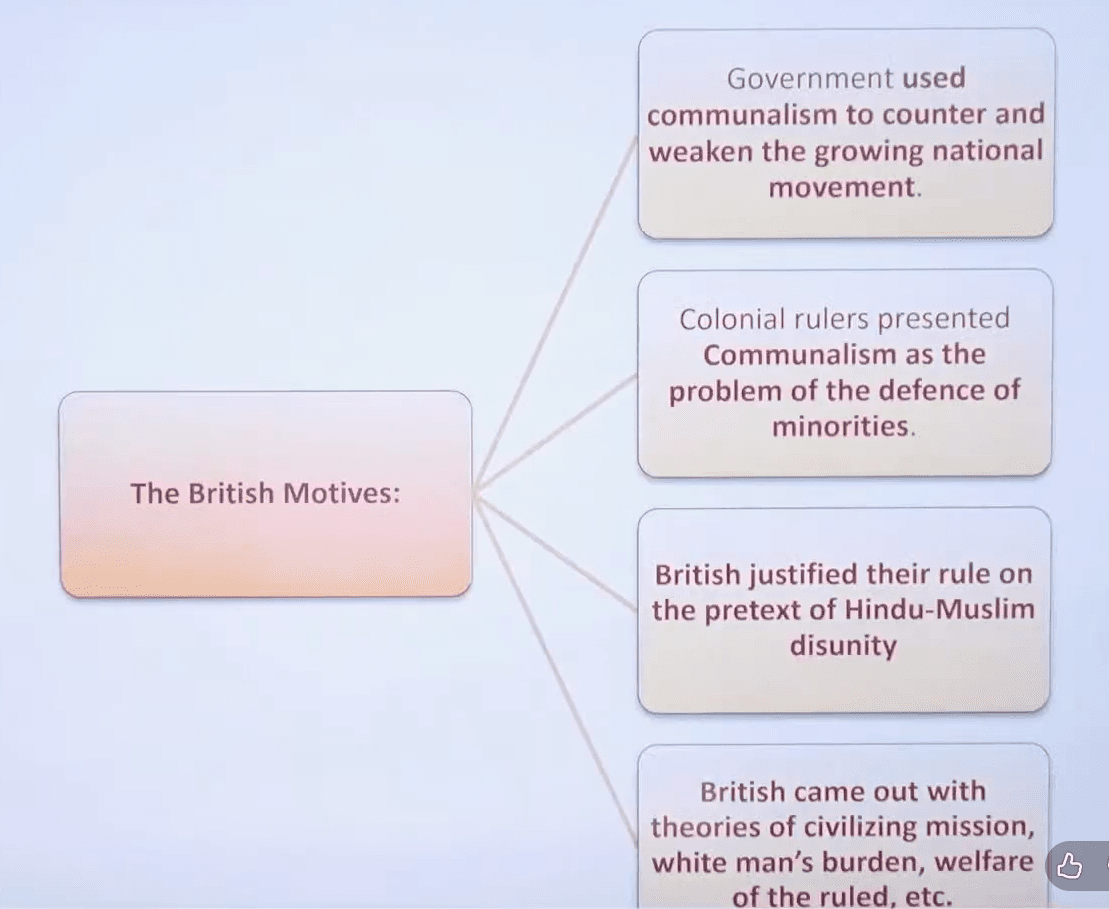
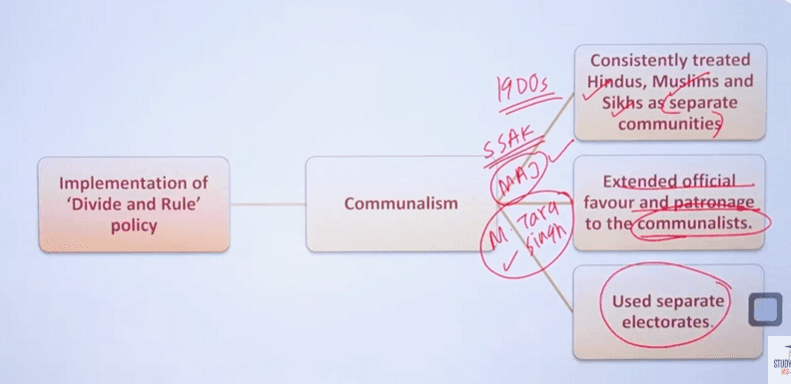
implementation
- The Alibi: They justified their rule by claiming Indians were too divided (Hindu vs. Muslim) to self-govern 🤥.
- The "Protector" Mask: They presented themselves as the sole defenders of minority rights 🛡️.
- The Weapon: The introduction of Separate Electorates 🗳️—the ultimate tool to institutionalize communal division in politics.
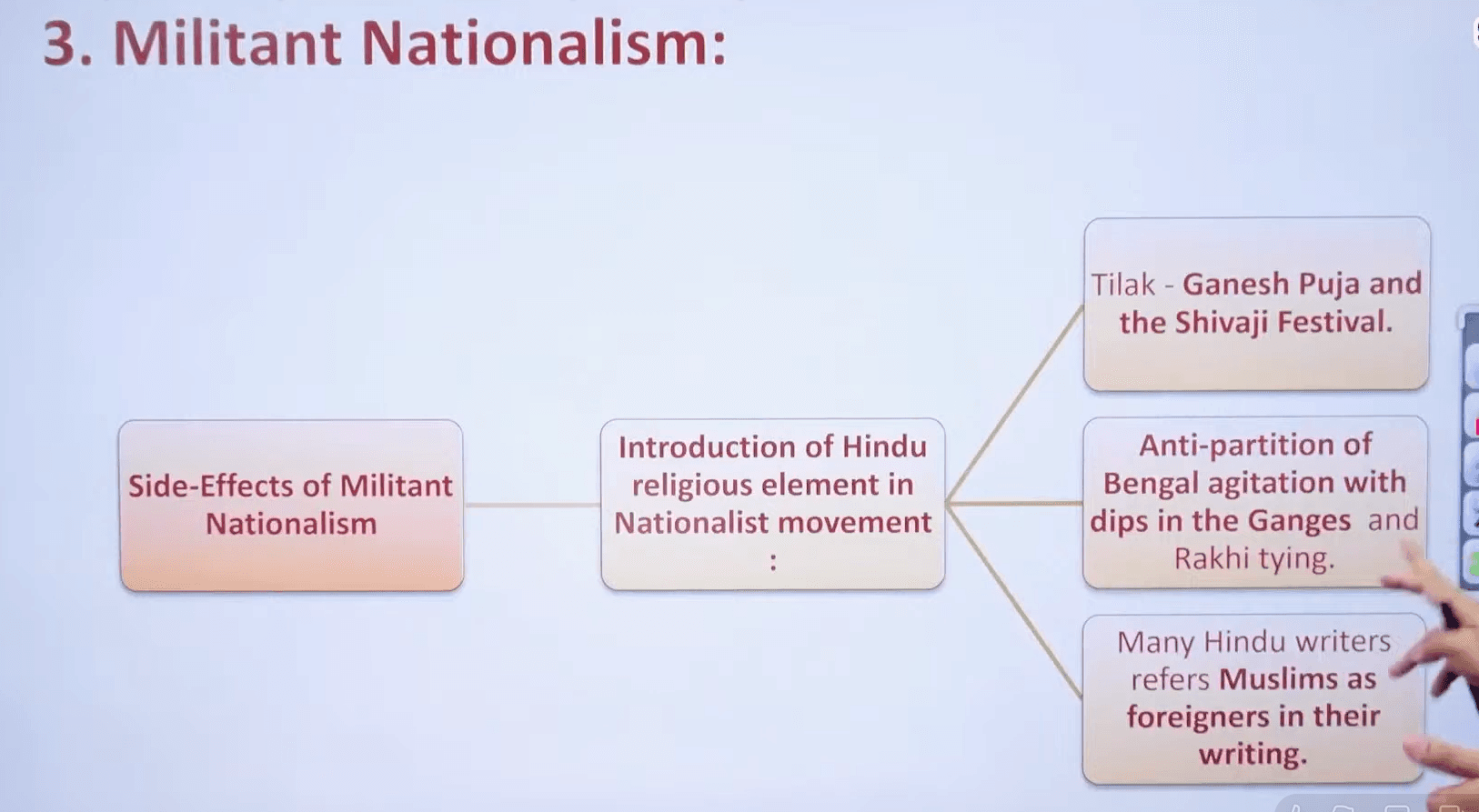
4. 🚩 Side-Effects of Militant Nationalism
Sometimes, the tools used to fight the British inadvertently fueled communalism:
- Religious Symbolism: Leaders like Tilak used Ganesh Puja and the Shivaji Festival to mobilize the masses. While effective for Hindus, it often alienated Muslims 🥁.
- Rituals in Protest: During the Anti-Partition of Bengal agitation, rituals like dipping in the Ganges and Rakhi-tying gave the movement a distinct Hindu color 🌊.
- Literary Bias: Some Hindu writers portrayed Muslims as "foreigners" or "oppressors" in their historical fiction ✍️.
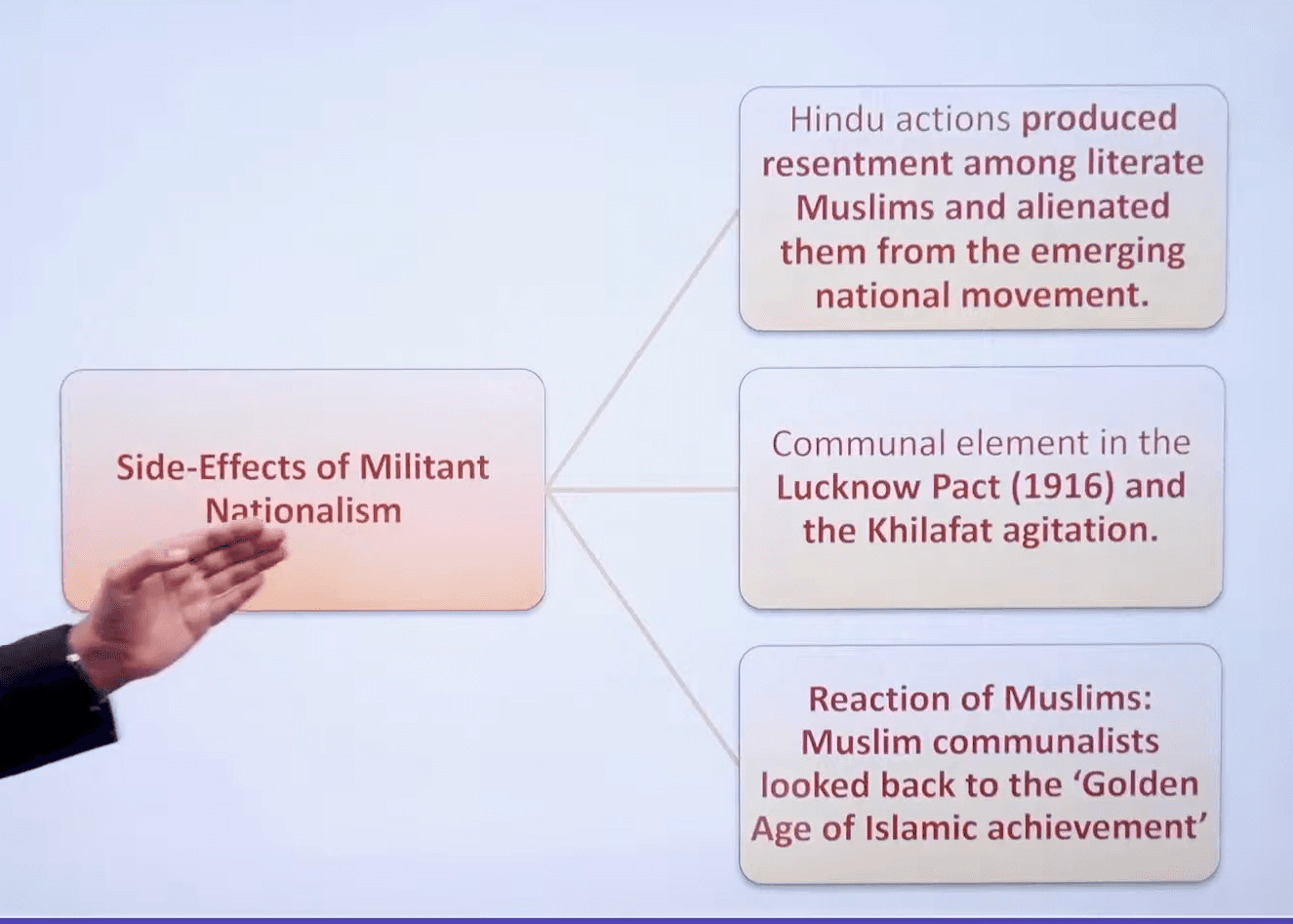
- Muslim Reaction: This led to resentment and a desire to look back at a "Golden Age of Islam" rather than a shared Indian past 🕌.
5. 🕉️ The Rise of the Hindu Mahasabha
⏳ Evolution of the Organization
- 1909: Punjab Hindu Sabha founded by U.N. Mukherjee and Lal Chand. Its stance? Support the British to fight the Muslims 🤝.
- 1915: Sarvadeshik Hindu Mahasabha formed. It aimed to unite Hindu society by removing internal divisions like caste and sect 🔗one of the founding member was MaDAN MOHAN MALVAI.
- 1921: Renamed Akhil Bharat Hindu Mahasabha. It became more "nationalist," removing the "loyalty to British" clause and seeking a self-governing India 🇮🇳.
👤 Key Leaders
- Pandit Madan Mohan Malaviya: Focused on Hindu education (BHU) and economic development 🏫.
- Lala Lajpat Rai: The "Lion of Punjab" who participated in its early leadership 🦁.
6. 📖 Savarkar and the Ideology of Hindutva
Under V.D. Savarkar, the movement gained a clear ideological textbook:
- Essentials of Hindutva: In his book, Savarkar defined a Hindu as someone who shares:
- Rashtra (A common Nation) 🗺️
- Jati (A common Race/Bloodline) 🩸
- Sanskriti (A common Culture/Civilization) 🏺
- Indic Religions: Savarkar considered Hindus, Buddhists, Jains, and Sikhs as part of the same "Hindu Nationality" because their religions originated in India 🕉️☸️☸️☬.
- Social Reform: He was a fierce critic of the Caste System and Untouchability, organizing "all-caste dinners" to build a monolithic Hindu identity 🍽️.
7. 🤝 Political Friction & Surprising Coalitions
⚡ Conflict with Congress (INC)
- The Mahasabha rejected the Nehru Report because it gave "too many concessions" to Muslims 📄.
- They stayed away from the Civil Disobedience Movement (1930) and the Quit India Movement (1942) 🚶♂️.
- World War II: While Congress resigned from the government, the Mahasabha helped the British with "Militarization Boards" to recruit Hindus into the army 🎖️.
🤝 The "Enemy of my Enemy" Coalitions (1941-1943)
In a strange twist of history, the Hindu Mahasabha formed coalition governments with the Muslim League in three provinces:
- Sindh: They remained in power even after the Sindh Assembly passed a resolution for Pakistan 🇵🇰.
- NWFP: Formed a government with Sardar Aurang Zeb Khan 🏔️.
- Bengal: Joined the Progressive Coalition under Fazlul Haq 🌾.
8. 🧐 Historiography: Expert Perspectives
- Anthony Parel: Argues that the idea of Hindu culture being "self-sufficient" is unhistorical and narcissistic, ignoring the melting pot of Indian history 🏺.
- Prabhat Patnaik: Views Hindutva as an attempt to create a "homogeneous majority" based on a sense of grievance and an appeal to "masculinity" rather than rational debate 🧠.
💡 Study Tip: Focus on the transition of the British policy from the 1870s and the contradictory nature of the Mahasabha-Muslim League coalitions for your Mains answers! ✍️✨
📌 Table of Contents
- 📉 The Deepening Divide: 1920s & 30s
- 🗳️ The Watershed Moment: 1937 Elections
- 📜 The "Pakistan" Resolution (1940)
- ⚔️ Post-War Deadlocks: Wavell Plan
- 🕊️ The Cabinet Mission: A Failed Alternative
- 🔥 The Final Push: Direct Action to Partition
- ⏳ Timeline: Evolution of the Two-Nation Theory (1888–1947)
1. 📉 The Deepening Divide: 1920s & 30s
Communalism in this phase transitioned from political demands to grassroots friction.
- Partition as Culmination: Many scholars view the 1947 Partition not as an accident, but as the final result of long-term communal politics 🚪.
- Institutionalized Division: Separate electorates (1909 & 1919) ensured that politicians only appealed to their own religious groups.
- Flashpoints of Conflict:
- Music-before-mosque: Disputes over religious processions passing mosques 🕌.
- Cow Protection Movement: A major source of Hindu-Muslim tension 🐄.
- Shuddhi Movement: The Arya Samaj's efforts to "reconvert" people back to Hinduism, which sparked retaliatory movements like Tabligh and Tanzeem among Muslims 🔄.
2. 🗳️ The Watershed Moment: 1937 Elections
The 1937 provincial elections revealed the changing political landscape.
- Congress's Mixed Results: While Congress dominated general seats, it performed poorly in constituencies reserved for Muslims 📉.
- League's Struggle: Surprisingly, the Muslim League failed to win a single seat in the North-West Frontier Province (NWFP).
- The United Provinces (UP) Friction:
- The Muslim League wanted to form a joint government with the Congress.
- Because Congress had won an absolute majority, they rejected the coalition ❌. This rejection is often cited as a turning point that convinced the League they could never share power with the Congress.
3. 📜 The "Pakistan" Resolution (1940)
- Date: March 23, 1940 (Lahore Session).
- The Demand: The League moved a resolution for "autonomy" for Muslim-majority areas in the North-West and East 📍.
- Ambiguity: Interestingly, the resolution never explicitly mentioned "Partition" or "Pakistan" at first.
- Formalization: The specific demand for a separate state named "Pakistan" was formalized later during the 1941 Karachi Session 🇵🇰.
4. ⚔️ Post-War Deadlocks: Wavell Plan
After WWII, the British tried to resolve the Indian deadlock.
- The Proposal: Viceroy Wavell agreed to create an entirely Indian Central Executive Council.
- The Veto Power: Discussions failed because M.A. Jinnah demanded a "Communal Veto"—that no decision affecting Muslims could be taken without the League's consent ✋.
- British Tilt: Wavell effectively gave the Muslim League a virtual veto over constitutional progress, frustrating the Congress.
5. 🕊️ The Cabinet Mission: A Failed Alternative
The last serious attempt to keep India united.
- The Plan: Recommended a loose three-tier confederation (Center, Groups of Provinces, and Provinces) 🏛️.
- Reluctant Agreement: Both the League and Congress initially agreed, but interpretations of "grouping" differed, leading to a breakdown.
- Firm Opposition: Mahatma Gandhi and Khan Abdul Ghaffar Khan (Frontier Gandhi) remained the most steadfast opponents of the partition idea until the very end 👤.
6. 🔥 The Final Push: Direct Action to Partition
- Direct Action Day: Frustrated by constitutional delays, the League announced August 16, 1946, as "Direct Action Day" to show the strength of Muslim feeling for Pakistan. It resulted in massive communal violence 🩸.
- Congress's Capitulation: By March 1947, seeing the uncontrollable violence, the Congress leadership finally agreed to divide the Punjab (and later Bengal) into two halves—effectively accepting Partition 🗺️.
7. ⏳ Timeline: Evolution of the Two-Nation Theory
| Year | Event / Development |
|---|---|
| 1888 | Viceroy Dufferin’s speech & George Hamilton’s accusations of Congress being "double-sided" 🗣️. |
| 1906 | Shimla Deputation & Formation of All India Muslim League 🤝. |
| 1909 | Morley-Minto Reforms (Separate Electorates) & Punjab Hindu Sabha 🗳️. |
| 1915 | First session of All India Hindu Mahasabha 🕉️. |
| 1916 |
