D2) Fiscal Deficit & FRBM Act
D2)Fiscal Deficit & FRBM Act.
📑 Pillar #2D2: Table of Contents
26. 💰 Budget ⮕ Capital ⮕ Receipt
**27. 📉 Types of Deficits:
- 27.1.1 **Types of Budget- Surplus, Deficit, Balanced
- 27.1.2 **Yudhishthir Disclaimer on Deficit Formulas 🏹
- 27.1.3 **Disclaimer #2 on the graphics for theory () 🖼️
- 27.1.4 **Budget Deficit = total income – total expense 💸
- 27.1.5 **Fiscal Deficit = Budget Deficit + Borrowing () 🏦
- 27.1.6 **Fiscal deficit formulas from ES26 ( 📕
- 27.1.7 **Gross Fiscal Deficit (GFD) vs NET fiscal Deficit 🔍
- 27.1.8 **Primary Deficit ) 🧶
- 27.1.9 **Gross Primary Deficit (GPD: 📊
- 27.2 **Revenue Deficit 🥘
- 27.3 **Effective Revenue Deficit ( 🏗️
- 27.3.1 Fiscal glide 🎢
- 27.4 **Extra-Budgetary Resources 🕵️♂️
- 27.5 **Debt Composition: Amount-wise 🏦
- 27.5.1 Debt Composition of Government: Type-wise ⚖️
- 27.5.2 Govt Debt: Nature and interest as per ES26 📕
- 27.5.3 Foreign Borrowing in Foreign Currency 💵
- 27.5.4 Budget: Foreign/external Borrowing DATA 📂
- 27.6 **Financing the deficit: negative consequences on economy ⚖️
- 27.6.1 Automatic financing of the deficit vs Market based financing ⚖️
- 27.6.2 Financing the Deficit: Ricardian Equivalence ( 🛍️
- 27.6.3 Ricardian Equivalence invalid for India says ES21 📕
- 27.6.4 Financing the deficit: “Crowding Out” of private borrowers 🧱
- 27.6.5 Crowding out of private investment? ES21 Observations📕
- 27.6.6 Financing the deficit: Printing More Money / monetization of debt🖨️
- 27.6.7 Direct vs Indirect monetisation - PHD not imp 🎓
- 27.6.8 Fiscal Deficit = India sovereign rating ?? ⭐️
- 27.7 **Countercyclical policy 🔄
- 27.7.1 Countercyclical: IRGD & Debt Sustainability 🦁
- 27.7.2 Countercyclical: Domar Condition of Debt Sustainability 📏
- 27.8 **Automatic Stabilizer- Income Tax ⚙️
- 27.8.1 Disposable income & marginal propensity to consume (MPC)🛒
- 27.8.2 Multipliers: various types of 🧮
- 27.8.3 Balanced budget multiplier = 1 how?⚖️
- 27.8.4 Effects of Budget/Fiscal policy on Demand & Savings 📉
- 27.8.5 THREE Functions of Govt Budget 📋
- 27.9 **Misc Terms related to Deficit Financing 📚
- 27.10 **Fiscal Consolidation / Prudence: 🛡️
- 27.11 **Fiscal stimulus 💉
- 27.11.1 Modi’s Atma-Nirbhar Bharat Economic Stimulus Package (2020)
- 27.11.2 Frontloading of Stimulus and Overheating in Economy🔥
- 27.12 **Fiscal Responsibility & Budget Management Act, 2003 📜
- 27.13 **FRBM: Trigger Mechanism (to) Escape (Deficit control) Clause 🔓
- 27.13.1 FRBM Act: Documents 📂
- 27.13.2 16th FC on Fiscal Deficit, subsidies & sarkaari companies 🏦
- 27.13.3 FRBM: we shd NOT reinstate 3% FD target! Says ES26 (📕
- 27.13.4 India’s debt is not financed by taxation & it is very महान- ES26 📕
- 27.14 **Fiscal Federalism: Helping the States in ATMANIRBHAR 🤝
- 27.14.1 Fiscal Deficit target for States 🏛️
- 27.14.2 State-level Debt: IP/RR ratio & problems ES26 📉
- 27.14.3 Kerala State Deficit problem vs Union Govt 🏛️
- 27.15 **FRBM: Misc. Concepts- Profligacy, Slippage 🎭
- 27.15.1 Budget marksmanship is Poor, says 15th Fc🎯
- 27.15.2 Fiscal Responsibility: Misc Bodies- PDMA, Fiscal Council 🏛️
26. 💰 Budget ⮕ Capital ⮕ Receipt
This section acts as the bridge. Before understanding "deficits" (the gap), we must remember that the government gets money through Receipts.
- Capital Receipts include borrowings (debt-creating) and disinvestment/loan recovery (non-debt creating).
- When these receipts are less than what the government wants to spend, a Deficit is born! 🐣
27. 📉 Types of Deficits
A deficit occurs when the government's wallet is lighter than its shopping list. 🛒💸
27.1.1 The Three States of a Budget ⚖️
- Surplus Budget : Income >> Expenditure. (Govt is "Saving" money). 💰⬆️
- Balanced Budget : Income == Expenditure. (Perfect equilibrium). ⚖️
- Deficit Budget : Expenditure >> Income. (Govt needs to borrow). 📉🚜
27.1.4 Budget Deficit💸
- Formula: Total Expenditure – Total Receipts (Revenue + Capital).
- The Reality Check: Since the 1997-98 Budget, the Indian Government has stopped showing "Budget Deficit" as a separate entry. Now, the focus is almost entirely on Fiscal Deficit. 🚫🔢
27.1.5 Fiscal Deficit 🏦⚓
This is the "Mother of all Deficits." It tells you exactly how much the government needs to borrow from all sources.

- total fiscal deficit of India is 12.52 lakh cr. 4.4% of the GDP
- Formula (NCERT): Total Expenditure – (Revenue Receipts + Non-debt creating Capital Receipts).
- Simplified Formula: total exp - total receipt = Budget Deficit + Borrowings & liabilities.
- Famous Committee: Sukhmoy Chakravarti (1997-98) defined the modern context of Fiscal Deficit. 📜
27.1.7 Gross vs. Net Fiscal Deficit 🔍🧐
- Gross Fiscal Deficit (GFD): The total borrowing needed by the Central Govt.
- Formula: Net borrowing at home + Borrowing from RBI + Borrowing from abroad. 🌏
- Net Fiscal Deficit: The actual burden on the Union.
- Formula: Gross Fiscal Deficit MINUS Net Lending (Loans given by the Union to States, CPSEs, and Foreign Nations). 🤝
- Logic: If the Union borrows ₹10 but lends ₹3 to a State, its "Net" burden is only ₹7.
27.1.8 Primary Deficit 🧶✂️
The government borrows money today, but a huge chunk of it goes into paying interest on loans taken by previous governments (e.g., Manmohan Singh, Vajpayee era).
- Formula: Fiscal Deficit MINUS Interest Payments on previous loans.
- FISCAL DEFICT - INTEREST ON EARLIER LOANS = PRIMARY DEFICIT
- Why it matters: It shows how much the current government is borrowing to fund new programs/schemes for the current year. 🆕
- Historical Fact: Mentioned first in 1993 by then Finance Minister Manmohan Singh. 🎤
27.1.9 Gross Primary Deficit (GPD) 📊
- Formula: Gross Fiscal Deficit MINUS Net Interest Liabilities.
- Net Interest Liabilities: (Interest to be paid by Union) – (Interest received by Union from its own loans). ➕➖
📉 Pillar #2D2: Revenue, Debt & Financing
27.2 Revenue Deficit 💸🥘
This happens when the government spends more than its income on daily operations.
- Formula: Revenue Expenditure – Revenue Receipts. (Income < Consumption).
- The Problem: Revenue expenditure is 'committed' (Interest on old loans, salaries, pensions). You can’t easily cut these. ✂️❌
- The Vicious Cycle: High RD ➡️ Govt borrows for consumption ➡️ Less money for Capital Expenditure (Schools, Hospitals) ➡️ Lower Human Development ➡️ Lower Economic Growth. 📉🏥
27.3 Effective Revenue Deficit 🏗️🧹
Introduced by P. Chidambaram in Budget 2011.
- union can give grants to state in 4 ways;
-
- finance commission Tax devolution
- **2) FC Grant in Aid, like panchayat, disaster management.
-
- union schemes like samagra siksha scheme
- 40 Capex loan to state.
- The Logic: Sometimes the Union gives a "Grant-in-Aid" to a State. This is recorded as Revenue Expenditure. But the State uses that money to build a Panchayat Bhavan or a Cranes for Disaster Management.
- The Asset: These are actually Capital Assets! 🏗️
- Formula: Revenue Deficit MINUS Grants for creation of capital assets.
27.3.1 Fiscal Glide 🎢📉
- Refers to the gradual reduction of fiscal deficit over time to keep the economy stable.
- Target: The government aims to bring the Fiscal Deficit down to 4.5% by 2025-26. 🎯
27.4 Extra-Budgetary Resources (EBR) 🕵️♂️🚪
Also known as "Off-Budget Borrowing." This is like hiding a credit card bill from your parents.
- The Trick: The Government (FinMin) tells the Food Corporation of India (FCI): "I won't give you a subsidy today. Go borrow 7,000 cr from the National Small Savings Fund (NSSF) yourself." 🤐
- The Result: The Fiscal Deficit looks smaller/better on paper, but the government's total liability is still there!
- Current Status: Budget 2021 announced an end to this practice to increase transparency. Both the 15th and 16th Finance Commissions have condemned this. 🚫🔦
27.5 Debt Composition: Amount-Wise 🏦📊
Where exactly does the government owe money?
- Internal Debt (94%): Mostly Rupee-denominated. Includes G-Secs and T-Bills. 🇮🇳
- External Debt (6%): Borrowed from foreign nations/banks (World Bank, ADB). 🌍
- Public Account Liabilities: Money in Post Office Savings, Provident Funds (NPS/EPFO). 📮
- internal debt + external debt = public debt +other public account liabilities + extra budgetary resources = total liability of the govt..
- internal+ external is called as total outstanding loan .
- marketable Debt : when govt sec are resell in the secondary market
- non marketable Debt: when govt sec which can not be resold in the secondary market , like if NABARd buys govt. sec form RBI but he is not allowed to sell it in the secondary market.
**27.5.1 Type-wise Breakdown ⚖️
- Majority: Long-term loans (13–19 years), Fixed Interest Rates, Rupee Denominated. ✅
- Minority: Short-term, Floating Interest Rates, Foreign Currency. ❌
**27.5.3 Foreign Borrowing in Foreign Currency 💵🔀
- Proposed in 2019 but not implemented.
- Argument Against: If the Rupee weakens (e.g., 1 = ₹80), we have to pay back much more in Rupee terms. Raghuram Rajan was a major critic of this idea. 🙅♂️💸
27.6 Financing the Deficit: Consequences ⚖️📉
deficit financing:
- means the government spends more money than it earns (through taxes and other revenues) and covers the gap by borrowing or printing new money How does the government fill the gap?
**1. Demanding More Taxes 📈🧾
- Problem: If taxes are too high, people stop working or start evading (The Laffer Curve). 📉
**2. Borrowing More Money 🏦🤝\
- borrowing more money by govt can leads to Ricardian equivalence and crowding out effect
- 1) Ricardian Equivalence: Theory that people save more today because they expect higher taxes tomorrow. (Mostly invalid for India). 🛍️❌
- 2) Crowding Out: Government takes all the bank's money ➡️ No money left for private business ➡️ No new factories ➡️ No jobs. 🏭🛑
- this is the financial repression of the households.
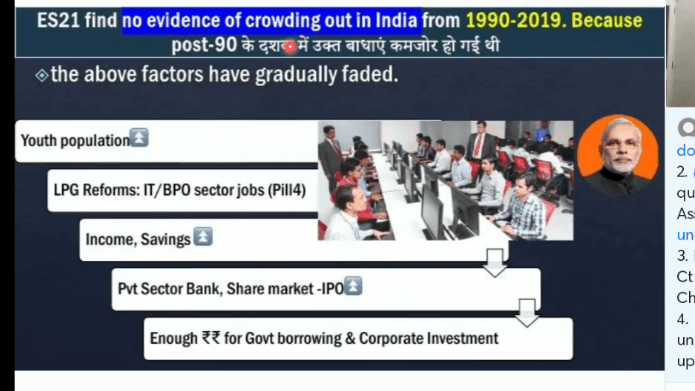
- crowding in : when govt encourages pvt. investment by granting loan .. it increases pvt. investment .
- 3) Rating Downgrade: A rating downgrade is a reduction in the credit rating of a country, company, or financial instrument due to increased risk of default. 🏢 Who Gives Ratings? Major credit rating agencies include:
- Moody’s
- Standard & Poor’s
- Fitch Ratings **Sovereign Ratings ⭐️📉
- Moody's Rating for India: Baa3 (Investment Grade: Lower Medium).
- If Fiscal Deficit rises too high, ratings fall to "Junk" status. 📉🗑️
- Implication: Foreign investors run away, and the govt has to pay much higher interest to lure them back. 🏃♂️💨
**3. Printing More Money (Monetization of deficit) 🖨️💵
- The Danger: Leads to Hyperinflation (Value of money falls, price of onions/tomatoes hits the roof). 🚀🍅
- Reform: In 1994, FM Manmohan Singh ended "Automatic Monetization" (Ad-hoc Treasury Bills) to make the RBI more independent. 🛑🔓
🔄 fiscal Policy Cycles & Stabilizers
27.7 Countercyclical fiscal Policy 🔄🏗️
This is the philosophy of "Swimming against the tide."
- Countercyclical fiscal policy is a government policy in which spending and taxation are adjusted opposite to the economic cycle to stabilize the economy.
- Origin Logic: Ancient Indian Kings used to build massive temples and palaces during famines. Why? To give jobs and money to people when the private sector was failing. 🏛️👷♂️
- thus, during an economic slowdown, the govt. must spend more rupees to achieve a similar objective.
- Expansionary Fiscal Policy (Slowdown): 📉
- Govt INCREASES Spending ⬆️ + DECREASES Taxes ⬇️.
- This leads to "Crowding-In": When the govt builds a highway in a remote area, private shops and hotels automatically follow. 🛣️🛍️
- Contractionary Fiscal Policy (Boom): 📈
- Govt DECREASES Spending ⬇️ to build reserves for future emergencies. 💰🛡️
- Pro-Cyclical Policy: (The bad way) Spending more during a boom and cutting spending during a crash. ❌
27.7.1 IRGD & Debt Sustainability 🦁📏
IRGD = Interest Rate Growth Rate Differential.
- Scenario A (Safe): GDP Growth (9%) > Loan Interest (6%). Difference = -3% (Negative IRGD). You earn more than you owe. The Lion is safe! ✅🦁
- Scenario B (Doomed): GDP Growth (4%) < Loan Interest (6%). Difference = +2% (Positive IRGD). Debt is eating your growth. 🦁💀
- Domar Condition: Public debt is sustainable only if GDP growth rate is higher than the debt growth rate. 📈⚖️
Here are the detailed notes for Section 27.8: Automatic Stabilizers and its sub-sections (27.8.1 to 27.8.5).
⚙️ 27.8 Automatic Stabilizer- Income Tax (स्वचालित-स्थिरीकारी)
What is it? 💨
- An automatic stabilizer is a feature of government finances that automatically adjusts spending or taxes in response to economic changes, helping stabilize the economy without any new government action.*
- How they work: During a slowdown, they automatically increase government spending or decrease the public's tax burden.
- The Logic:
- Recession/Slowdown: People earn less ⮕ They automatically fall into lower tax brackets ⮕ They pay less tax ⮕ They have more "disposable income" to spend ⮕ This prevents a total collapse in demand. 📉🛍️
- Examples:
- Direct Taxes: Income Tax, Corporation Tax. 📑
- Welfare Spending: Unemployment allowances (like MGNREGA), Food subsidies (PDS). 🌾🥘
- Important Distinction: 🛑
- Automatic Stabilizers: Income Tax, NREGA (Self-acting).
- Discretionary Stabilizers: Repo rate cuts, GST 2.0, New Fiscal Stimulus packages (Requires the Govt/RBI to take a fresh decision). 🧠⚖️
💸 27.8.1 Disposable Income & MPC
- Disposable Income: The money left in your wallet after paying direct taxes. 👛
- Formula: Personal Income – Personal Income Taxes.
- Marginal Propensity to Consume (MPC): This measures how much of your extra income you spend versus save. 🛒💰
- Marginal Propensity to Consume (MPC) is the proportion of an additional income that a person spends on consumption. **🔢 Formula MPC=ΔC/ΔY
🧮 27.8.2 Various Types of Multipliers
A multiplier explains how a change in one economic variable (like spending) leads to a much larger change in another (like GDP). 📈
- Autonomous Expenditure Multiplier (AEM): Spending on essentials (food, shelter) that you must do regardless of income. 🏠🥖
- Autonomous expenditure is spending that occurs regardless of the level of income. it remains constant.

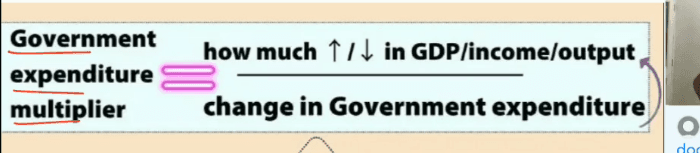
- Govt Expenditure Multiplier:
- it is the ratio of change in national income to the change in government spending
- measures how much national income increases as a result of an increase in government spending.
- Tax Multiplier: This is a Negative Multiplier. 📉
- there is inverse relationship between tax and GDP growth.
- Increase Taxes ⬆️ ⮕ Decrease GDP ⬇️.
- Decrease Taxes ⬇️ ⮕ Increase GDP ⬆️.
⚖️ 27.8.3 & 27.8.4 Balanced Budget Multiplier = 1 (How?)
-
The balanced budget multiplier refers to the effect on national income when the government increases spending and taxes by the same amount*
-
Balanced budget multiplier means that when government expenditure (G) and taxes (T) increase equally, national income increases by the same amount
-
**Balanced Budget Multiplier=1
-
The Result: The "Negative" effect of the tax and the "Positive" effect of the spending cancel each other out. 🔄
-
GDP Growth: The GDP increases exactly by 1X. It doesn't get an extra "boost" because the money was just shifted from the public's pocket to the government's project. ⚖️📏
🏛️ 27.8.5 THREE Functions of a Govt Budget
According to economic theory, the budget serves three primary purposes:
- Allocation: Providing goods/services that the private market won't provide because they aren't "profitable" but are essential.
- Examples: National defense, Police, Roads, Public parks. 🛡️🛣️
- Redistribution : Reducing inequality by taking more from the rich (progressive tax) and spending it on the poor (welfare schemes). 🏹🍎
- Stabilisation : Using fiscal policy to manage the economy during "Booms" (controlling inflation) and "Busts" (fighting recession). ⚖️📈
27.9 Misc Terms: How to Pay Back Debt? 💸🔄
When the government borrows, it must eventually pay. Here is the "Debt Dictionary":
- Redemption/ Terminal Annuity : Repaying the loan principal and interest at regular intervals. ⏳💰
- Sinking Fund : A "Piggy Bank" where the govt deposits money regularly so it has enough to pay back G-Secs when they mature. 🐷🏦 first done in England.
- Conversion/Restructuring: Changing an old, expensive loan into a new, cheaper one (lower interest/longer time). 📉🔄
- Evergreening: Taking a new loan just to pay an old loan. (A dangerous trap!) 📉🪤
- Repudiation: Simply refusing to pay! 🙅♂️ E.g., Lenin in 1917 refused to pay the Czar's debts. (Result: Nobody will ever lend to you again!). 🚫🇷🇺
27.10 Fiscal Consolidation / Prudence 🛡️📉
- Fiscal consolidation is the process by which a government reduces its budget deficit and debt levels through measures like cutting expenditure and/or increasing revenue (taxes)
- Fiscal consolidation means reducing government deficit by controlling spending and increasing income
- Reducing the Fiscal Deficit by cutting wasteful spending. "Reducing the Fat."
- DBT/JAM Trinity: Stopping leakages in subsidies. 📲💳
- Deregulating Fuel: Govt no longer pays for Petrol/Diesel subsidies. ⛽🚫
- Shutting PSUs: Closing loss-making companies like HMT Watches. ⌚🏢
- Austerity: Banning flower bouquets, luxury travel, and ending canteen subsidies. 💐❌
27.11 Fiscal Stimulus 💉📈
The opposite of consolidation. Giving the economy a "shot of adrenaline" during a crisis.
- Fiscal stimulus is a government policy of increasing spending or reducing taxes to boost economic activity, especially during a slowdown or recession.
- Fiscal stimulus means government action to increase demand in the economy by spending more or taxing less
- Example: Atma-Nirbhar Bharat (2020). 🇮🇳🛡️
- The Cost: Total package was ~₹20-30 Lakh Crore (~10-15% of GDP).
- Warning (27.11.2): Too much stimulus can cause "Overheating" (Hyperinflation). 🌡️🔥.
📜 27.12 Fiscal Responsibility & Budget Management Act, 2003 (FRBM)
The FRBM Act was designed to force the government to be financially disciplined and stop spending money it didn't have. It essentially sets "speed limits" for the government's borrowing. 🏎️🛑
**🎯 The Original Targets (The "Old" Rulebook)
When the Act was passed in 2003, the goal was to reach these targets by 2008:
- Fiscal Deficit (FD): Reduce to 3% of GDP for the Union (and 3% of GSDP for States). 🏦
- Revenue Deficit (RD): Eliminate it completely (0%). (Basically: No borrowing for daily consumption). 📉🚫
**🔄 Shifting the Goalposts (The "Reality" Check)
Governments struggled to meet these targets due to global crises and internal pressures.
- 2012 Amendment: The government realized 0% RD was too hard. They changed the target to 0% Effective Revenue Deficit (ERD) by 2015. 🏗️
- N.K. Singh Review Panel (2016): Suggested a more flexible path in FRBM ACT ⚖️
- Covid-19 Impact (2020): The targets were completely blown out of the water. 🦠💥
- Current Path (Budget 2021): Aiming for a Fiscal Deficit of 4.5% by 2025-26. 🎯📉
🔓 27.13 FRBM: Trigger Mechanism (to) Escape Clause
Section 4(2) of the FRBM Act provides a "Panic Button" or Escape Clause. It allows the government to cross the deficit targets under specific, extreme situations. 🚨🔓
**🖐️ The 5 Trigger Conditions (When can the Govt break the rules?)
- National Security / Act of War: Protecting the country's borders. ⚔️🛡️
- National Calamity: Major natural disasters (Earthquakes, Floods) or Pandemics (like Corona). 🌪️🦠
- Agriculture Collapse: If farm output or incomes crash. 🌾💀
- GDP Crash: If the real GDP growth rate falls significantly beyond a set limit. 📉📉
- Structural Reforms: Major economic changes with unpredictable costs (e.g., GST or Banking cleanup). 🏗️⚖️
**📏 The "Half-Percent" Rule
If any of the above happens, the Union Govt can deviate from the FD target by a maximum of 0.5% of GDP, as recommended by the N.K. Singh Committee. 📊⚖️
📂 **27.13.1 FRBM Act: Mandatory Documents
Under the FRBM Act, the Finance Minister must present four specific documents along with the Budget:
- Macroeconomic Framework Statement: Shows the big picture—GDP growth, imports, and exports. 🌏📈
- Medium Term Fiscal Policy Statement: Outlines the strategy for the next 3 years. (Presented as a single PDF). 📄⏳
- Fiscal Policy Strategy Statement: Explains the "Why" behind the govt's financial moves. 🧠📜
- Medium-term Expenditure Framework: Shows spending targets. (Note: This has been suspended since Corona until 2026). 🏗️🚫
🏦 **27.13.2 The 16th Finance Commission (FC) & Future Targets
The 16th FC has suggested a new set of targets to maintain "credibility":
- Union FD Target: 3.5% of GDP by 2030-31.
- State FD Target: 3% of GSDP.
- New Framework (ES26): Suggested we should stop obsessing over 3% FD and instead aim for a Debt-to-GDP ratio of 50% ± 1% by March 2031. 📉📊
🤝 27.14 Fiscal Federalism: Helping the States
Fiscal Federalism deals with the financial relationship between the Central (Union) government and the State governments. 🏛️↔️🏛️
**🔒 The Legal Rule: Article 293
- The Restriction: Under Constitution Article 293, States must obtain permission from the Union government before borrowing money if they still owe any debt to the Union. 📜🚫
- The Power: This allows the Union to act as a "Disciplinarian" for State finances.
**🥕 The "Carrot & Stick" Borrowing Limits (Post-Covid)
Before 2020, States could only borrow up to 3% of their GSDP. During the Atma-Nirbhar package, the Union increased this limit but added conditions. 📉📈
| Sr | If State Government does these Reforms… | Extra Borrowing Allowed |
|---|---|---|
| 1 | No conditions (Un-tied) | 0.50% |
| 2 | One Nation One Ration Card 🌾 | 0.25% |
| 3 | Ease of Doing Business 🏢 | 0.25% |
| 4 | Urban Local Body Reforms (Sewage/Water) 🚽 | 0.25% |
| 5 | Power Sector Reforms ⚡ | 0.25% |
| 6 | Bonus: If any 3 of the above are done | 0.50% |
| Total Extra Potential | 2% of GSDP |
**📈 Fiscal Deficit Targets for States (Timeline)
- 2020-21: Increased to 5% (to fight Corona). 🦠
- 2021-22: 4.5% (4% + 0.5% conditional).
- 2022-23: 4% (3.5% + 0.5% for power reforms).
- 2023 onwards: 3.5% (3% + 0.5% for power reforms).
- 16th FC Recommendation: Move back to a steady 3% of GSDP. 🎯
**📉 27.14.2 State-Level Debt Metrics
- Debt/GSDP Ratio: Average for 28 states is 28.1%. (Lower is better). 📉
- IP/RR Ratio (Interest Payment ÷ Revenue Receipts): 12.6%.
- Logic: This shows how much of a state's income goes just toward paying interest. If this is high, there is no money left for schools or roads. 🏫❌
- The "Revdi" Culture: Both ES26 and the Finance Commission have warned states against excessive "freebies" (populist spending) that weaken their financial health. 🍬🚫
🎭 27.15 FRBM: Misc. Concepts
1. Fiscal Profligacy 🕺💸
- This refers to reckless and wasteful spending of public money by the government. Think of it as "living beyond your means" without building any assets.
2. Fiscal Slippage (🎿📉
- When the government sets a target (e.g., "We will keep FD at 3.3%") but fails to meet it (e.g., it ends up at 3.6%). This "slip" is called Fiscal Slippage.
🎯 27.15.1 Budget Marksmanship
- Definition: The ability of the government to keep its actual income and expenditure close to its estimated (budgeted) numbers. 🏹
- India's Status: The 15th FC says India’s marksmanship is Poor.
- Why? 📉
- Overestimation: Govt projects "rosy" tax income to look good, but fails to collect it.
- Tax Litigation: Huge amounts (approx ₹10 Lakh Crore) are stuck in court disputes (e.g., Vodafone case). ⚖️💰
- Ad-hoc management: Randomly cutting schemes mid-year because the money ran out.
🏛️ 27.15.2 Miscellaneous Bodies
- Expenditure Management Commission (2014): Headed by Dr. Bimal Jalan to suggest ways to reduce the subsidy bill. 📉
- Public Debt Management Agency (PDMA): A proposed body to manage government debt (currently managed by RBI). Note: Not yet set up. 🏗️
- Fiscal Council: A proposed independent permanent body to act as a "watchdog" for the budget. Note: Not yet set up. 🐕🏦
🛑 Relevant Practice Questions
Q1. Under Article 293 of the Constitution, a State government cannot borrow from the market without the consent of the Union if: (a) The State has a high Fiscal Deficit. (b) The State still owes any part of a loan to the Union. (c) The State is under President's Rule. (d) The 16th Finance Commission forbids it.
Q2. Which of the following reforms was NOT linked to the extra borrowing permission for States post-COVID? (a) One Nation One Ration Card (b) Ease of Doing Business (c) Privatization of State PSUs ✅ (Not among the 4 specific reforms). (d) Power Sector Reforms
Q3. "Fiscal Slippage" refers to: (a) A decrease in the tax-to-GDP ratio. (b) Missing the targeted Fiscal Deficit due to higher spending or lower revenue. (c) A sudden drop in the stock market. (d) Giving too many subsidies to farmers.
Q4. The Bimal Jalan Commission (2014) was related to: (a) Reviewing the FRBM targets. (b) Expenditure Management and reducing the subsidy bill. (c) Setting up a Fiscal Council. (d) Managing the external debt of India.
Q5. The excess of total expenditure of Govt over its total receipts, excluding borrowings, is: (CDS-2021-i) (a) Primary deficit (b) Fiscal deficit (c) Current deficit (d) Capital deficit
Q6. Suppose the revenue expenditure is ₹ 80,000 cr and the revenue receipts are ₹ 60,000 cr. The Budget shows borrowings of ₹ 10,000 cr and interest payments of ₹ 6,000 cr. Which is correct? (Pre’25 Practice) I. Revenue deficit is ₹ 20,000 cr (80k - 60k). II. Fiscal deficit is ₹ 10,000 cr (Borrowing). III. Primary deficit is ₹ 4,000 cr (10k FD - 6k Interest).
Q7. If Primary Deficit (PD) = 0, what does it mean? (a) The government is in surplus. (b) The government's current income is exactly enough to meet its non-interest expenditure. (c) The government has no debt. (d) The government is not paying any interest.
Q8. Find Correct Statement(s): (UPSC-Pre-2017)
- Tax revenue as a percent of GDP of India has steadily increased in the last decade.
- Fiscal deficit as a percent of GDP of India has steadily increased in the last decade.
Q9. Which measure made monetary policy independent of fiscal policy in India? (GPSC’25) (A) Nationalization of banks (B) Privatization of banks (C) Ending the practice of automatic financing of fiscal deficit by the RBI in 1994* (D) Setting up of MPC in 2016.
Q10. Crowding out of private investment refers to: (a) High taxes reducing spending. (b) Government borrowing reducing the availability of funds for private players. (c) Foreign investors leaving the country. (d) People saving more due to future tax fears.
Q11. India’s current sovereign rating by Moody's is: (a) Aaa (b) Aa1 (c) Baa3 (d) Junk
Q12. The increase in private investment spending induced by the increase in Government spending is known as: (CDS-2021-i) (a) Crowding in (b) Deficit financing (c) Crowding out (d) Pumping out
Q13. What is expansionary fiscal policy? (GPSC’25) (A) Decrease in direct and indirect tax rates and increase in public expenditure (B) Decrease in direct and indirect tax rates and decrease in public expenditure (C) Increase in direct and indirect tax rates and decrease in public expenditure
Q14. Find Correct: (GPSC’25)
- To control inflation, repo rate should be decreased by the RBI. (False - should be increased)
- To tackle recession, the government should increase its expenditure. (True) Answer: (B) 2 only ✅
Q15. Which of the following is an automatic stabilizer? (CAPF-2021) (a) Income tax (b) Reverse repo (c) Open market operation (d) Bond price
Q16. If the Interest Rate is 8% and the GDP Growth Rate is 10%, the IRGD is: (a) +2% (Doomed) (b) -2% (Safe) ✅ (Formula: Interest - Growth = 8-10 = -2)
Q17. What can be done by the government to reduce the deficit? (IAS-2015)
- Reducing revenue expenditure
- Introducing new welfare schemes
- Rationalizing subsidies
- Expanding industries
Answer: (a) 1 and 3 only ✅ (New schemes and expansion increase spending).
Q18. In India, the price of petroleum products has been deregulated to: (CDS-2013-II) (a) reduce the burden of subsidies given to the oil companies (b) discourage the exploration of oil reserves (c) discourage demand for private vehicles
Q19. Which one of the following describes the “fiscal stimulus”? (UPSC-Pre-2011) (1) Massive investment in manufacturing (2) An intense affirmative action of the Government to boost economic activity (3) Action on financial institutions to ensure loans for agriculture
Q20. According to FRBM Act, which document is NOT presented with the budget? (CDS-2008-I) (a) Macroeconomic Framework Statement (b) Fiscal Policy Strategy Statement (c) Medium-term Fiscal Policy Statement (d) Statement showing Short term Fiscal Policy
Q21. Why does the FM place 'The Macro Economic Framework Statement' in Parliament? (IAS-2020) (a) Article 112 (b) Article 113 (c) Provisions of the FRBM Act, 2003
Q22. Which of the following is an automatic stabilizer? (CAPF-2021) (a) income tax (b) Reverse repo (c) Open market operation (d) Bond price
Q23. In a balanced budget, if the government increases both taxes and expenditure by ₹500 crore, the multiplier effect on GDP will be: (a) 0 (b) 1 (c) 2 (d) 5
Q24. Disposable income refers to: (a) Total salary earned. (b) Income left after paying direct taxes. (c) Income spent on luxury goods. (d) Income saved in bank accounts.
Q25. According to the FRBM Act, which document is NOT presented to Parliament? (CDS-2008-I) (a) Macroeconomic Framework Statement (b) Fiscal Policy Strategy Statement (c) Medium-term Fiscal Policy Statement (d) Statement showing Short term Fiscal Policy (This is not required by FRBM).
Q26. Why does the Finance Minister place ‘The Macro Economic Framework Statement’ in Parliament? (IAS-2020) [a) Long standing parliamentary convention [b) Article 112 and Article 110(1) [c) Article 113 of the Constitution [d) Provisions of the Fiscal Responsibility and Budget Management Act, 2003
Q27. Under the FRBM Escape Clause, by how much can the Govt deviate from the FD target? (a) 1.0% (b) 0.5% (c) 2.0% (d) 0.25%
Answers
| Q | A | Q | A | Q | A |
|---|---|---|---|---|---|
| 1 | b | 12 | b | 19 | b |
| 2 | c | 13 | a | 20 | d |
| 3 | b | 14 | a | 21 | c |
| 4 | b | 15 | a | 22 | a |
| 5 | b | 13 | a | 23 | b |
| 6 | d | 14 | b | 24 | b |
| 7 | C | 15 | a | 25 | d |
| 8 | d | 16 | B | 26 | d |
| 10 | b | 17 | 1 &3 | 27 | b |
| 11 | c | 18 | A | 27 | b |
