💰 #2A1: DIRECT TAXES
💰 #2A1: DIRECT TAXES
📑 Table of Contents
- 20 Fundamental Concepts of Direct Taxes 🧠
- 20.1.1 Direct vs. Indirect: Impact & Incidence 🎯
- 20.1.2 Progressive vs. Regressive Structure 📈📉
- 20.1.3 Proportional vs. Degressive Taxes ⚖️
- 20.1.4 Adam Smith’s 4 Canons of Taxation 📜
- 21 Types of Direct Taxes & Mechanisms 🏛️
- 21.1 - 21.2 Abolished Taxes & Merits/Demerits ⚰️
- 21.3 Surcharge and Cess (PMSSN) ➕🩹
- 21.4 Corporation Tax (Domestic vs. Foreign) 🏢
- 21.5 MAT, AMT & Startup Tax Holidays 🧀
- 21.6 - 21.8 Google Tax, DDT & Buyback Tax 💻💸
- 21.9 Capital Gains Tax (CGT) - Budget 2024 Updates 📈
- 21.10 Personal Income Tax: OTR vs. NTR (Default) 👤
- 21.11 Misc: HUF, Presumptive & Advance Tax 📑
- 21.12 - 21.14 TDS, TCS & Influencer Tax ✂️🚘
- 21.15 Transaction Taxes: Tobin, STT & CTT 💱💹
20 🧠 Fundamental Concepts of Direct Taxes
20.1.1 Direct vs. Indirect: The "Impact & Incidence" Rule 🎯
- Impact (Collection Point): Who physically deposits the tax to the Govt?
- Incidence (Ultimate Burden): Whose net income is actually reduced?
- Direct Tax: Impact and Incidence are on the SAME person (e.g., Income Tax). You can't shift the burden.
- Indirect Tax: Impact (Seller) and Incidence (Buyer) are on DIFFERENT persons (e.g., GST on biscuits).
20.1.2 Progressive vs. Regressive Structure 📈📉
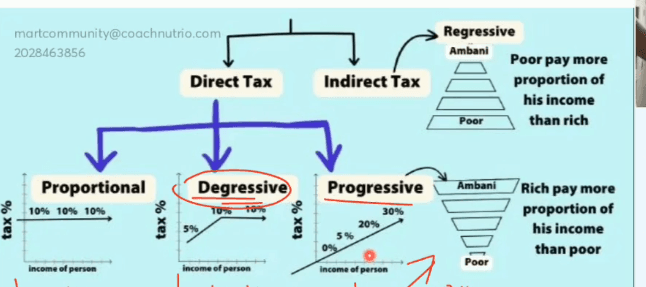
- Progressive (प्रगामी): "Richer the person, higher the tax rate." (e.g., Indian Income Tax 5% ➡️ 30%). Reduces inequality. 📉💰
- Regressive (प्रतिगामी): Tax rate is fixed (e.g., 18% GST), but it pinches the poor more because it consumes a larger proportion of their small income. 🍞😟
20.1.3 Proportional vs. Degressive ⚖️
- Proportional: Flat rate for everyone (e.g., 10% for poor and rich alike).
- Degressive: Increases up to a limit and then stays constant. UPSC Tip: If a question asks, Indian Income Tax is Progressive.
20.1.4 Adam Smith’s 4 Canons 📜
- Equality: Tax should be proportionate to the ability to pay.
- Certainty: Slabs and dates should be known in advance (No "Surprise" taxes).
- Convenience: The mode of payment should be easy for the citizen.
- Economy: Collection cost should be low.
21 🏛️ Types of Direct Taxes & Mechanisms
This section covers the specific types of direct taxes levied by the Union and State governments, their merits, administrative tools like TDS/TCS, and recent reforms from Budget 2024, 2025, and 2026.
21.1 ⚰️ Abolished "Paper Taxes"
- Estate Duty, Wealth Tax, Gift Tax: These were informally called "Paper Taxes" because they generated a mountain of paperwork but very little revenue. 📜📉
- Abolition:
- Estate Duty (1985)
- Gift Tax (1998)
- Wealth Tax (2015)
- Reason: High administrative cost of collection and wide scope for evasion via property undervaluation.
21.2 ⚖️ Merits and Demerits of Direct Taxes
| 😊 Merits | 😟 Demerits |
|---|---|
| Progressive: Reduces income inequality. 📉 | Externality Ignored: Same tax for Author vs. Film Star promoting tobacco. 🚬 |
| Civic Consciousness: Citizens feel the "pinch," leading to higher accountability. 🧐 | Hardship: Doesn't differentiate between a hardworking carpenter and a lazy landlord. 🛠️ |
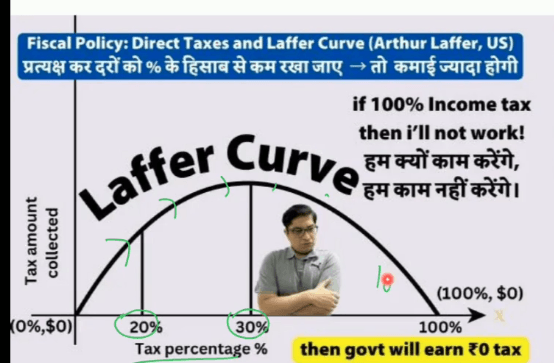
| Elasticity: Revenue increases automatically as the public gets richer. 📈 | Laziness: Very high rates can discourage hard work and foreign investment. 😴 |
| Tobin Tax Potential: Can reduce currency volatility (speculation). 💱 | Narrow Base: Covers very few people; supervising the poor is too costly. 🕵️♂️ |
| to encourage saving and investment: Income tax deduction/exemptions can given on nps/ppf/lic. | |
| certainty when and how |
➕ 21.3 Union Tax, Cess and Surcharge (केंद्रीय कर, उपकर और अधिभार)
When you pay tax, it isn't just one amount. It’s a layer-cake of charges: Income Tax ➡️ Surcharge (on that Tax) ➡️ Cess (on Tax + Surcharge). 🍰📈
⚖️ Definitions & Destinations
| Charge Type | What is it computed on? | Shared with States? | Final Destination |
|---|---|---|---|
| Union Tax (संघ कर) | Taxable Income / Profit | YES (per Finance Commission %) 🍕 | Consolidated Fund (CFI) |
| Surcharge (अधिभार) | The Tax Amount (Tax on Tax) | NO (Union keeps 100%) ✋ | Consolidated Fund (CFI) |
| Cess (उपकर) | [Tax + Surcharge] | NO (Union keeps 100%) ✋ | CFI ➡️ Public Account |
🧐 FAQ: Why keep the Finance Commission out?
- The Strategy: By levying a Surcharge or Cess instead of increasing the basic tax rate, the Union Government doesn't have to share that extra revenue with State Governments. It’s "pocket money" for their favorite central schemes. 💰🏦
🎯 Common Cess Examples
- Health & Education Cess: 4% levied on Direct Taxes (Income Tax/Corp Tax). 📚🩺
- AIDC (Agriculture Infrastructure & Dev Cess): Levied on Customs (imported gold/silver) and Excise (Petrol/Diesel). 🚜⛽
- Road & Infrastructure Cess: Levied on Petrol and Diesel. 🛣️
- GST Compensation Cess: Levied on "Sin goods" like Tobacco and Luxury cars. 🚬🏎️
- SWM Cess: Solid Waste Management cess collected by local bodies (ULBs) via property tax (usually ₹30-50/month). 🚮🏘️
🏥 21.3.2 Direct Tax Cess: PMSSN
The 4% Health & Education Cess collected from your income tax doesn't just vanish. It goes into a specific fund:
- Fund Name: PMSSN (Pradhan Mantri Swasthya Suraksha Nidhi). 🩹
- Nature: Non-Lapsable (money doesn't expire at the end of the year).
- Location: Public Account of India. 📂
- Usage by Health Ministry:
- Ayushman Bharat (PM-JAY): Free health insurance for the poor. 🚑
- Health & Wellness Centres: Primary healthcare. 🩺
- National Health Mission (NHM). 🇮🇳
- Upgrading Medical Colleges: Building AIIMS-like institutions in every state. 🏗️🏥
21.4 🏢 Corporation Tax (निगम कर)
Levied on a company's net profit. 💰
- New Indian MFG Companies: Registered after 1/10/2019 pay ~17.01% (effective).
- Other Indian Companies: Pay ~25.17% (effective).
- Foreign Companies: Budget-2024 reduced the rate from 40% ➡️ 35%. 🌍📉
- Budget-2026: 0% tax for foreign companies providing cloud services from Indian data centers until 2047. ☁️💻
21.5 🧀 MAT, AMT & Startups
- MAT (Minimum Alternate Tax): For "Zero-profit" companies using accounting tricks. Reduced to 14% (Budget-2026). 📉
- AMT: Similar tax for Cooperative societies (e.g., Amul).
- Startup Tax Holiday: Can claim 100% tax deduction for 3 out of the first 10 years. 🚀
- Angel Tax (21.5.3): DELETED/ABOLISHED in Budget-2024 to boost startup investments. 😇❌
21.6 – 21.8 💻 Google, Dividends & Buybacks
- Google Tax (Equalisation Levy): Abolished in Budget-2024. 🚫💻
- DDT (Dividend Distribution Tax): Abolished in 2020. Dividends are now taxed in the hands of the shareholder. 💸
- it was abolished because
- Buyback Tax: 22-30% tax when companies buy back shares from the market. (Budget-2026).
21.9 📈 Capital Gains Tax (CGT)
**Tax on profit from selling capital assets (Property, Shares, Gold) . patents, trademarks, share , bonds ,mf tec, bitcoins and other virtual digial assets and non agricultural land.
- CGT: not levied in personal article like shirts, belt etc
- not on consumer goods
- Budget-2024-July Updates: ⏫
- Short-Term (STCG): Hiked to 20% (Asset held < 1 year).
- Long-Term (LTCG): Hiked to 12.5% (Asset held > 1 year).
- Indexation (21.9.2): when govt allows you to adjust profit or income against the inflation. Benefit of adjusting for inflation. Stopped for Debt Mutual Funds since April 2023. 🛑
- VDA virtual digital assets. (Bitcoin/NFT non fungible tocken ): Profit taxed at 30% + 1% TDS on transfers. ₿
21.10 👤 Income Tax on Individuals
- Founder: Introduced by James Wilson on 24 July 1860 to compensate British losses during the 1857 Sepoy Mutiny. 💂♂️📉
- Income Tax Day: 24th July is celebrated as Aaykar Diwas. 🗓️🎂
🌓 21.10.1 Old Tax Regime (OTR) vs. New Tax Regime (NTR)
Currently, India has two systems. You can choose any ONE. Since 2023, NTR is the 'Default' system. 🏁
| Feature | Old Tax Regime (OTR) 👴 | New Tax Regime (NTR) 🚀 |
|---|---|---|
| Rates | Higher (5%, 20%, 30%) | Lower (5%, 10%, 15%, 20%, 25%, 30%) |
| Deductions | Allowed (LIC, NPS, Home Loan) ✅ | NOT Allowed (Simplified) ❌ |
| Std. Deduction | ₹50,000 | ₹75,000 (Budget-2025) ⏫ |
| Zero Tax Limit | Up to ₹7 Lakh (with rebate) | Up to ₹12 Lakh (Budget-2025) 🆓 |
🪄 The "Tax Rebate" Magic (Section 87A)
- Rule: If your Taxable Income is below a certain limit, the Govt gives a rebate that makes your Total Tax = ZERO.
- Budget-2025: If you earn up to ₹12 Lakh in NTR, after standard deductions and rebates, you pay ₹0 tax. 🥂✨
🛍️ 21.10.2 NTR Increases Disposable Income
- Disposable Income: The money left in your pocket for spending after paying taxes. 💵🛒
- The Logic: Because NTR has lower rates and higher rebate limits, people have more money to spend.
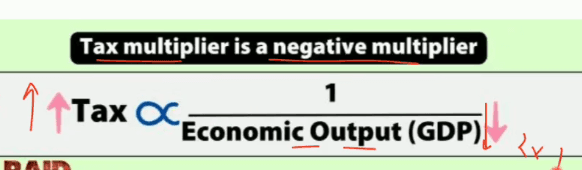
- Macro Impact: Higher spending ➡️ Higher demand ➡️ Industrial growth ➡️ Higher GDP. 📈🚀
🔄 21.10.3 Switching: Can you change your mind?
- Salaried Employees: Can switch between NTR and OTR every single year. 👨💼🔄
- Businesses / Freelancers: Can only choose ONCE in a lifetime. If they opt for OTR once and then switch to NTR, they can never go back to OTR. 🏢🚫
📈 21.10.4 Surcharge on Income Tax
This is an additional tax on the rich to promote equity. 🍕⚖️
| Taxable Income | Surcharge Rate |
|---|---|
| ₹50 Lakh - ₹1 Crore | 10% |
| ₹1 Crore - ₹2 Crore | 15% |
| ₹2 Crore - ₹5 Crore | 25% |
| Above ₹5 Crore | 25% (NTR) vs 37% (OTR) |
🤴 21.10.5 Effective Tax on Super-Rich (>₹5 Cr)
- Because of the combination of the highest slab (30%), the surcharge, and the 4% cess, the super-rich pay a massive portion of their income as tax.
- In NTR: Effective tax is 39%.
- In OTR: Effective tax is 42.74%. 👑💸
👴 21.10.6 Income Tax for Senior Citizens
- New Tax Regime: Does not have separate slabs for seniors. Everyone is treated same. 🧊
- Old Tax Regime: Slabs are slightly relaxed.
- Below 60 yrs: Tax starts after ₹2.5 Lakh.
- 60 - 80 yrs: Tax starts after ₹3 Lakh.
- Above 80 yrs (Super Senior): Tax starts after ₹5 Lakh.
💸 21.10.7 Revenue Forgone / Tax Expenditure
- Meaning: The revenue the government deliberately loses by giving tax breaks, rebates, and incentives. 📉
- Goal: It's an "investment" to boost consumption and GDP.
- Data (Budget-2025): The Union govt "lost" ~₹1 Lakh crore in direct taxes and ~₹2600 cr in indirect taxes due to these reliefs. 🧧🇮🇳
21.11 📑 Miscellaneous Concepts
- HUF (Hindu Undivided Family): Separate entity for tax saving. 👨👩👧👦
- Presumptive Taxation: Simplified tax calculation for self-employed professionals (Lawyers, Doctors, DJs). ⚕️🎧
- Advance Tax: Must be paid in quarterly installments if annual liability is ≥₹10,000. ⏰💸it is paid advance by rich people.
21.12 – 21.14 ✂️ TDS, TCS & Refunds
- TDS (Tax Deducted at Source): The Buyer/Payer cuts tax before paying the seller (e.g., Employer cutting tax from Salary). ✂️
- TCS (Tax Collected at Source): The Seller collects extra tax from the buyer (e.g., 1% extra on luxury car purchase). 🚘➕
- Influencer Tax (21.13.1): 10% TDS on freebies (phones, trips) given to social media influencers. 🤳📱
- Tax Refund: If you paid more tax than your actual liability, the Govt returns it with interest. 💸🔙
21.15 💹 Transaction Taxes
- Tobin Tax: Concept of taxing currency conversion to stop "Hot Money" flight. 💱
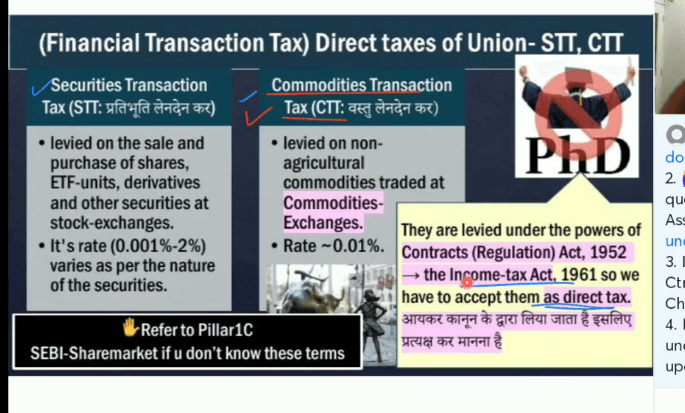
- STT (Securities Transaction Tax): Levied on share market trades.
- F&O Hike (21.15.3): STT on Futures & Options hiked in Budget-2026 to prevent "Over-financialization" (Excessive gambling in the market). 🛑📉
- Stamp Duty: Collected by Union, but distributed to the State where the buyer resides. Uniform rates since 2020. 🏛️
🏛️ STATE GOVERNMENT TAXES (राज्य सरकार के कर)
While the Union collects massive taxes like Income Tax and GST, the Constitution provides State Governments with specific powers to levy their own taxes to maintain their financial autonomy. 🏰⚖️
📑 Table of Contents
- Direct Taxes of the State 🌾💼
- Indirect Taxes Subsumed under SGST 📥✨
- The "Cash Cows": Taxes OUTSIDE GST 🍷⛽
- Electricity & Road Tax ⚡🚗
- 2024 SC Rulings: Mining & Industrial Alcohol ⛏️🧪
1. 💼 Direct Taxes of the State (Not Replaced by GST)
These are collected directly from the individual or the asset owner.
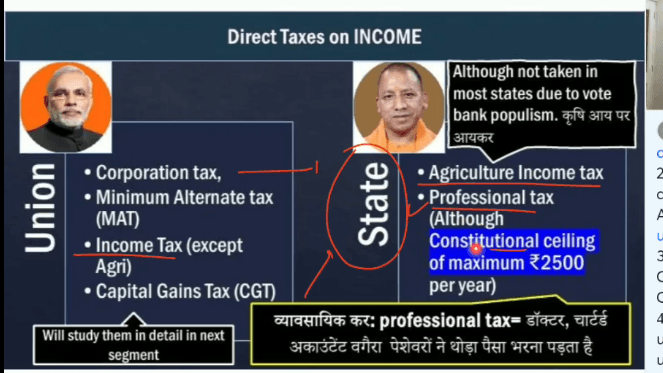
- Professional Tax (व्यवसाय कर): Levied on professionals (doctors, lawyers, etc.). 👨⚕️⚖️
- Fact: The Constitution sets a ceiling of max ₹2,500 per year per person.
- Agriculture Income Tax: Most states choose not to levy this for political reasons, but they have the power. 🌾🚜
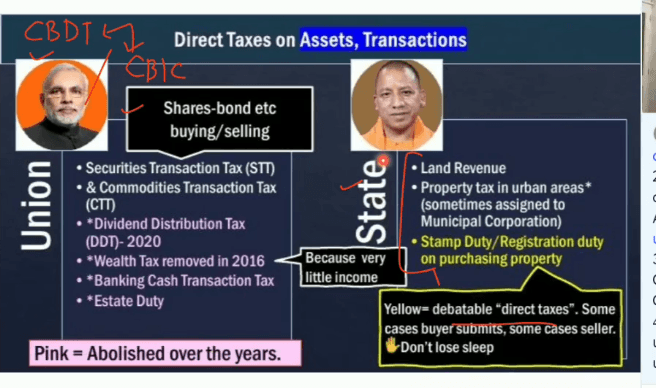
- Land Revenue (भू राजस्व): Tax on land ownership. 🗺️
- Stamp Duty & Registration: Fees for property transactions and legal documents. 📄🏠
- Property Tax: Collected in urban areas (usually by municipalities). 🏙️
2. 📥 Indirect Taxes Subsumed (Merged) into SGST
Before 2017, states collected these separately. Now, they are part of the State GST (SGST). ✨
- VAT on Goods: General sales tax on most products. 🛍️
- Entry Tax / Octroi: Tax on goods entering a local area. 🚛🛑
- Luxury Tax: On hotels, spas, and resorts. ⛱️🏨
- Entertainment Tax: On cinema, cable TV, and live shows (unless levied by local bodies). 🎬🎭
- Lottery, Betting & Gambling: Sin goods that are heavily taxed. 🎰🏇
- Purchase Tax: On vehicles, boats, and animals. 🐎🚤
3. 🍷 The "Cash Cows": Taxes Kept OUTSIDE GST
States were unwilling to give up these high-revenue items to the GST Council. 🙅♂️💸
- Alcohol for Human Consumption: 🍷
- States levy State Excise Duty on production and VAT on sales.
- This is the primary reason liquor prices vary drastically between states (e.g., Delhi vs. UP).
- Petroleum Products (The "High-5"): ⛽
- Crude oil, Petrol, Diesel, Natural Gas, and Aviation Turbine Fuel.
- States currently levy VAT on these. They will only come under GST when the GST Council decides on a future date. 🗓️⏳
4. ⚡ Electricity & Road Tax
- Electricity Duty: Tax on power consumption. It is NOT replaced by GST. 💡🔌
- Road Tax on Vehicles: Collected when you register a new car/bike. Its status is often vague, but it remains a state-level charge. 🚗🛣️
5. ⚖️ 2024 Supreme Court Rulings (High Yield for Exams!)
⛏️ A. Minerals: Royalty is NOT a Tax (2024)
- The Case: Mining companies (like India Cement) vs. States.
- SC Verdict: Royalty paid for mining is a "contractual consideration," not a tax.
- Power: States CAN demand a separate tax on the land used for mining (under Entry 49 of the State List). 🧱✅
🧪 B. Industrial Alcohol (2024)
- Old Rule: Only the Union could tax industrial (non-drinkable) alcohol.
- SC Verdict: States have the power to regulate and tax industrial alcohol as well.
- Reason: To prevent the illegal "denaturing" of industrial alcohol into poisonous drinkable liquor which causes deaths. 🥃🚫
❓ Practice Questions on State Taxes
Q1. Which of the following state taxes was NOT subsumed into the Goods and Services Tax (GST)? (a) Entry Tax (b) Luxury Tax (c) Electricity Duty (d) Advertisement Tax
Q2. What is the maximum Constitutional limit for "Professional Tax" that a State Government can levy per person per year? (a) ₹1,000 (b) ₹2,500 (c) ₹5,000 (d) No limit
Q3. Regarding the recent 2024 SC ruling on Mineral Rights, consider the following:
- Royalty paid to the government for mining is classified as a tax.
- States have the power to tax lands and buildings under Entry 49 of the State List. Which of the statements given above is/are correct? (a) 1 only (b) 2 only (c) Both 1 and 2 (d) Neither 1 nor 2
Q4. Which of the following items are currently kept outside the GST regime, allowing states to levy VAT and Excise?
- Alcoholic liquor for human consumption
- High-speed diesel
- Tobacco products
- Education services Codes: (a) 1 and 2 only (b) 1, 2 and 3 (c) 3 and 4 only (d) 1, 2, 3 and 4
Q5. The state share of taxes, as recommended by the Finance Commission, does NOT apply to which of the following? (a) Income Tax (b) Corporation Tax (c) Union Surcharge and Cess (d) Central GST (CGST)
❓ PREVIOUS YEAR QUESTIONS (PQYs)
Q1. Which one of following is a progressive tax structure? [UPSC-CDS-2015-II] (a) Tax rate is the same across all incomes (b) Tax rate increases as income increases (c) Tax rate decreases as income increases (d) Each household pays equal amount of tax
Q2. Which of the following was not advocated by Adam Smith? [UPSC-CDS-2019-1] (a) Canon of equality (b) Canon of certainty (c) Canon of convenience (d) Canon of fiscal adequacy
Q3. Corporation tax is imposed by: [UPSC-CDS-2013-II] (a) State Government (b) Central Govt (c) Local Government (d) State as well as Central Govt
Q4. In which of the following circumstances may ‘capital gains’ arise? [Prelims-2012]
- When there is an increase in the sales of a product.
- When there is a natural increase in the value of the property owned.
- When you purchase a painting & there is a growth in its value due to increase in its popularity. Codes: (a) 1 only (b) 2 and 3 only (c) 2 only (d) 1, 2 and 3
Q5. Consider the following statements: [Prelims-2025] St-I: In India, income from allied agricultural activities like poultry farming and wool rearing in rural areas is exempted from any tax. St-II: In India, rural agricultural land is not considered a capital asset under the provisions of the Income-tax Act, 1961. Codes: (a) Both St-I and St-II are correct and St-II explains St-I (b) Both St-I and St-II are correct but St-II does not explain St-I (c) St-I is correct but St-II is not correct (d) St-I is not correct but St-II is correct
Q6. Public Financial Management System (PFMS) is a web-based online software application designed, developed, owned and implemented by the: [UPSC-CDS-2019-II] (a) Department of Financial Services (b) Institute of Government Accounts and Finance (c) Controller General of Accounts (d) National Institute of Financial Management
Q7. Find correct about Securities Transaction Tax (STT) in India: [GPSC-2025]
- STT is a tax levied on transactions carried out on the domestic stock exchanges.
- STT is an indirect tax.
- STT is collected for the government of India by the stock exchanges. Codes: (A) 1 and 2 only (B) 1 and 3 only (C) 1 only (D) 2 and 3 only.
Q8. Find Correct Statements: [UPSC-CDS-2016-1]
- Ability to pay principle of taxation holds that taxes people pay should relate to their income or wealth.
- The Benefit Principle of taxation states that individuals should be taxed in proportion to the benefit they receive from Government programmes.
- A progressive tax takes a larger share of tax from poor families than it does from rich families.
- Indirect taxes have the advantage of being cheaper and easier to collect. Codes: (a) 1 and 3 only (b) 2 and 4 only (c) 1, 2 and 4 only (d) 1, 2, 3 and 4
