#2B1& B2 &Finance Commission-TAXATION
#2B1& B2 &Finance Commission-TAXATION
📑 Table of Contents: Finance Commission)
-
23 🍋 (⚖️👨🏫👩🏫) Taxation → Finance Commission …
-
23.1 Introduction to Finance Commission (वित्त आयोग) ..
-
23.2 👨💼♂️(🍋⚖️👨🏫) 15th vs 16th FC - Membership …
- 23.2.1 👨🏫 15th vs 16th FC - timelines .
- 23.2.2 👨🏫 FC not setup ‘every five years’ in reality
-
23.3 👨🏫 15th vs 16th FC - Terms of Reference (TOR)
-
23.4 🍋 [⚖️(👨🏫👩🏫)] FC: Vertical Tax Devolution …==
-
23.5 🍋 [👨🏫⚖️👩🏫⚖️] Horizontal Tax Devolution: 15th & 16th
- 23.5.1 ⚖️ States’ Share: How gained who lost? …
- 23.5.2 🍋 14th Finance Commission- Horizontal formula …
- 23.5.3 💁♀️ FC don’t give ₹₹ to UTs of Delhi, J&K & Ladakh
-
23.6 💸🤝 Grants from Union to States: 14FC vs 15FC vs 16FC …
- 23.6.1 👦→💸🤝(👨🏫👩🏫) Grants Comparison …
-
23.7 💸🤝🏗️ 16th FC: Local Bodies Grants (स्थानीय निकाय अनुदान) .
- 23.7.1 👐 3 conditions to get local bodies grant by 16FC …
- 23.7.2 👐 Grants → 16th FC → Local Bodies → 3 conditions …
- 23.7.3 👐 Grants → 16th FC → Local Bodies → both PRI & ULB
- 23.7.4 👐🏗️ Grants → 16th FC → Local Bodies → ONLY ULB
- 23.7.5 💸🤝🌪️ 16th FC: Disaster Management Grants
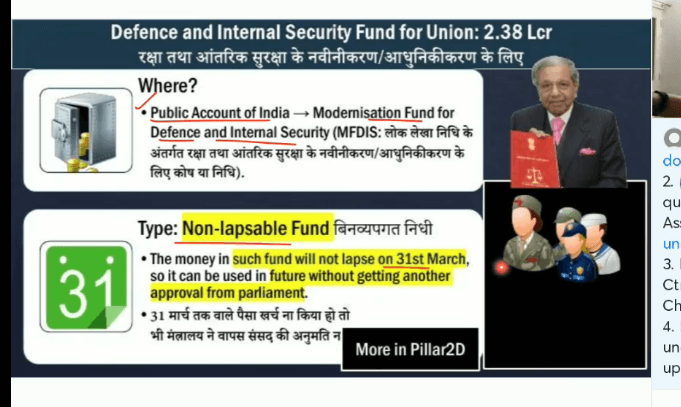
- 23.7.7 🔫🛡️ Defence and Internal Security Fund for Union (15th FC)
- 23.7.8 👨💼♂️(🍋⚖️👨🏫)⏰ FC: Giving Permanent Status
-
23.8 👨🏫 FC vs PC vs NITI: What’s the Difference?
-
**23.9 🍋(⚖️👨🏫♂️) Special Category States?
-
**23.10 ⚖️ Vertical Fiscal Imbalance- Meaning
-
23.11 📊 Report/Ranking related to States
-
B2📑Black Money, Subsidies & Revenue Expenditure
- 24 🍋🌚 Taxation → Black Money & Allied Issues …
- 24.1 (🕵️♂️🏢) Notable Organizations (ED, FIU, FATF, OECD) …
- 24.2 - 24.3 (⚖️⛓️) Tax Evasion & Laws (PMLA, UFIA, BTPA) .]
- 24.4 (📢💰) Govt Announcements & Amnesty Schemes (Vivad se Vishwas) ..
- 24.5 (🧗♂️🕳️) Tax Avoidance & Loopholes (DTAA, BEPS, GAAR) .
- 24.6 (⏪⌛) Retrospective Tax: The Vodafone & Cairn Story
- 24.7 (🌍📉) Global Minimum Tax (G7 Framework) …
- 24.8 - 24.10 (📑🤝) Tax Reforms, Charter & Ombudsman ..
- 24.11 - 24.13 (📜🌐) DTC, IT Bill 2025 & Global Treaties …
- 24.14 (🚫💸) Demonetisation: Why & What happened?
- 24.15 (📊📉) Revenue Shortfall, Laffer Curve & Buoyancy
- 25 (💸🏛️) Budget → Revenue Expenditure & Subsidies …]
- 25.1.8 - 25.1.13 (💼🎖️) NRA & Pay Commissions (7th & 8th) ..
- 📝 Previous Year Questions (PYQs) & MCQs … End
23 🍋 (⚖️👨🏫👩🏫) TAXATION → FINANCE COMMISSION
23.1 Introduction to Finance Commission
- 🤝 Fiscal Federalism: Refers to the division of responsibilities of i) taxation and ii) expenditure between different levels of government.
- 📜 7th Schedule: Assigns many expenditure responsibilities to States, but their taxation power is lower than the Union's. The FC bridges this gap.
- 🏛️ Article 280:
- President of India forms the FC every 5th year or earlier.
- It is a quasi-judicial body.
- Composition: 1 Chairman + 4 Members.
- Eligibility: Members are eligible for re-appointment.
- Nature: Recommendations are not binding but usually accepted.
23.2 👨💼♂️(🍋⚖️👨🏫) 15TH VS 16TH FC - MEMBERSHIP
| Matter | 15th FC | 16th FC |
|---|---|---|
| Chairman 👨💼 | NK Singh (IAS) | Dr. Arvind Panagariya (Economist) |
| Full Time 👔 | 1. Dr. Anoop Singh 2. Dr. Ashok Lahiri 3. Ajay Narayan Jha | 1. Mrs. Annie George Mathew 2. Dr. Manoj Panda |
| Part Time ⌚ | Prof. Ramesh Chand | 1. Dr. Soumya Kanti Ghosh 2. Mr T Rabi Sankar |
| Secretary 🖊️ | Arvind Mehta | Ritvik Pandey |
| Resigned 🏃♂️ | None | 1. Dr. Niranjan Rajadhyaksha 2. Ajay Narayan Jha |
23.2.1 👨🏫 Timelines ⏰
- 15th FC: Formed Nov-2017. Covered 6 years (2020-2026) via two reports because of J&K reorganization.
- 16th FC: Formed Nov-2023. Covers 5 years (April 2026 - 2031).
23.3 👨🏫 15TH VS 16TH FC - TERMS OF REFERENCE (TOR)
| 15th FC Mandates | 16th FC Status |
|---|---|
| 1. Vertical & Horizontal Tax Devolution | Same as 15th FC |
| 2. Grants-in-aid to states | Same as 15th FC |
| 3. Helping Panchayats/Municipalities | Same as 15th FC |
| 4. Disaster Management Funds | Same as 15th FC |
| Reward Population Control & Tax collection | 😶 Silent |
| Performance based incentives/grants | 😶 Silent |
| Census-2011 Data usage | 😶 Silent |
| Stop "Revdi-culture" (Freebies) | 😶 Silent |
23.4 🍋 Vertical Tax Devolution (Union to States) 📉
- Vertical Tax Devolution (Simple Definition):
👉 It is the sharing of tax revenue from the central government to the state governments. Finance Commission recommends the share of the "divisible pool" (excludes Cess, Surcharge, IGST). - 14th FC: 42%
- 15th FC: 41% (1% kept by Union for UTs of J&K & Ladakh security).
- 16th FC: 41% (Proposed).
23.5 🍋 Horizontal Tax Devolution Formula 🧪
- Horizontal Tax Devolution (Simple Definition):**
👉 It is the distribution of tax revenue among different state governments.
| Component/ indicator | 15FC (21-26) | 16FC (26-31) | Notes |
|---|---|---|---|
| Income Distance 💰 | 45% | 42.5% ↓ | Poorer states get more. |
| Population (2011) 👥 | 15% | 17.5% ↑ | More people = more money. |
| Demographic Perf. 👶 | 12.5% | 10% ↓ | Rewards lower fertility/growth. |
| Area 🗺️ | 15% | 10% ↓ | More area = more money. |
| Forest & Ecology 🌳 | 10% | 10% | Rewards environmental care. |
| Tax Effort 📈 | 2.5% | N/A | Rewarding tax collection. |
| GDP Contribution 🏭 | N/A | 10% | NEW! Rewards Industrial states. |
 | |||
 |
23.5.1 ⚖️ Winners vs Losers:
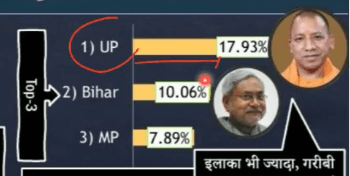
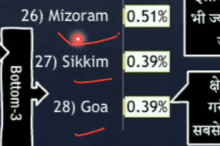
- Gainers ⬆️: Coastal & Industrial states (Maharashtra, Karnataka, TN, Gujarat) due to 10% GDP weightage.
- Losers ⬇️: Populous inland states (UP, Bihar, MP, Rajasthan) as area/income weights decreased.
23.6 💸🤝 GRANTS FROM UNION TO STATES

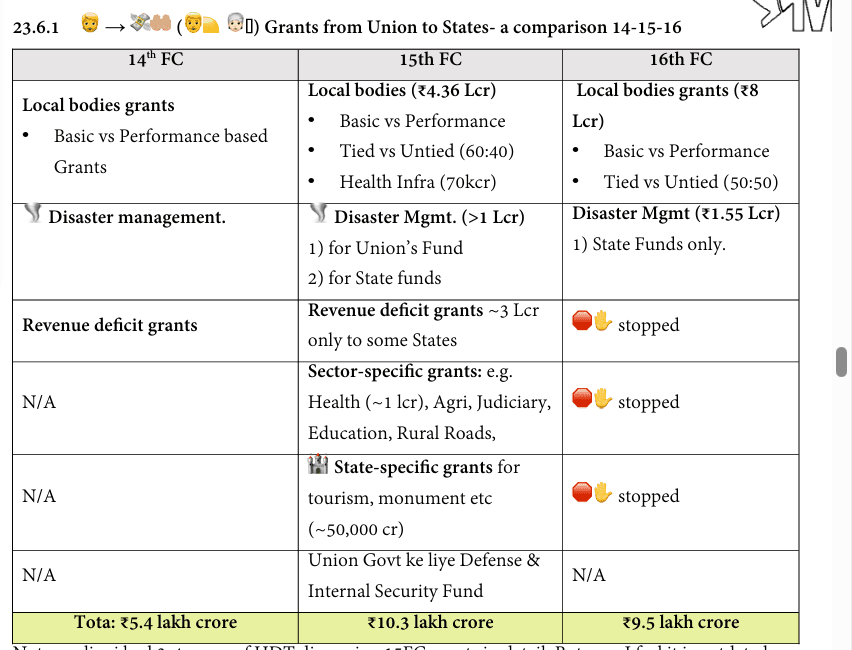
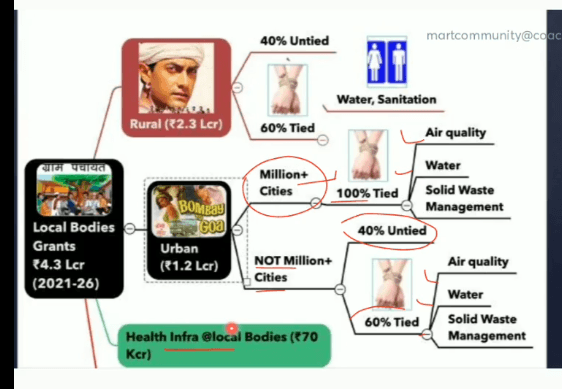
23.7 💸🤝🏗️ 16TH FC: LOCAL BODIES GRANTS
Total: ₹8 Lakh Crore.
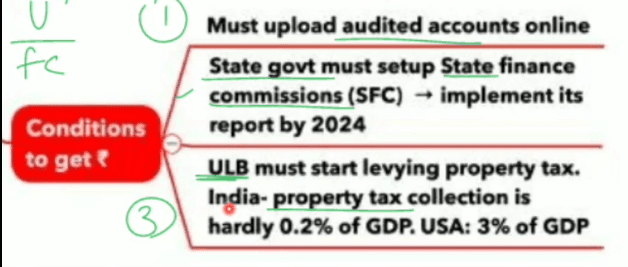
- 3 Conditions to get grant: 👐
- Setup State Finance Commission (SFC) on time.
- Elections/Constitutional setup of local bodies.
- Publish audited accounts online.
Structure (PRI & ULB):
- Basic Grant (80%):
- 50% Tied (Sanitation/Water). 🚿
- 50% Untied (General use, but NO salaries). 🚫👔
- Performance-based (20%): Improvement in Own Sources of Revenue (OSR). 📈
23.7.5 💸🤝🌪️ Disaster Management Grants
- Structure: 100% Grant = SDMF (Mitigation) 20% + SDRF (Response) 80%.
- Sharing: 90:10 (NE/Himalayan), 75:25 (Others).
- Proposed: Add Heatwave and Lightning ⚡ to the disaster list.
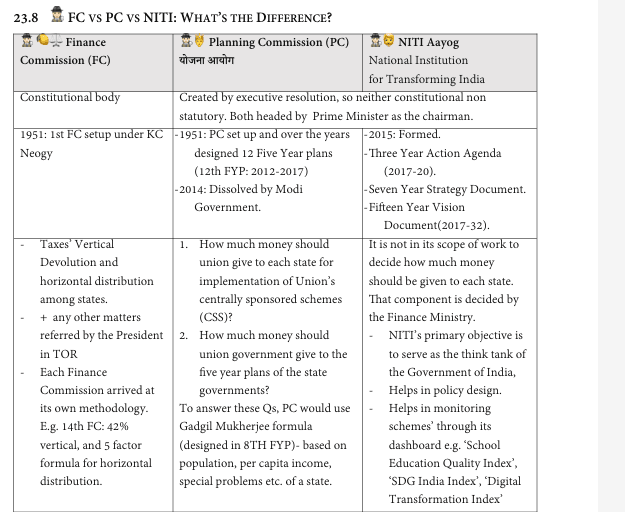
23.8 👨🏫 FC VS PC VS NITI: THE DIFFERENCE
- Finance Commission (FC): ⚖️ Constitutional Body. Decides vertical/horizontal taxes.
- Planning Commission (PC): 🏛️ Executive Body (Dissolved 2014). Designed 5-year plans.
- NITI Aayog: 🧠 Executive Body (2015). Think Tank. Does NOT decide money sharing; helps in policy/monitoring.
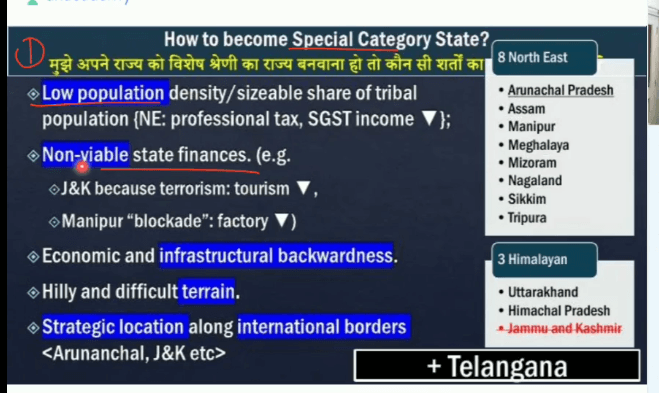
23.9 🍋 Special Category States (SCS) 🏔️
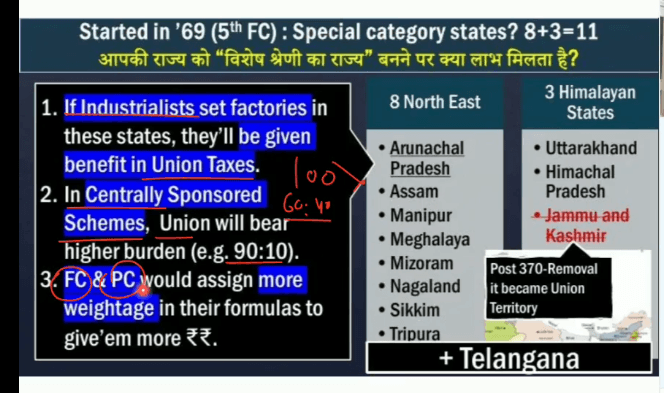
- Started: 1969 (5th FC).
- Criteria: Hilly terrain, low density, tribal pop, strategic border location, economic backwardness.
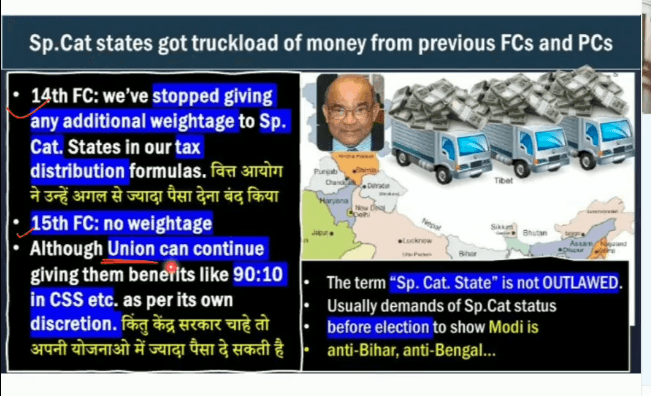
- Benefits: 90:10 ratio in Central Schemes. 🎁
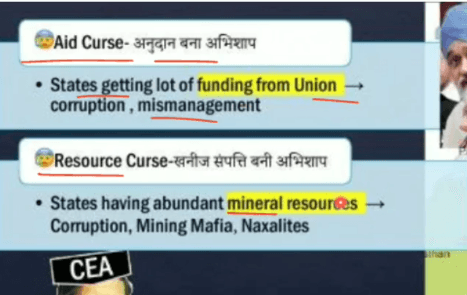
- Current status: 14th/15th/16th FC STOPPED giving them extra weightage in the formula.
 *
* 
-
23.10 ⚖️ VERTICAL FISCAL IMBALANCE
What does it mean? 🤔
- Fiscal Imbalance: When a government’s future debt obligations do not align with its future revenues.📉
- Vertical Fiscal Imbalance (VFI): When income does not match expenditures across different levels of government (Union vs. States vs. Local Bodies). 🏛️↔️🏡
- Result: It makes the States heavily dependent on the Union for funds. 🤝🆘
23.10.1 ⚖️ Factors Responsible for the Imbalance
The gap exists because the Union has "fat" wallets 💰, while States have "thin" wallets 👛 but "heavy" responsibilities.
| Union (The "Big Brother") 🏛️ | States (The "Responsibility Bearers") 🏡 |
|---|---|
| Direct Tax Giant: Earns over ₹20 lakh crore from Income Tax and Corporation Tax. 💸 | No Agri Tax: Due to electoral politics, states don't tax agricultural income, even for rich farmers. 🚜🗳️ |
| Customs Duty: Earns over ₹2 lakh crore from import/export duties. 🚢🛃 | No Power: States have zero power to impose customs duties on imports/exports. 🚫🚢 |
| Cess & Surcharges: The Union keeps 100% of these; they are NOT shared with the states. 🛑💰 | Professional Tax Cap: The Constitution (Art 276) prohibits States from charging more than ₹2,500/year as professional tax. 🛑👔 |
| GST Control: Union collects and distributes the GST pool. 💳 | GST Delays: States face problems with the timely release of GST Compensation Cess by the Union. ⏳😟 |
💡 Quick Summary for Revision:
- Union's Power: High Taxation Power (Direct Taxes, Customs, Cess). 🦁
- State's Burden: High Expenditure (Health, Education, Police) but Low Tax Power + Constitutional Caps. 🐢
- The Solution: The Finance Commission (FC) acts as the "Bridge" 🌉 to transfer funds from the Union to the States to fix this vertical gap! ⚖️✅
23.11 📊 REPORT/RANKING RELATED TO STATES
These rankings help in identifying which states are managing their money well and which states are empowering their local governments! 🏛️📈
23.11.1 🏥 “Fiscal Health Index (FHI) of States” by NITI Aayog
This index measures how "financially fit" a state is. 🩺💰
- 🏆 Rank #1 (2025): Odisha (The champion of fiscal management!) 🥇
- 🆕 New Beginning: This index was started for the first time by NITI Aayog in 2025.
- 🔝 Top-5 States: Odisha, Chhattisgarh, Goa, Jharkhand, and Gujarat. ✅
- 📉 Bottom-5 (Aspirational): Haryana, Kerala, West Bengal, Andhra Pradesh, and Punjab. (Need to work harder! 🏃♂️💨)
- **🖐️ The 5 Key Indicators :
- Quality of Expenditure: Is money spent on assets or just wasted? 🏗️
- Revenue Mobilization: How well is the state collecting its own taxes? 💸
- Fiscal Prudence: Is the state sticking to its budget limits? 📐
- Debt Index: How much loan has the state taken? 💳
- Debt Sustainability: Can the state pay back its loans in the future? 🔄
- 📝 Note: UPSC already asked a question about this index in the Mains 2025 exam! 🎯
23.11.2 🏡 Panchayats Devolution Index
This index checks if State Governments are actually giving money and power to the village Panchayats as required by the 73rd Amendment.
- 🏆 Rank #1 (2025): Karnataka 🥇
- 🥈 Rank #2: Kerala
- 🥉 Rank #3: Tamil Nadu
- 📅 History: This report/index has been made annually since 2009 to monitor progress.
- 🧩 The 6 Indicators (6 'F's and more):
- (i) Framework 📋 | (ii) Functions ⚙️ | (iii) Finances 💰 | (iv) Functionaries (Staff) 👨💼 | (v) Capacity Enhancement (Training) 🧠 | (vi) Accountability (Transparency) 🔍
- 🏢 The "Bosses" behind the Report:
- Ministry of Panchayati Raj 🏛️
- Data Survey by IIPA: Indian Institute of Public Administration (An autonomous body under the Personnel Ministry). ✍️📊
1. 24 🍋🌚 Taxation → Black Money & Allied Issues
Key Definitions 📖
- Tax Planning / Mitigation: 😇 Legal and ethical. Using LIC/PPF to claim deductions under the IT Act. 👉 It is the legal way of managing your income and expenses to reduce tax liability.
- Black Money (काला धन): 🌚 Income not reported to tax authorities. It creates a Parallel Economy: which mean economy run through the use of black money.
- Tax Evasion (चोरी): 🕵️♂️ Illegal. Hiding income to avoid paying tax.
- Tax Avoidance: 🧗♂️ Unethical but often technically legal. Using loopholes (like Tax Havens) to reduce tax liability.
- Tax Haven (कर स्वर्ग): 🏝️ Small countries (Mauritius, Cayman Islands) with little to no tax, used for avoidance.
- Money Laundering: 🧼🏦 Disguising illegal money (drugs, corruption) as "clean" money from legitimate sources.
- Hawala: 💼 Illegal/informal money transfer system via agents without moving physical cash across borders.
- Shell Firms: 🐚 Fake companies with no active business, created only for money laundering.
- Round Tripping: 🔄 Money leaves India (via Hawala) → reaches a Tax Haven → returns to India as "Foreign Investment."
2. 24.1 (🕵️♂️🏢) Notable Organizations
- ED (Enforcement Directorate): 👮♂️ FinMin agency. Enforces FEMA, PMLA, and COFEPOSA.
- DRI (Directorate of Revenue Intelligence): 🕵️♀️ Investigates smuggling (customs, wildlife, arms) under Customs Act.
- FIU-IND (Financial Intelligence Unit): 💻 Analyzes suspicious transactions. Regulator of Crypto-exchanges under PMLA.
- FATF (Financial Action Task Force): 🌍 HQ: Paris. Brainchild of G7.
- Greylist: Nations serving as safe havens for terror funding.
- Blacklist: Non-cooperative nations (e.g., North Korea, Iran).
- OECD: 🤝 HQ: Paris. Known for BEPS norms. India is not a member but cooperates.
- EIC (Economic Intelligence Council): 🏛️ Headed by Finance Minister. Includes members from RBI, SEBI, IB.
3. 24.2 - 24.3 (⚖️⛓️) Tax Evasion Laws
PMLA (Prevention of Money Laundering Act, 2002) ⚖️
- Enacted after UN declaration.
- Adjudication: PMLA Adjudicating Authority → Appellate Tribunal → HC → SC.
- Crypto 2023: Crypto-exchanges must now perform KYC and notify suspicious transactions to authorities.
Burden of Proof ⚖️
- Normal Law: Prosecution/Police must prove the crime.
- Reverse Burden of Proof (PMLA/Benami/NDPS): The Accused must prove they are innocent. This makes getting bail very difficult.
Other Major Acts 📜
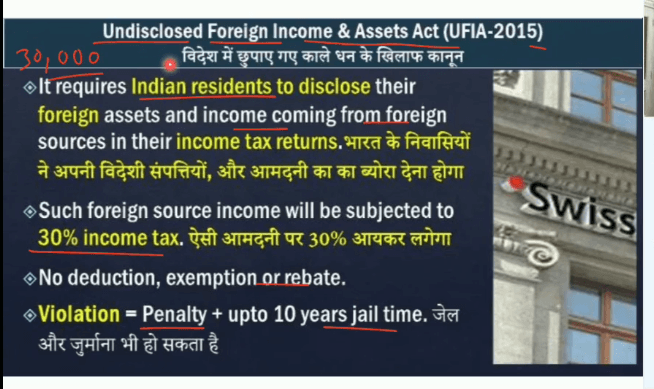
- UFIA (Undisclosed Foreign Income & Assets Act, 2015): 🌍 30% tax + penalty + up to 10 years jail for undisclosed foreign assets.
- BTPA (Benami Transactions Prohibition Act): 🏠 Prohibition of properties held in the name of others (drivers, relatives) to hide the real owner. Main Agency: IT Dept.
. 24.4 (📢💰) Govt Announcements & Amnesty(surrender scheme)
- IDS (Income Declaration Scheme, 2016): 🏳️ Surrender black money by paying 45% (tax + penalty).
- PMGKY (Garib Kalyan Yojana): 🧤 Post-demonetisation scheme. 50% taken as tax/penalty; 25% kept in zero-interest deposit for 4 years.
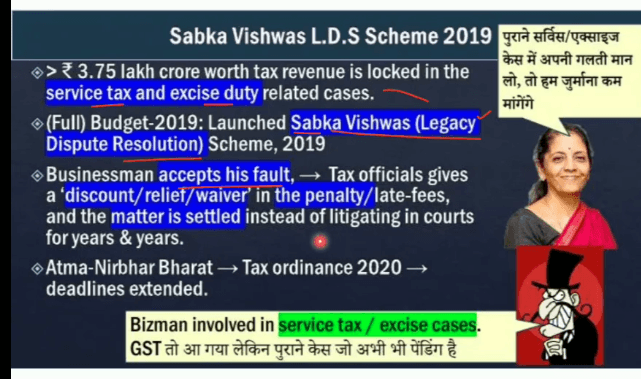
- Vivad se Vishwas (2020): 🤝 Settling pending direct tax cases by paying the disputed tax while getting a waiver on interest/penalties.
- DRC (Dispute Resolution Committee): 🧘 For small taxpayers (income < ₹50L, dispute < ₹10L) to settle matters facelessly.
24.5 (🧗♂️🕳️) Tax Avoidance Loopholes
Unlike tax evasion (which is illegal), Tax Avoidance is the practice of using legal loopholes to minimize tax liability. It is "technically legal" but considered unethical.
1. 🤝 DTAA & Round Tripping (दोहरा कराधान परिहार समझौता)
- DTAA (Double Taxation Avoidance Agreement): A treaty between two countries so a taxpayer doesn't pay tax on the same income twice.
- The Loophole: India has high Capital Gains Tax (CGT) (12.5% to 20%), while tax havens like Mauritius have ~0-3%.
- 🔄 Round Tripping:
- Indian black money is sent abroad via Hawala. 💼
- A Shell Company (fake company) is opened in Mauritius. 🐚
- That company "invests" the money back into India as Foreign Direct Investment (FDI).
- Result: The investor avoids paying Indian taxes by claiming benefits under the Mauritius DTAA.
2. 🔍 Principal Purpose Test (PPT)
- New Rule (March 2024): India and Mauritius amended their DTAA to include the PPT.
- Logic: If the government finds that the "Principal Purpose" of a transaction was just to avoid tax (and not real business), the DTAA benefits will be denied. 🚫🙅♂️
- Impact: This led to a massive exit of foreign investors and a stock market fall in early 2024. 📉
3. ✈️ Avoidance via Non-Resident Status
- The Rule: If you are an "Ordinarily Resident," you pay tax on global income. If you are a "Non-Resident," you only pay tax on income earned inside India. 🇮🇳
- Budget 2020 Change: To be treated as a Non-Resident, a person now has to stay out of India for a longer period (246 days instead of the old 182 days).
- Motive: To stop rich individuals from "managing" their travel dates just to avoid paying tax on their foreign earnings. 🛂🏛️
4. 🧠 POEM: Place of Effective Management
- Concept: If a company is registered in a tax haven (like Mauritius) but all its big decisions and management are happening in India, it is considered to have its "POEM" in India.
- Result: India will demand tax on that company's USA/Global income because it is effectively an Indian-managed company. 🏢🇮🇳
5. 🥤 Transfer Pricing & AAR
- Transfer Pricing: When two branches of the same MNC (e.g., Coca-Cola USA and Coca-Cola India) trade with each other at fake prices (too high or too low) to shift profits to a low-tax country. 📉💰
- AAR (Authority for Advance Rulings): A body where companies can ask the government in advance: "If we do this transaction, how much tax will you charge?" This helps avoid future legal fights. ⚖️🤝
6. 🌍 BEPS (Base Erosion and Profit Shifting)
- Definition: MNCs "eroding" the tax base of a country like India by "shifting" profits to tax havens.
- OECD/G20 Framework: India signed the MLI (Multilateral Instrument) to implement international standards to stop this profit shifting. 🤝🌐
7. 🛡️ GAAR (General Anti-Avoidance Rules)
- Origin: Suggested by the Parthasarathi Shome Panel. 👨🏫
- Power: It gives "superpowers" to Income Tax officials. If they suspect a deal is made only to avoid tax, they can cancel the tax benefits.
- Criticism: Critics call it "Tax Terrorism" because it gives too much power to officials to harass honest businesses. 🔫😠
- Status: Finally implemented on April 1, 2017.
8. ⚓ Safe Harbour Rules
- Meaning: "Safe Harbor" is a zone of legal immunity. 🛡️✅
- Example: If a foreign IT company or AI Data center signs an agreement to pay a fixed tax (around 15%), the Indian tax officers promise not to take action or harass them regarding Transfer Pricing. It's a "peace treaty" between the taxpayer and the govt. 🤝🕊️
24.6 (⏪⌛) Retrospective Tax
- The Issue: ⏪ Demanding tax today for a transaction that happened in the past (when the law didn't exist).
- Vodafone Case: 📱 Vodafone bought Hutch (Cayman Islands deal). India demanded tax retrospectively in 2012.
- 2021 Amendment: 🚫 Govt finally ended retrospective tax rules to regain investor trust after losing cases against Vodafone and Cairn Energy in international courts.
7. 24.7 (🌍📉) Global Minimum Tax
- G7 Framework (2021): 🤝 Agreement for a 15% minimum global corporate tax to stop the "race to the bottom" where countries cut taxes to attract FDI.
- Current Status (2025): 🇺🇸 Donald Trump has declared the deal has no force/validity in the USA, effectively walking out of the agreement.
24.8 - 24.10 📑🤝 TAX REFORMS, CHARTER & OMBUDSMAN
These sections focus on moving away from "Tax Terrorism" (harassment) towards a "Taxpayer Friendly" environment. (ईमानदार करदाता का सम्मान!) 😇🏛️
24.8 🕵️♂️🚫 REFORMS TO REDUCE TAX TERRORISM / HARASSMENT
The goal is to make the Income Tax Department strict against evaders but friendly to honest citizens. 🤝👮♂️
-
24.8.1 📝 Pre-filled Online Forms:
- The IT Dept extracts your data from Banks, Stock Exchanges, and Mutual Funds. 🏦📈
- Result: You get a form that is already filled with your salary and interest income.
- Benefit: Saves time and energy; no need to hire a CA for simple filings. ⏳⚡
-
24.8.2 💻 Faceless Interaction:
- Old Way: You meet the officer, which leads to bribes or harassment. 💸😠
- New Way: Cases are allotted via Random Computerized Lottery. 🎰
- The officer doesn't know your name/location, and you don't know theirs.
- Communication: Done via email, Zoom, or video conference. 📧📹
-
24.8.3 🔢 Document Identification Number (DIN):
- Every official letter (summons, arrest memo, notice) MUST have a computer-generated DIN.
- Benefit: If a notice has no DIN, it is INVALID. This prevents corrupt officials from sending fake notices for bribes. 🚫✍️
24.9 📜 TAXPAYERS’ CHARTER (BUDGET-2020)
A "Citizens' Charter" is a promise of quality service. India released its Taxpayer Charter in August 2020. 🇮🇳🤝
- **CITIZENS CHARTR: document of commitment made by a government agency to the citizens.
- **1986: UK tax payers' Charter
- **1991: UK PM John Major started Citizen Charter
- **1997: India also introduced Citizen Charter.
Government’s Promises to You: 🤝
- Professionalism: Treat you in an impartial and courteous manner. 👔
- Presumption of Honesty: You are honest unless proven otherwise. 😇
- Accuracy: Provide timely and accurate information on rules. 📖
- Correct Tax: Collect only the correct amount; no "extortion." 💰
- Privacy: Respect your confidentiality and privacy. 🔐
- Accountability: Hold officers responsible for wrongful actions. 👮♂️⚖️
What the Govt expects from You: 🫵
- Be honest and pay taxes on time. ⏰
- Keep accurate records and respond to notices promptly. 📑
24.10 🕵️♂️♂️♂️ TAX OMBUDSMAN & E-GOVERNANCE
- Ombudsman : A Swedish concept. A person who listens to citizen grievances. 👂⚖️
- Indian Experience:
- Direct Tax Ombudsman started in 2003; Indirect in 2011.
- 2019: Both posts were Abolished. 🛑
- 2021: Economic Survey recommended bringing them back with Statutory Powers. ⏫
24.10.2 📱 Online Portals & Apps for Ease of Paying Tax
- Aaykar Setu: Mobile app for Income Tax help and TDS refunds. 📲
- ICEGATE: Web portal for e-services related to Customs Duty. 🚢
- ATITHI App: For international travelers to file customs declarations (gold/electronics) before landing to avoid airport queues. ✈️💎
- ICEDASH: A public dashboard to view daily data on customs clearance speed. 📊
24.10.4 💻 Important E-Governance Systems
- NMS (Non-Filers Monitoring System): Software that tracks high-value buyers (e.g., someone buying a ₹1.5L iPhone 📱) who haven't filed an ITR.
- TRACES: Portal for managing TDS (Tax Deducted at Source) and refunds. 💸
- Project Insight (2017): A high-tech platform using data mining to track tax evaders. 🔍🕸️
- CASS: Computer Assisted Scrutiny Selection — uses algorithms to pick cases for raids/prosecution. 🤖⚖️
24.11 - 24.16 📜🌐 DIRECT TAX CODE, DEMONETISATION & REVENUE CONCEPTS
This section covers the future of Indian Tax laws, global cooperation, and the math behind how the government calculates its earnings. 🧮🏛️
24.11 📜 DIRECT TAX CODE (DTC) TASK FORCE (2017-2019)
- The Mission: 🚀 To replace the old Income Tax Act of 1961 with a simpler "Direct Tax Code" (प्रत्यक्ष कर संहिता).
- The Team: Headed by Arbind Modi, then later by Akhilesh Ranjan (CBDT members). 👨💼👨💼
- Status: Recommendations were submitted but not fully implemented as one single code; instead, the government brought in a separate Income Tax Bill.
24.12 ⚖️ INCOME TAX BILL 2025: SIMPLIFY & COMPRESS
The goal is to make the law readable for humans, not just lawyers! 📖⚖️
- Compression: 📉 Shrinking the law from 5.12 lakh words to 2.60 lakh words. (Converting paragraphs into tables/charts).
- 24.12.1 Notable Changes (Effective 1-April-2026):
- "Assessment Year" is gone: 🕰️ Replaced with a simpler "Tax Year" (12-month period starting April 1).
- Virtual Digital Space: 💻 Tax officers can now search/seize email servers, social media accounts, and cloud storage.
- Crypto = Property: 🪙 Bitcoins, NFTs, and other virtual assets are now officially "Property." (30% Capital Gains tax applies).
- Softening the Blow: 🧘 The word "Penalty" will be renamed to "Additional Amount" to reduce negative connotations for taxpayers. (नाम बदल दिया, पर पैसे तो देने पड़ेंगे! 😅)
24.13 🌍 TAXATION → GLOBAL TREATIES & INDEXES
Tax evaders can run, but they can't hide from global cooperation! 🏃♂️🌐
- 24.13.1 TIEA (Tax Information Exchange Agreement): 🤝 Mutual sharing of info between nations (e.g., India & Marshall Islands). Nodal Agency: CBDT.
- 24.13.2 FATCA (USA's Law): 🇺🇸 US law that requires Indian/Global banks to report assets held by Americans back to the US IRS.
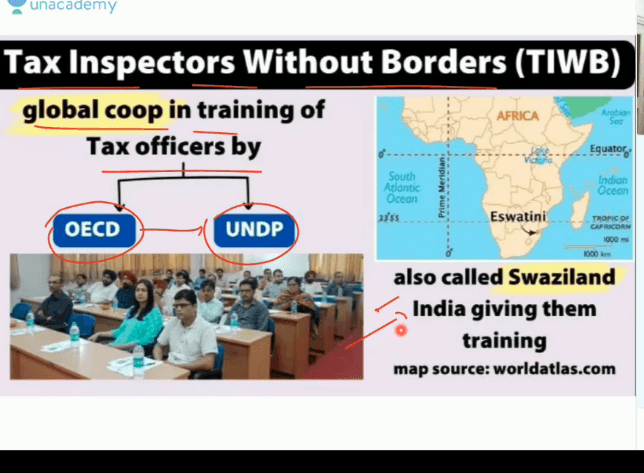
- 24.13.3 TIWB (Tax Inspectors Without Borders): 🕵️♂️ A joint initiative of UNDP + OECD. India helps train tax officers of Eswatini (formerly Swaziland).
- 24.13.4 Global Financial Secrecy Index: 📉 Prepared by Tax Justice Network. 2022 Rank: 1st (Most Secretive): USA. India is at #36.
24.14 🚫💸 BLACK MONEY → DEMONETISATION
The "wholesale withdrawal" of currency from circulation. 📉💰
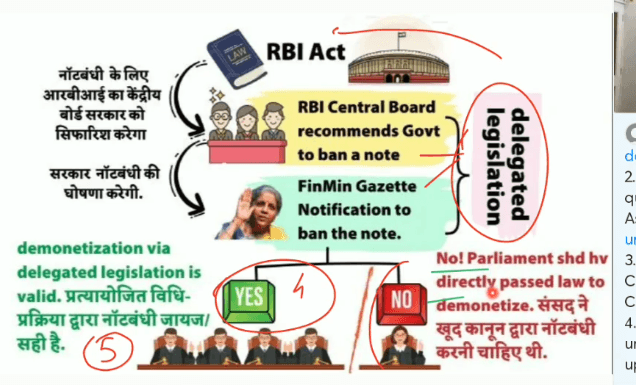
- Timeline: 🗓️ 8th Nov 2016. ₹500 & ₹1000 notes (SBN: Specified Bank Notes) were banned.
- Legal Basis: Done via the RBI Act 1934.
- RBI us **soil rate of the currency printed in the economy.
- The Result: 🏦 ~99.30% of the money came back to the banks. Only ₹10,720 crore of black money was "destroyed."
- SC Verdict (2023): ⚖️ The Supreme Court upheld the decision (4:1) as "legal" under the concept of Delegated Legislation.
- Why is India's Tax-to-GDP Ratio low? 📉
- Huge Informal Sector (Cash transactions). 🛍️💵
- No tax on Agricultural Income. 🚜🌾
- Low per capita income & poverty. 🛖
- Loopholes & Tax Avoidance. 🧗♂️🕳️
24.15 📊 REVENUE SHORTFALL & KEY TERMS
How the government measures its tax performance. 📉📈
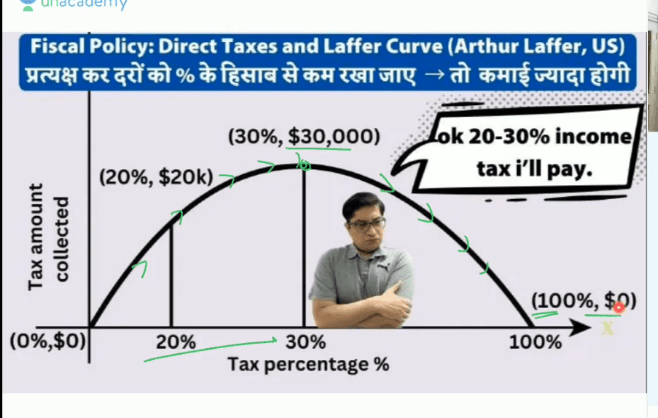
- Laffer Curve: 📈 Theory by Arthur Laffer. If you tax people too much (e.g., 90%), they will stop working or start cheating. Tax cuts can sometimes actually increase revenue! ✂️💰
- Tax Buoyancy: ⛵ Measures how tax revenue grows as the economy (GDP) grows.
- Formula:
% Change in Tax Revenue ÷ % Change in GDP. - If Buoyancy > 1, tax is growing faster than the economy! 🚀GST ; 1.12
- if buoyancy<1, =means low buoyancy.
- Formula:
- Net Tax Revenue Calculation: 🧮
- Gross Tax Revenue (Total collected) 🏦
- MINUS Devolution to States (41%) 🤝
- MINUS Contribution to NDRF (Disaster fund) 🌪️
- EQUALS Net Tax Revenue of the Union. ✅
24.16 🏗️ BUDGET → REVENUE PART → NON-TAX RECEIPTS
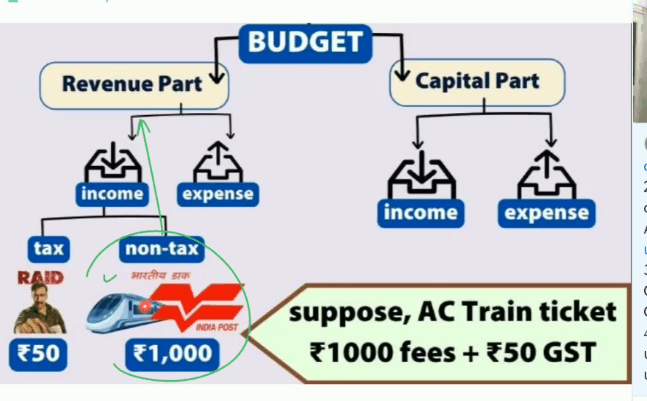
Earnings of the government other than taxes. 🏛️💸
- Interest Receipts: 💳 Interest earned on loans given to States, Railways, or Foreign Countries.
- Dividends & Profits: 📈 Profit from PSUs (ONGC, BSNL), Public Sector Banks, and the RBI Surplus.
- General Services: 🎟️ Money from Railway tickets, Post office stamps, Selling 'Yojana' magazines, and Spectrum Auctions.
- Grants-in-Aid: 🎁 Donations or gifts received from foreign countries/organizations.
11. 25 (💸🏛️) Revenue Expenditure & Subsidies
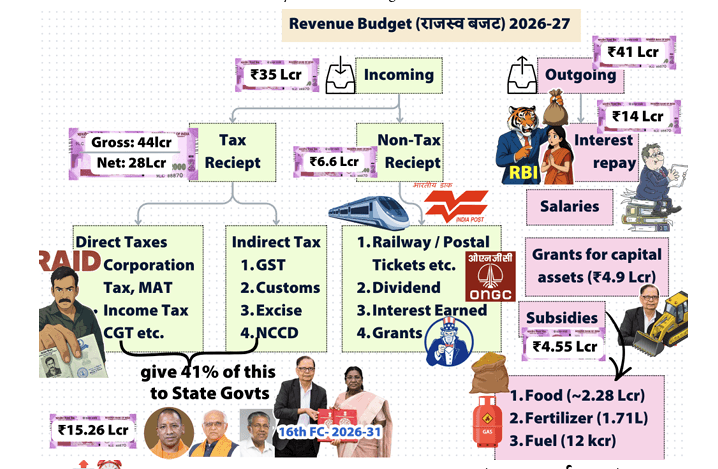
- Revenue Expenditure: 💸 Money spent on day-to-day functioning (Salaries, Pensions, Interest, Subsidies). Does NOT create assets.
- Major Items (Size wise):
- Interest Payments: 🥇 (Highest component).
- Defence Revenue Exp: 🥈
- Subsidies: 🥉:
- Pensions: 🎖️
- Subsidies Types: ⛽
25 ⏰ BUDGET → REVENUE EXPENDITURE (राजस्व खर्च/ व्यय)
What is it? 🤔
- Definition: Money spent on the day-to-day functioning of the government. (जैसे घर चलाने का रोज़ाना का खर्चा!) 🏠💸
- Characteristics:
- It does not create any income-generating assets (No factories, no roads built here). 🚫🏗️
- It includes money spent on salaries, pensions, stationery, electricity bills, and phone bills. 📄☎️
- Interest Payments: This is the highest component among all revenue expenditures. (पुराने कर्जों का ब्याज भरना सबसे बड़ा बोझ है!) 🥇📈
25.1 ⏰(🍱⛽) REVENUE EXPENDITURE → SUBSIDIES (सब्सिडी)
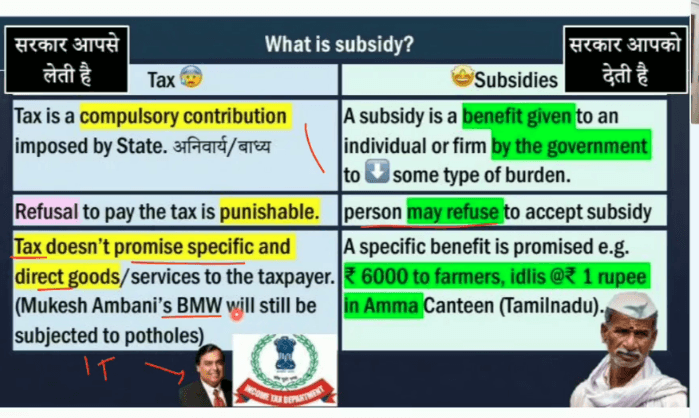
A Subsidy is a benefit given to individuals or firms to reduce their burden. Unlike taxes, you can refuse a subsidy without being punished! 🤝🎁
25.1.1 🍱⛽ Types of Subsidies with Examples:
- Direct Cash: 💸 Money directly into the bank account (e.g., PM-KISAN ₹6,000, LPG Pahal).
- In Kind: 🎒 Free items (e.g., free school bags, uniforms, books, or medicines in govt hospitals).
- Indirect: 📉 Govt pays the company to sell products cheaply to you (e.g., cheap urea, kerosene, or low fees in govt colleges).
- Implicit: 🐔 Govt manipulates the market (e.g., banning chicken imports so local poultry can charge higher prices).
- Cross-Subsidization: 🚆 Charging one group more to help another. (e.g., Railways charge high for Freight/Cargo 📦 to keep Passenger 🎫 tickets cheap).
- Procurement: 🌾 Govt buying food grains at Minimum Support Price (MSP).
- Interest Subvention: 📉 Govt pays part of your loan interest (e.g., for farmers, MSMEs, or affordable housing).
25.1.2 👍👎 Impact of Subsidies:
- Merit Goods (+): 🎓 Healthcare, education, and LPG are "Merit Goods" because they create positive externalities. (Cheap LPG = less indoor pollution).
- Negative Externalities (-): 💨 Cheap diesel/kerosene harms the environment. Excessive urea subsidy leads to soil and water pollution. 🧪🌊
- Subsidy Leakage: 🕳️ When "Ghost Beneficiaries" (non-existent people) or rich people receive benefits meant for the poor. ( reduce this problem through JAM trinity )
25.1.4 🛰️ Tech-Driven Solutions (To stop leakages)
- DBT (Direct Benefit Transfer): 📲 Beneficiaries increased from 11cr to 176cr in 10 years!
- SNA-SPARSH: 💸 Funds are released from RBI accounts only against "actual expenditure," so states can't sit on the money.
- RO-PDS (IIT-Delhi): 🚚 Algorithms to find the best route for food trucks to reduce fuel costs and leakages.
25.1.8 🏢 National Recruitment Agency (NRA)
- Problem: Multiple exams by multiple agencies (SSC, IBPS, RRB). 📑🤯
- Solution: Common Eligibility Test (CET) for Group B & C non-gazetted posts.
- Benefit: One exam, one center in every district. Saves time and money for candidates. ⏳💰
25.1.9 - 25.1.13 🎖️ Pay Commissions & Benefits
The government sets the salaries of its employees every few years. 📈👔
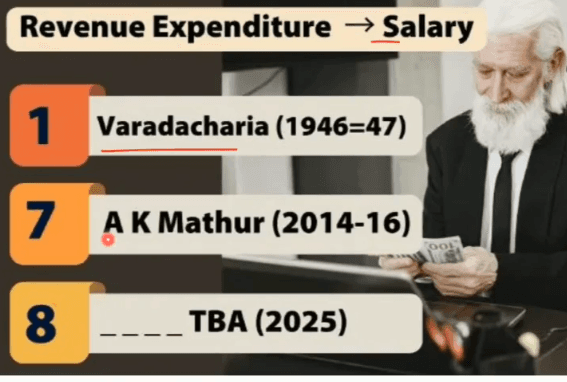
- 7th Pay Commission (2014): 📅 Headed by Justice AK Mathur.
- Introduced the "Pay Matrix" system.
- Minimum pay set at ₹18,000/month. 💵
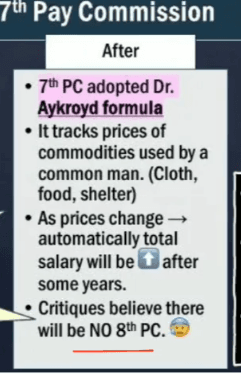
- 8th Pay Commission (2025): ⏳ Headed by Justice Ranjana Desai. Report will benefit nearly 5 million employees from Jan 2026.
- DA vs DR: 🍞
- DA (Dearness Allowance): For serving employees to fight inflation.
- DR (Dearness Relief): For retired employees (pensioners)
- **HRA ( HOUSE RENT ALLOUNCE) .
- OROP (One Rank One Pension): 🎖️ Same pension for same rank and same length of service, regardless of retirement date.
- Gratuity: 💰 A lump sum amount given to an employee for serving many years continuously, usually given at retirement.
📝 Notable Data for Subsidies (Budget 2026-27 Projection):
- Food Subsidy: 🍱 ~₹2.28 Lakh Crore (Highest)
- Fertilizer Subsidy: 🚜 ~₹1.71 Lakh Crore
- Fuel (LPG) Subsidy: ⛽ ~₹12,000 Crore
📚 SECTION 1: FINANCE COMMISSION (Pillar 2B1) ⚖️🏛️
Q1. For the horizontal tax devolution, the Fifteenth Finance Commission used how many of the following as criteria other than population, area and income distance? (UPSC Prelims-2023)
- Demographic performance
- Forest and ecology
- Governance reforms
- Stable government
- Tax and fiscal efforts. Codes: (a) Only two (b) Only three (c) Only four (d) All five
- Ans: (b) Only three
- Reason: The 15th FC used Demographic Performance, Forest & Ecology, and Tax Effort. Governance reforms and Stable government were not used.
Q2. Find correct statements regarding Finance Commissions: (CAPF-2024)
- 15th FC used fiscal effort as a criterion for horizontal devolution unlike the 14th FC.
- Both the 14th & 15th FC used pre-2011 demographic variables as a criteria for horizontal devolution. Codes: (a) 1 only (b) 2 only (c) Both 1 and 2 (d) Neither 1 nor 2
- Ans: (a) 1 only
- Reason: 15th FC reintroduced Tax (Fiscal) effort. Statement 2 is wrong because the 15th FC used only the 2011 Census.
Q3. Population of 2011 was first introduced in the tax devolution formula by which Finance Commission? (CAPF-2024) (a) 13th FC (b) 15th FC (c) 14th FC (d) 12th FC
- Ans: (c) 14th FC
- Note: The 14th FC was the first to use 2011 population (with 10% weightage), though it also used 1971 data.
Q4. Find correct statements about 15th FC: (CAPF-2025 / EPFO-2023)
- Basic (untied) grants can be used by rural local bodies for location-specific felt needs… except for salaries and other establishment costs.
- Tied grants can be used for basic services of sanitation and maintenance of ODF status, management and treatment of household waste.
- It recommended 'Health Grants' to create diagnostic infrastructure in primary health care facilities. Codes: (a) 1 only (b) 2 and 3 only (c) 1 and 3 only (d) 1, 2 and 3
- Ans: (d) 1, 2 and 3
Q5. Find correct statements about the 15th Finance Commission: (Pre’25) I. It has recommended grants of ₹ 4,800 crores for incentivizing States to enhance educational outcomes. II. 45% of the net proceeds of Union taxes are to be shared with States. III. ₹ 45,000 crores as performance-based incentive for all States for agricultural reforms. IV. It reintroduced tax effort criteria to reward fiscal performance. Codes: (a) I, II and III (b) I, II and IV (c) I, III and IV (d) II, III and IV
- Ans: (c) I, III and IV
- Hint: Statement II is wrong. The share is 41%, not 45%.
Q6. In India, which of the following review(s) the independent regulators in sectors like telecommunications, insurance, electricity etc.? (UPSC Prelims-2019)
- Ad Hoc Committees set up by the Parliament.
- Parliamentary Department Related Standing Committees.
- Finance Commission.
- Financial Sector Legislative Reforms Commission.
- NITI Aayog. Codes: (a) 1 and 2 (b) 1, 3 and 4 (c) 3, 4 and 5 (d) 2 and 5
- Ans: (a) 1 and 2
📚 SECTION 2: BLACK MONEY, TAXATION & SUBSIDIES (Pillar 2B2/2C) 🌚💰
Q7. How many of the following pairs are correct? (Pre’25)
| Organization | Function | Works Under |
|---|---|---|
| I. Enforcement Directorate | Fugitive Economic Offenders Act | Internal Security Div-I, MHA |
| II. Directorate of Revenue Intelligence | Customs Act, 1962 | Dept. of Revenue, FinMin |
| III. DG Systems and Data Mgmt | Data analytics to nab evaders | Dept. of Revenue, FinMin |
Codes: (a) Only one (b) Only two (c) All the three (d) None
- Ans: (b) Only two
- Reason: Pair I is wrong because ED works under Ministry of Finance (FinMin), not MHA.
Q8. Which one of the following situations best reflects “Indirect Transfers”? (UPSC Prelims-2022) (a) An Indian company investing in a foreign enterprise and paying taxes to the foreign country. (b) A foreign company investing in India and paying taxes to the country of its base. (c) An Indian company purchases tangible assets in a foreign country and sells them later. (d) A foreign company transfers shares and such shares derive their substantial value from assets located in India.
- Ans: (d)
- Note: This was the core issue in the Vodafone-Hutch case.
Q9. ‘Quantified Domestic Minimum Top-up Tax’ is a term related to? (EPFO-2023) (a) Global Anti-Base Erosion Rules (BEPS/OECD) (b) Prevention of Money Laundering (c) Regulation of Crypto-currency (d) Virtual Digital Asset Transactions
- Ans: (a) Global Anti-Base Erosion Rules
Q10. Regarding ‘Prohibition of Benami Transactions Act’, find correct statement(s): (UPSC Pre-2017)
- A property transaction is not treated as a benami transaction if the owner of the property is not aware of the transaction.
- Properties held benami are liable for confiscation by the Govt.
- The Act provides for 3 authorities for investigation but does not provide any appellate mechanism. Codes: (a) 1 only (b) 2 only (c) 1 and 3 only (d) 2 and 3 only
- Ans: (b) 2 only
- Reason: Statement 1 is false (ignorance is no excuse). Statement 3 is false because there is an appellate mechanism (Appellate Tribunal).
Q11. Which of the following two organizations are parts of TIWB (Tax Inspectors Without Borders)? (CAPF-2024) (a) UNDP + ASEAN (b) OECD + ASEAN (c) UNDP + OECD (d) ILO + ASEAN
- Ans: (c) UNDP + OECD
Q12. As per the Budget 2019-20, the maximum subsidy expenditure was likely to be on: (CDS-2020-ii) (a) Urea subsidy (b) Petroleum subsidy (c) Food subsidy (d) Fertilizer subsidy
- Ans: (c) Food subsidy
- Note: Food subsidy remains the largest component of India's subsidy bill.
Q13. Which item comprises the major portion of the revenue expenditure? (CDS-2024-2) (a) Salaries (b) Interest Payments (c) Roads (d) Defence Services
- Ans: (b) Interest Payments
Q14. Find correct statements about National Recruitment Agency (NRA): (CDS-2024-2) (a) It is a body to conduct Common Eligibility Test (CET) to shortlist candidates for Group 'B' and 'Group C' of the Government. (b) Employment in private sector is facilitated in all districts. (c) It was set up in 2014. (d) It has been accorded constitutional status in 2021.
- Ans: (a)
END OF PYQ COMPILATION 🏁✅
