D1) Capital Budget Disinvestment
Pillar#2D1: Capital Budget Disinvestment
Table of Contents
- 26 🗓️ Budget Capital Receipts …
- **26.1 🗓️ Budget Capital Receipts ☒ Disinvestment:
- 26.1.1 🏢 🏢 🏢 CPSE vs PSU vs PSB …
- 26.1.2 🏅 Ratna Companies = freedom to govt companies based on performing …
- 26.1.3 🧔 💼 ♐️ Government policy towards disinvestment before 2021
- 26.1.4 Chronology of Nationalisation and Privatisation
- 26.1.5 🧔 💼 ♐️ Methods of Disinvestment in Modi Raj : ETF, OFS, etc
- 26.1.6 🧔 💼 ♐️ Disinvestment targets – usually fail .
- 26.2 🧔 💼 ♐️ Privatization / Strategic Disinvestment in Modi Raj …
- 26.2.1 🧔 💼 🏢 New Public Sector Enterprise (PSE) Policy (2021)
- 26.2.2 📕 ES26 on CPSE- change definition for faster PVTZN : 51% 26%
- 26.2.3 🍋 16th FC on CPSE- shut down/privatize .
- 26.3 Disinvestment – Misc. Topics …
- 26.3.1 🏗️ 💎 National Monetisation Pipeline (NMP 2021)
- 26.3.2 🎂 💰 Minimum Dividend Rule (2024-Nov)
- **26.4 🗓️ Budget Capital Part Expenditure
- 26.4.1 🧔 🏢 🖋️ 🏗️ State CAPEX Loans (SASCI) .
- 26.4.2 🗓️ Budget Capital Part ☒ Effective Capital Expenditure
- 26.4.3 🗓️ 🏢 Capital expenditure for a Company
- **26.1 🗓️ Budget Capital Receipts ☒ Disinvestment:
26 🗓️ BUDGET CAPITAL RECEIPTS
CAPITAL BUDGET 2026-27
| Incoming (Total: ₹18 Lcr) | Outgoing (Total: ₹12 Lcr) |
|---|---|
| Debt (~17 lcr) 4.3% GDP • Internal: ₹16.9 Lcr • External (World Bank): ₹15 kcr | 1. Infra/assets (Bulldozer icon) 2. Loans given by Union to State/Foreign Nations (Workers icon) |
| Non-Debt (1.18 Lcr) • ONGC Disinvest: ₹80,000cr • Loan Recover: ₹38,000cr (Yogi Adityanath icon) | 3. investment by Govt in share/bonds (SBI icon) 4. Union repaying loan principal (BASEL icon) |
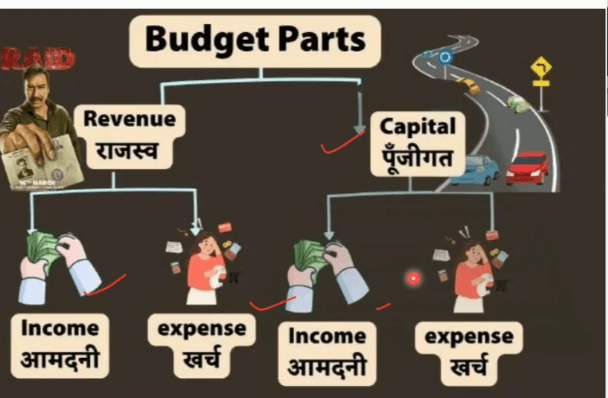
- **Capital receipts are those receipts of the government that either create a liability or reduce its assets
- Money received by the government that increases debt or reduces assets
| Capital Debt Receipts | Capital Non-Debt Receipts: |
|---|---|
| 💼 💰 👨👩👧 Internal Borrowing 15 lakh cr dollar : long term and short term - short term less then 1 year 🐯 From RBI, - CMB, T- BILLS , WMA -long term: more than 1 year > From small savings (Post-Office Savings Accounts, Kisan Vikas Patra, etc) - From Provident Funds (EPFO, PPF) - national saving certificate Sukanya Samriddhi fixed deposit. from capital markets instruments > G-sec, Sovern green bonds , soc gold bonds, inflation index. | Loan Principal recovered (i.e. Union government would have given loans to state governments, foreign countries, public sector companies etc.) so when they return Principal amount back that is counted here but the interest given on that loan is not counted on the capital side , it will be counted on the revenue side of the budget . |
| 💼 💰 👶 External borrowing 30k dollar : from foreign countries & international institutions like IMF, World Bank, BRICS bank etc. | Disinvestment i.e. Union selling its shares from Public Sector Undertakings (PSUs) / Central Public Sector Enterprises (CPSEs). |
| Bigger portion of Capital Receipts from this side | Smaller portion |
26.1 🧔 💼 ♐️ BUDGET CAPITAL RECEIPTS DISINVESTMENT:
- Disinvestment means the process by which a government or a company sells or reduces its ownership (shares or assets) in a business or organization. There are THREE types of Commercial or industrial undertaking owned by the govt:
| ✉️ Departmental Undertakings | 🐯 Statutory Corporations | ⛽ Govt. Companies |
|---|---|---|
| Directly part of a ministry e.g. Postal, Railways. They can be created easily because, no laws required, no Companies Act registration required. | Created by an act of Parliament or state legislature. E.g. RBI Act, SBI Act, LIC Act, FCI Act, EPFO Act. etc, SIDBI, NABARD, NHB, EXIM etc. | Registered under the Companies Act, Govt’s shareholding is 51% or more. Coal India ltd, GAIL, SAIL, NTPC, IOCL, BHEL & various Public Sector Banks and NBFCs which are not statutory corporations. |
| Risk aversion by officers. 👹 High level of ministerial interference | 🤟 Middle of both sides | More operational flexibility to officers. Less interference by Ministers |
| CAG will audit directly | Some of these Acts provide for internal audit & exclude CAG from auditing the Corporation. E.g. RBI, LIC. | Companies Act requires them to produce audited reports. CAG will empanel the (private) auditors for them. |
| Their earning will go directly in Public Account / CFI | Their earning profit dividend goes to shareholders. | |
| Their employees are considered government employee-subjected to service and discipline or conduct rules 8 framed by the government. | Not considered govt employees. Their service / discipline conditions are governed by the respective organizations’ internal manuals. . | same |
**All three types of org are Answerable under the Right to Information Act, 2005 govt companies Objective: Public interest & welfare through affordable services, Development of infrastructure, regional balance, prevent concentration of economic power in the hands of Corporates /MNCs.
😪 Challenges? Political interference, lack of innovation & consumer responsiveness, employee unions, loss making business.
26.1.1 🏢 🏢 🏢 CPSE vs PSU vs PSB
PSB: Public Sector Banks = Banks wherein Govt has majority shareholding. Central Public Sector Enterprises (CPSEs: : Registered in Companies act & Union Government has 51%/> shareholding. Commonly known as ‘Govt companies’. The word CPSE is mainly used to denote “govt companies other than Public Sector Banks, Public Sector Insurance Companies and Public Sector NBFCs”. Public sector Undertaking (PSU: = collective term for all the govt companies owned by Union Govt + State Government + Local Bodies.
✋ Note: Some book/internet may differ in this definition. But we need not loose sleep over pedantry.
26.1.2 🏅 Ratna Companies = freedom to govt companies based on performing
Dept of Public Enterprises under FinMin decides Ratna Status. (REF: Handout #2A for more). ✋ This is NOT for private owned companies like Tata, Infosys or Adani. “Ratna” status-walli central Govt Companies are given for the flexibility in their operations e.g. hiring more professionals, acquisition of other companies etc. without requiring government approval for every small decision.*
| Category | Condition and examples |
|---|---|
| 🥉 Miniratna Cat-I and Cat-II | ✓ made profits in the last 3 years continuously, further subdivision in Category-I & Category-II depending on how much profit is generated. ✓ Examples: National Film Development Corporation ltd, Mazagaon Dock ltd, Mishra Dhatu Nigam, NHPC ltd, WAPCOS, ONGC Videsh, Rail Vikas Nigam |
| 🥈 Navratna | ✓ A Mini Ratna company fulfilling “x” conditions OR ✓ Non-Mini Ratna Govt companies fulfilling “y” conditions such as Manpower cost to total cost of production etc. ✓ Examples: Rashtriya Ispat Nigam ltd, Rural Electrification Corporation ltd, Shipping Corporation of India ltd, Oil India ltd, National Aluminum Company ltd, Neyveli Lignite Corporation ltd, Mahanagar Telephone Nigam ltd, Hindustan Aeronautics ltd, Container Corporation of India ltd, Bharat Electronics ltd. |
| 🥇 Maharatna | ✓ Already a Navratna Company + fulfilling “z” conditions such as min. ₹ 5000 crore profit per year in last 3 yrs, listed at a Stock exchange, significant global presence ✓ Very few here: 1) Bharat Heavy Electricals, 2) Bharat Petroleum Corporation, 3) Coal India, 4) GAIL (India), 5) Hindustan Petroleum, 6) Indian Oil Corporation, 7) NTPC, 8) Oil & Natural Gas Corporation (ONGC), 9) Power Grid Corporation, 10) Steel Authority of India (SAIL) |
✋ Above Ratna examples taken on 1/1/2020. List may change afterwards. Some companies get privatized. Don’t loose sleep, unless preparing for their specific recruitment exam. e.g. ONGC
✔️ 🧐 FAQ. Are Public Sector Banks (PSB) given Ratna Status? Ans. No. While PSBs are a sub-set of Government companies but Ratna status is for CPSEs who are NOT PSBs. ✔️ 🧐 FAQ. Are Statutory Corporation like LIC, EPFO etc given Ratna Status? Ans. No. It’s for Central Govt’s companies only. It is not for statutory corporation. ✔️ 🧐 FAQ. Are State Govt’s Govt Companies given Ratna Status? Ans. No. It is for Central Govt owned companies only. (ये सिर्फ केंद्र सरकार की सरकारी कम्पनियो के लिए है) ✔️ 🧐 FAQ. Are Private sector Companies like Tata/Reliance given Ratna Status? ❓ MCQ. Which among the following is designated with ‘Navratna’ status? (CDS-2021-i) (a) Indian Oil Corporation Limited (b) Gas Authority of India Limited (c) Bharat Petroleum Corporation Limited (d) Bharat Electronics Limited
26.1.3 🧔 💼 ♐️ Government policy towards disinvestment before 2021
Disinvestment: ↓↓ govt shareholding in a Government company but govt keeps atleast 51% shareholding with itself. Privatization / Divestment / Strategic Disinvestment : When govt sells upto 50 per cent or more shareholding, along with transfer of management control. (Definition as per DIPAM Dept) ✅ Arguments in favour: ↓↓ govt shareholding Private investors will enter in the board of directors ↑↑ efficiency, innovation and autonomy. (दक्षता, नवाचार स्वायत्तता) Disinvestment proceeds can be used for welfare schemes, and ↓↓ fiscal deficit. ✋ Argument Against: MNC monopolies, exploitation of worker, job loss.
26.1.4 Chronology of Nationalisation and Privatisation
| Year | Nationalization and Disinvestment related developments |
|---|---|
| 1951 | ✓ First Constitution Amendment Act: While 19(1)(g) gives citizen's right to practice any profession. But Government can impose reasonable restrictions on it for interests of general public this allowed for nationalization of pvt industries e.g. Bank nationalization in Pillar#1B1 () ✓ (🎓 NOTE: first amendment act also contain some other provisions for SEBC, 9th Schedule etc, but we are only focusing on the parts that are related with nationalization/disinvestment) |
| 1953 | 1953: Air Corporations Act: Govt nationalised nine airlines—including Air India (started by JRD Tata in 1932 two sarkaari companies made I) Indian Airlines II) Air India International. |
| 1991 | The term 'disinvestment' was used first time in Interim Budget 1991. “We will reduce shareholding in all Govt Companies”- said PM Narasimha Rao. (Images of Manmohan Singh and Narasimha Rao: " |
| 1998’s PM Vajpayee | - In strategic sector (Railways, Defense, Atomic Energy)- ✋we’ll not do disinvestment - In Non-strategic sector = ✅we’ll do disinvestment in a phased manner . - 1999: PM Vajpayee set up Department of Disinvestment privatisation of Maruti Udyog, Hindustan Zinc, Bharat Aluminum and Videsh Sanchar Nigam Limited (VSNL) etc. 12 govt companies. |
| UPA-1 (2004-09) | Due to pressure from Leftist/Marxist coalition parties = No Disinvestment from any government companies. If a government company is sick, we will try to revive it. |
| UPA-2 | ✓ All Govt Companies can be disinvested upto 49% = Govt will keep 51% |
| (2009-14) | minimum and sell remaining shares. ✓ ₹₹ will goto National Investment Fund (NIF, in Public Account) used for Bank recapitalization, metro rail, nuke energy, EXIM-NABARD-RRB etc. ✓ Also launched CPSE-Exchange Traded funds (ETF): 📄 Ref Pill#1C:SEBI |
26.1.5 🧔 💼 ♐️ Methods of Disinvestment in Modi Raj : ETF, OFS, etc.
✓ Various methods of Disinvestment, depending on the Company
- Converting Private Limited Company to public limited company and issuing **Initial Public Offers (IPOs) e.g. Indian Railway Catering and Tourism Corporation (IRCTC) and Rail Vikas Nigam Ltd (RVNL)
- Exchange Traded Funds (ETFs): CPSE-ETF, Bharat-22-ETF (Ref: Pillar#1C)
- Institutional placement Programme (IPP): offer shares only to non-retail investors.
- Offer for sale (OFS): Govt sells its existing shares to both retail and non-retail investors
- Share Buyback i.e. Govt company itself buys the shares owned by Govt, thereby decreasing Government's shareholding portion viz a viz private sector's shareholding.
✓ Modi govt shut down many sick Govt companies such as HMT watches, Hindustan Photo Film etc. ( ✓ Budget-2016 renamed FinMin’s Dept of Disinvestment into Dept. of Investment & Public Asset Management (DIPAM:
26.1.6 🧔 💼 ♐️ Disinvestment targets – usually fail
| Budget | 2018-19 | 2019-20 to 2023-24 | 2023-24 | 2025-26 | 2026-27 |
|---|---|---|---|---|---|
| Target | 80,000 cr | Big targets | 50,000 cr | ₹47,000cr | ₹80,000 |
| Achieved? | ✅ yes | Not achieved | 🤨 33,000 cr | 🤨 33,000cr | We’ll see |
Disinvestment vs Strategic Disinvestment (Privatization)
- 100% LIC 95%: Disinvestment
- Strategic Sector: keep min 1 CPSE (e.g. Nuke, Bank…)
- Non-Strategic: Privatize Everything (Image of Air India logo and PM Modi) 0%
26.2 🧔 💼 ♐️ PRIVATIZATION / STRATEGIC DISINVESTMENT IN MODI RAJ
Strategic Disinvestment : it means selling a substantial portion of Government shareholding in a CPSEs along with transfer of management control to a private party. also called as Divestment For this action, NITI Aayog prefers to use the term ‘strategic disinvestment’, ‘strategic sale’ instead of ‘privatization’, lest the opposition parties create uproar about it. Sometimes, press statement also uses the word “Divestment” for it.
26.2.1 🧔 💼 💼 New Public Sector Enterprise (PSE) Policy (2021)
| Strategic sectors | Non strategic sectors | |
|---|---|---|
| Example | 1) Atomic energy, Space, Defence 2) Transport, Telecom 3) Power, Petroleum, Coal, other minerals 4) Banking, Insurance and financial services | All the other sectors. (बाकी तमाम क्षेत्रों = गैर-महत्वपूर्ण क्षेत्रो में जितने भी सरकारी कंपनियां है उन सब को या तो निजीकरण कर देंगे या बंद कर देंगे) |
| Will there be a govt company here? | Minimum one government company will be kept. Remaining will be merged/ privatized/shutdown | No government company will be kept. All the Existing government companies will be privatized/shutdown. |
26.2.2 📕 ES26 on CPSE- change definition for faster PVTZN : 51% 26%
- Problem: Companies Act says “govt company” = min 51% govt stake. So beyond 49% = loss of “govt company” status.
- This blocks more disinvestment fearing backlash from factory workers and opposition parties.
- Consequently, even though 36 CPSE approved for privatization, only 13 actually completed since 2016. e.g. Air India.
ES26 suggests two options:
| Option | Approach |
|---|---|
| A | Redefine "govt company" from 51% ownership to 26% (since effective control over company needs only 26%) |
| B | No legal change — keep doing phased disinvestment below 51%, all the way up to 0% ownership i.e. complete privatization- as done in Air India. |
26.2.3 🍋 16th FC on CPSE- shut down/privatize
- States government should actively privatize State electricity distribution companies (DISCOMs).
- Shutdown 308 inactive State Public Sector Enterprises (SPSEs).
- If State or union PSEs incur losses for 3 out of 4 consecutive years, then union/state govt should decide closure/privatization.
❓ MCQ. Why is Govt disinvesting its equity in the Central Public Sector Enterprises (Pre’11)
-
The Government intends to use the revenue earned from the disinvestment mainly to pay back the external debt.
-
The Government no longer intends to retain the management control of the CPSEs. Ans Codes: (a) 1 only (b) 2 only (c) Both 1 and 2 (d) Neither 1 nor 2
26.3 DISINVESTMENT – MISC. TOPICS
26.3.1 🏗️ 💎 National Monetization Pipeline (NMP 2021)
Govt initiative for selling/renting/leasing the land/building/machine/assets of CPSE/National Highways/Railways to mobilise ₹6 lakh crore by 2025. More in 🏦 Pillar#5- along with other associated topics like 1) National Investment and Infrastructure Fund (NIIF) 2) National Infrastructure Pipeline / GATI Shakti initiative etc.
26.3.2 🎂 💰 Minimum Dividend Rule (2024-Nov)
- Finance Ministry requires central public sector enterprises (CPSEs e.g. ONGC) and Sarkaari-NBFCs (e.g. LIC, Power Finance Corp, etc) to pay minimum 30% of their profit as dividend.
- Note1: what about sarkaari banks like SBI/PNB? Ans. Not given in newspaper, so I did not do self-PHD/James-Bondgiri for it.
- Note2: It has more terms and condition related to net worth, but poor cost benefit for MCQ.
26.4 🗓️ 🏗️ BUDGET CAPITAL PART EXPENDITURE
- Capital Expenditure is the money a business spends to acquire, improve, or maintain long-term assets such as buildings, machinery, or equipment : Its notable components in decreasing order are:
- Capital assets for various schemes, ministries, departments (Building, vehicles..)
- Giving debt/equity finance to PSUs & foreign institutes, giving loans to State Govt & Foreign Govt. Note: FinMin: Dept of Economic Affairs (DEA)’s Indian Development and Economic Assistance Scheme (IDEAS) gives such ₹₹ to foreign nations.
- Union repaying loan principal for Internal Debts
- Union repaying loan principal for External Debts
26.4.1 🧔 🏢 🖋️ 🏗️ State CAPEX Loans (SASCI)
Scheme of Special Assistance to States for Capital Expenditure (SASCI) 2020: Union to loan interest-free 50-year loan to states. Total amount approx. ₹12,000 cr for capital expenditure like, health, rural development, water supply, irrigation, power, transport, education, urban development. 👛 Budget-2023: we’ll give capex loans & Some of these CAPEX loans will be linked to:
- Scrapping old government vehicles
- Urban planning reform, Urban local bodies reforms
- Housing for policemen; - Constructing Unity Malls- Ref Pillar#3A
- Libraries and digital infrastructure 👛 Budget-2024, 2025 gave loans. 👛 Budget-2026: allotted ₹2 lakh cr
26.4.2 🗓️ 🏗️ Budget Capital Part Effective Capital Expenditure (
(₹ करोड़) (In ₹ crore)
- Effective Capital expenditure: ** refers to the actual amount of money a company spends on acquiring, upgrading, or maintaining physical assets_—after adjusting for certain factors that affect the real cash outflow or economic impact
Effective Capital Expenditure is the true or adjusted capital spending of a business, considering elements like subsidies, reimbursements, or timing differences
| 2024-2025 Actuals | 2025-2026 Budget Estimates | 2025-2026 Revised Estimates | 2026-2027 Budget Estimates | ||
|---|---|---|---|---|---|
| Capital Expenditure | 1051953 | 1121090 | 1095755 | 1221821 | |
| Grants in Aid for creation of capital assets¹ | 272656 | 427192 | 308151 | 492702 | |
| effective cap exp | 1324609 | जोड़ | 1548282 | 1403906 | 1714523 |
🙋♀️ What does above chart mean? Ans. Explained in the video lecture. 👩🏫 🎬
26.4.3 🗓️ 🏢 Capital expenditure for a Company
Capital Expenditures of a company = the amount of money invested by the company in (income generating) assets such as:
| 🏗️ Tangible Assets | 🌐 Intangible Assets |
|---|---|
| > Tangible assets are physical assets that you can see and touch. Examples: | **Intangible assets are non-physical assets that cannot be seen or touched but still have value |
| Land, Buildings, Vehicles, Equipment | Patents for vaccines, copyright for books/music/movies/softwares, Brand-logo, Trade secret formulas (e.g. KFC burger, Cocacola), |
| Raw material and Unsold inventory (finished goods) | License fees (e.g Software, mining, telecom etc) (Ref: Pillar#5- Infra) |
| Investments made in the shares/bonds of other companies. | Clients’ database / mailing list |
| Accounts receivable (Ref#1C) | Goodwill (Ref: Pillar#1C - eg Byjus buying Whitehall jr.) |
| Cash & deposits in bank account | Website domain name |
We can further sub-divide these assets into current assets, financial assets, fixed assets. More of that in Pillar7: Microeconomics.
❓ MCQ. Find correct about company’s Expenditure (Prelims-2022)
- Acquiring new technology is capital expenditure.
- Debt financing is considered capital expenditure, while equity financing is considered revenue expenditure Codes: (a) 1 only (b) 2 only. (c) Both 1 and 2. (d) Neither 1 nor 2
❓ MCQ. How many of the above are considered intangible investments? (Prelims-2023)
- Brand recognition 2. Inventory 3. Intellectual property 4. Mailing list of clients Codes: (a) Only one (b) Only two (c) Only three (d) All four
Next HDT: 2D2- Fiscal Deficit, FRBM Act
❓ MCQ. Which of following is not a component of ‘Capital Receipts’? (IEnggS-2018) (a) Market borrowings including special bonds (b) External/foreign loans raised by the Central Govt (c) Taxes on property and capital transactions (d) Provident Funds (State Provident Funds and Public Provident Fund)
❓ MCQ. Find capital receipt of the Govt of India? (CAPF-2024)
- Disinvestment receipts 2. Interest receipts 3. Small savings 4. Net market borrowing. Codes: (a) 1 and 3 only (b) 2 and 4 only (c) 1, 2, 3 and 4 (d) 1, 3 and 4 only.
❓ MCQ. Find Correct (Pre’25) I. Capital receipts create a liability or cause a reduction in the assets of the Government. II. Borrowings and disinvestment are capital receipts. III. Interest received on loans creates a liability of the Government. Codes: (a) I and II only (b) II and III only (c) I and III only (d) I, II and III
