🧾 #2A2: Indirect Taxes & GST
🧾 #2A2: Indirect Taxes & GST
📑 Table of Contents
- 22.1 Indirect Taxes: Types & Shifting 💸
- 22.2 Merits & Demerits of Indirect Taxes ⚖️
- 22.3 Pigouvian Tax & Customs Duty 🏭⚓
- Gold Baggage Allowance & Budget 2026 Reforms ✈️
- Petrol & Diesel Taxation (Windfall Tax, Oil Bonds) ⛽
- 22.4 Misc. Issues (Mining Royalty, Water Cess) ⛏️
- 22.5 Cascading Effect of Taxes 🪜
- 22.6 - 22.7 Timeline: From MODVAT to GST ⏳
- 22.8 - 22.9 GST: 101st Amendment & GST Council 🏛️
- 22.10 Input Tax Credit (ITC) & Inverted Duty Structure 🔄↩️
- 22.11 - 22.12 Subsumed Taxes (Centre & States) 📥
- SC Ruling on Industrial Alcohol (2024) 🧪
- 22.13 GST on Services (Actionable Claims, Gaming) 🎰
- 22.14 GST on Goods (0% Items, Pre-packed Rules) 🍞
- 22.15 GST 2.0 (Sept 2025 Reforms) 🚀🆕
- 22.16 - 22.17 Negative Critiques & Pan Masala Taxes 🚭
- 22.18 - 22.20 Composition Scheme, RCM, E-Way Bill 🚛
- 22.21 - 22.22 GST Compensation & Loans 💰🤝
- 22.23 GST Organizations (GSTAT, GSTN, NAA) 🏢
- 22.24 PAN vs. GSTIN vs. Aadhaar (PAN 2.0) 🆔
- 22.25 GST Benefits & Revenue Neutral Rate (RNR) ✨
22.1 Indirect Taxes: Types 🛒
Administrative Authority: FinMin ➡️ Dept of Revenue ➡️ CBIC (Central Board of Indirect Taxes and Customs).
🏷️ Two Main Categories:
- Ad-Valorem Tax : Based on the Value of the item. 💎
- Example: 35% Customs Duty on orange juice. If price = ₹1000, tax = ₹350.
- Specific Tax per unit : Based on the Quantity/Physical Units. 🚬
- Example: ₹260 Excise duty on every 1000 cigarettes (65-70mm). Value doesn't matter.
22.1.1 Burden Shifting 🔄
How a businessman handles a tax hike (e.g., GST from 18% to 28%):
- Forward Shifting: Pass the burden to the Customer by increasing the price. 📈
- Backward Shifting: Absorb the tax by reducing workers' salaries or vendor payments to keep the price the same. 📉
22.2 Indirect Taxes: Merits and Demerits ⚖️
| 😊 Merits (लाभ) | 😟 Demerits (नुकसान) |
|---|---|
| Convenient: Traders collect it; Govt doesn't need to chase individuals. | Regressive: Hits the poor harder as they pay the same amount as the rich. 🍞 |
| Wider Base: Everyone (even the poor) pays it via consumption. | Hidden: Promotes less civic consciousness; people don't "feel" the tax. 🕵️♂️ |
| Elastic: Small hikes generate massive revenue for the Govt. | Inflationary: Directly increases the price of goods/services. 🚀 |
| Social Control: Can discourage harmful habits (Alcohol/Tobacco). 🚭 | Cascading Effect: Leads to "Tax on Tax" if ITC is not given. 🪜 |
⚓ 22.3 (Concept) Pigouvian Tax & Indirect Tax Dynamics
A Pigouvian Tax is a tax levied on any market activity that generates negative externalities (costs not included in the market price). Named after British economist Arthur C. Pigou. 🧪🏭
🚬 22.3 Pigouvian Tax: The Cost of Harm
- Externality: A consequence of economic activity felt by unrelated third parties.
- Example: A cement factory pollutes the air. The factory and the buyer profit, but the local community suffers health issues. 🏭🌬️
- The Tax: Govt taxes these activities to discourage them.
- Sin Tax: A similar concept specifically for "immoral" items like alcohol and tobacco. 🍷🚭
- Note: We currently have high indirect taxes on petroleum, tobacco, and alcohol.
🏅 22.3.1 - 22.3.2 Customs Duty on Precious Metals
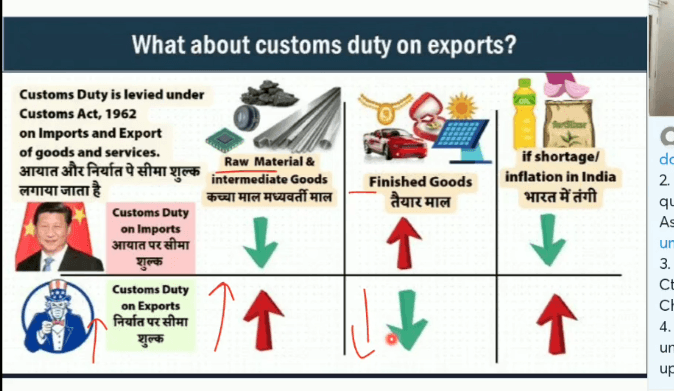
- Custom Duty: custom duty is levied under Custom Act, 1962 on imports and exports of good and services.
- Gold & Silver Bars: Reduced from 15% to 6% in Budget 2024 to discourage smuggling. 🏅🕵️♂️
- Platinum/Palladium: Reduced to 6.4%.
- ✈️ Baggage Allowance (Duty-Free):
- **✈️ Customs Duty-Free Gold Baggage Allowance
If you are a passenger returning to India after staying abroad for more than one year, you can bring a limited amount of gold jewelry without paying any customs duty.
| Passenger Category | ⚖️ Jewelry Weight Limit | 💰 Max Value Limit | ⚓ Customs Duty | |
|---|---|---|---|---|
| Male Passenger 👨 | Up to 20 grams | ₹ 50,000 | NIL (No Duty) ✅ | |
| Female Passenger 👩 | Up to 40 grams | ₹ 1,00,000 | NIL (No Duty) ✅ |
If you carry gold jewelry beyond these limits (either in weight or value), you are required to pay 3% to 10% customs duty, depending on the total weight and type of gold. 📉💸
- Note: If you exceed these, you pay 3-10% duty. In 2025, Delhi HC ordered CBIC to increase these limits to reduce harassment of NRIs. ⚖️🏛️
⚓ 22.3.3 - 22.3.4 Customs Duty Patterns & Budget 2026
- Normal Pattern:
- Inputs/Raw Materials: Low Duty ⬇️ (To help local industry).
- Finished Goods: High Duty ⬆️ (To protect 'Make in India').
- Budget 2026 Cuts:
- Duty cut on machinery for Lithium-Ion Cells (EV push). 🔋
- 0% Duty on specific Cancer drugs. 💊✅
- Personal items (Perfume/Fashion) duty cut from 20% to 10%. 🧴👗
🩹 22.3.5 - 22.3.6 Cess & Surcharge on Customs
- SWS (Social Welfare Surcharge): 10% on Customs Duty. (Abolished for gold/silver in 2021).
- Health Cess (2020): 5% on imported medical devices. 🩺
- Use: To build hospitals in Aspirational Districts. 🏥📍
- Budget 2025 Rationalization: To counter global criticism of "tariff abuse," Govt decided to apply not more than one cess or surcharge on a single imported item. 🛠️✅
⛽ 22.3.7 - 22.3.9 The Petroleum Price Saga
Petrol/Diesel prices are high because of a "Tax Cocktail":
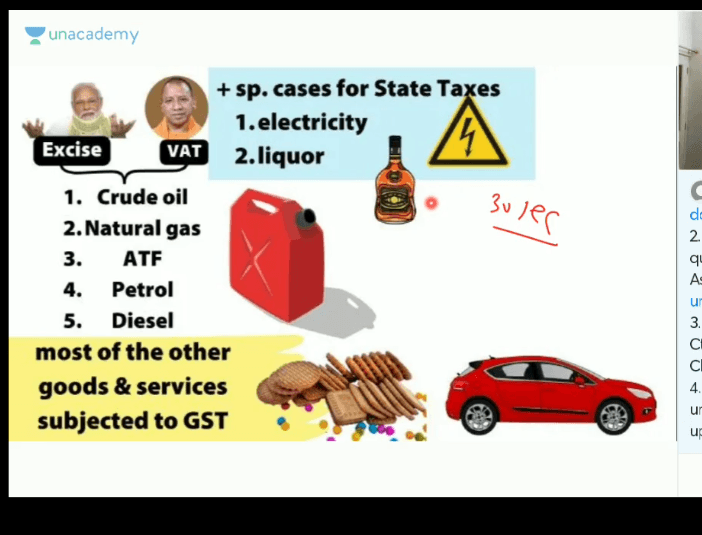
- Union Tax: Basic Excise + Special Addl. Excise + Road Infrastructure Cess + AIDC( Agriculture Infrastructure and development Cess.)
- State Tax: VAT (Value Added Tax).
- Total Tax Burden: ~135% for Petrol and ~116% for Diesel. 📈🔥
If fuel is brought under 28% GST, Union/State govts would lose over ₹4 Lakh crore in revenue. This is why they are reluctant to move it to GST. 📉💸
⛽ 22.3.8 Shareability Rule
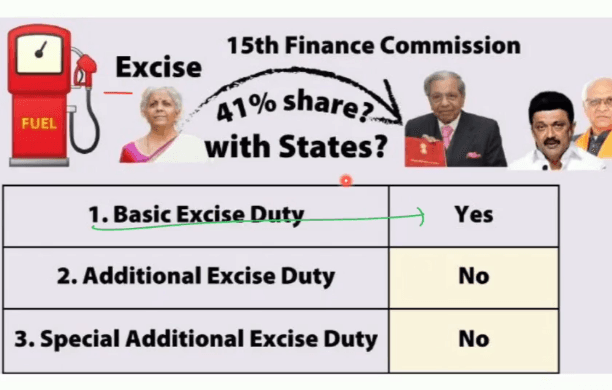
- Basic Excise Duty: Shared with States via Finance Commission. ✅
- Additional/Special Excise: NOT shared with States. ✋💰
⛽ 22.3.9 Unblended Petrol Duty (Budget 2022)
- Ethanol Blended: ₹0 extra duty. 🌽
- Unblended Petrol: ₹2/Litre extra excise duty. ⛽➕ (**ADED Additional Differential Excise Duty)
- Goal: To force refineries to reach the 20% ethanol blending target by 2025. 📉🌿
🌬️ 22.3.10 Windfall Tax (SAED)
- windfall gain: unexpected , unprecedented profit.
- Context: In 2022, global fuel prices spiked. Indian refineries were making "unforeseen/extraordinary" profits by exporting. 📊💰
- windfall tax is a nickname given to tax when it is levied on an unforeseen/ unexpected.
- to prevent excess export
- Action: Govt imposed SAED (Special Additional Excise Duty) on exports of Petrol, Diesel, and ATF.
- Current Status: Being gradually reduced/deleted as global prices fall. 📉🍃
📉 22.3.11 - 22.3.12 Dynamic Pricing & Oil Bonds
- APM Era (Pre-2002): Govt fixed prices and gave "Oil Bonds" to companies to cover their losses. 📄⛓️
- Dynamic Pricing (Present): OMCs (IOCL, BPCL, HPCL) change prices Daily based on international rates and Trade Parity Price (TPP). 🕰️⚡
- Repayment Issue: FM Sitharaman stated that excise duty can't be cut because current tax money is being used to pay back the Principal + Interest on Oil Bonds issued by past governments. 📉🏦
22.4# ⛏️ 22.4 MISC. ISSUES RELATED TO INDIRECT TAXES
This section covers important legal disputes and recent Supreme Court (SC) rulings regarding the taxing powers of States versus the Union, specifically focusing on mining, waste management, and electricity.
⛏️ 22.4.1 Minerals: Royalty is NOT a Tax (SC 2024)
A landmark ruling by the Supreme Court resolved a long-standing dispute between the Union and States regarding mining revenue.
- The Case: Mining companies (like India Cement) were paying Royalty to state governments but argued states couldn't levy additional taxes.
- SC Verdict:
- Royalty is NOT a tax. ❌ It is a "contractual consideration" paid by the mining company for the right to use mineral resources. 📑
- States can demand a separate tax. ✅ States have the power to tax lands and buildings (Entry 49 of the State List), which includes land used for mining.
- Constitutional Jurisdictions: | Provision | Authority | Description | | :— | :— | :— | | Entry 49 (State List) | State Govt | Power to tax lands and buildings. 🏡 | | Entry 50 (Union List) | Union Parliament | Power to impose limitations on mining taxes (via MMDRA Act 1957). 📜⚖️ |
- Result: States can levy tax on mines from April 1, 2005. Companies can pay the pending dues (2005–2024) in installments over the next 12 years. ⏳💰
🚮 22.4.2 ULB Solid Waste Management (SWM) Cess
- Who Levies it? Urban Local Bodies (ULBs/Municipalities). 🏘️
- Authority: Solid Waste Management Rules, 2016 (Environment Ministry).
- The Charge: Typically a small "User Fee" or Cess ranging from ₹30 to ₹50 per month. 🪙
- Collection: It is usually collected along with your Property Tax. 🏠🧾
🌊 22.4.3 Himachal Water-cess on Hydel Project (Unconstitutional)
- The Conflict: In 2023-24, Himachal Pradesh tried to levy a "Water Cess" (10–50 paise per cubic meter) on hydroelectric companies. ⚡💧
- Union's Argument: The State is already charging electricity duty. Charging a tax on the process of electricity generation violates the Constitution. 🚫⚖️
- 2024 Ruling: The Himachal High Court ruled the cess as ultra vires / unconstitutional. States cannot tax the generation process of electricity. 🏛️🔨
🪜 THE GST REVOLUTION
22.5 Cascading Effect of Indirect Taxes 🪜
- Definition: "Tax on Tax." 💸✖️💸
- The Problem: In the old system (Excise + Sales Tax), a businessman paid tax on his inputs but couldn't deduct it from the tax he charged customers.
- Example:
- Factory sells a chalk box for ₹1000 + 10% tax = ₹1100.
- Coaching center buys it for ₹1100. When calculating fees, the coaching center adds tax on the entire ₹1100.
- The ₹100 tax paid earlier is taxed again! 😱
- GST Solution: GST provides Input Tax Credit (ITC), ensuring tax is only levied on the Value Addition. ✨✅
22.6 - 22.7 Timeline of Reforms ⏳
The journey from a fragmented tax system to "One Nation, One Tax":
| Year | Milestone |
|---|---|
| 1986-2004 | MODVAT: ITC provided on Union Excise duty only. 🛠️ |
| 2004-2017 | CENVAT: ITC extended to Union Excise + Service Tax. 📡 |
| 2004 | Vijay Kelkar Task Force recommends GST. 📑 |
| 2005-2017 | State VAT: ITC provided on state-level sales tax. 🏙️ |
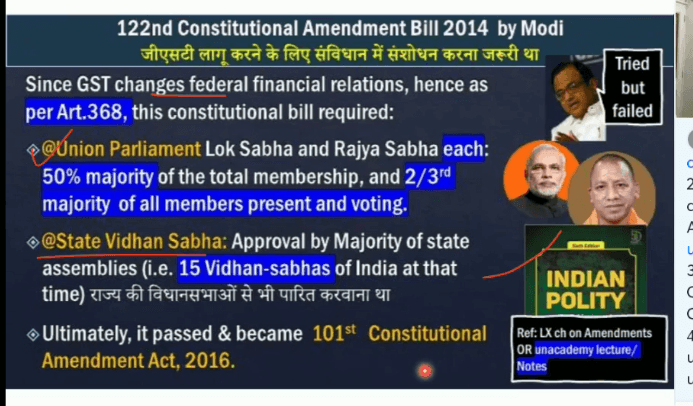
| 2014-2016 | 122nd Amendment Bill introduced and passed. 🗳️ |
| 2017 (July 1) | GST Launch: Combined Union & State taxes with full ITC. 🚀 |
22.8.. 101st Constitutional Amendment Act, 2016 🏛️📜
This Act changed the fundamental power of the Centre and States to tax:
- Art 246-A: Gives Dual Power to both Centre and States to tax goods and services. (Earlier, Centre taxed services, States taxed goods). ⚖️
- Art 269-A: IGST (Inter-state) will be collected by the Union but shared with States. 🍕
- Art 279-A: President to constitute the GST Council. 🏢
- Art 366: Defines GST; explicitly excludes Alcoholic Liquor for human consumption. 🍷🚫
- Art 268-A: Service Tax article was deleted. 💨
22.9 GST Council: Composition & Voting 🗳️👨💼
👥 Composition (33 Members):
- Union Finance Minister: Chairperson. 👩💼
- Union Minister of State (Finance/Revenue): Member.
- State Finance Ministers: 31 members (28 States + 3 UTs with legislature: Delhi, Puducherry, J&K). 🏙️
🗳️ Voting Power & Quorum:
- Quorum: 50% of total members must be present. ✋
- Union Vote: 1/3rd weightage.
- States' Vote: 2/3rd weightage.
- Decision Rule: To pass a proposal, a 3/4th Majority (75%) is required. 📈
- Result: Neither the Union nor the States can pass a decision alone. They must work together! 🤝
⚖️ 22.9.2 Binding Nature:
- SC Ruling (2022): The Supreme Court clarified that GST Council decisions are NOT binding on States. They are only "persuasive recommendations." ✋🏛️
22.10 GST Input Tax Credit (ITC) 🔄
- Concept: While paying the final tax, a businessman can subtract the tax he already paid on his raw materials/inputs.
- Destination Based: GST is collected in the state where the Final Consumption happens. 📍🏘️
↩️ 22.10.1 Inverted Duty Structure (IDS)
- The Problem: When Tax on Inputs > Tax on Final Product.
- Example: Fabric (Input) is taxed at 18%, but the finished Shirt (Output) is taxed at 5%. 👕🧵
- The Result: The businessman accumulates excess tax credit. He asks the Govt for a refund.
- The Pain: It causes "Administrative & Accounting inconvenience" and gets the businessman's capital stuck. 🐢💸
- Fix: In GST 2.0 (2025), the Govt is trying to reduce input rates (e.g., fiber cut from 18% to 5%) to solve this. ✅
📥 SUBSUMPTION & SERVICE RATES (22.11 – 22.13)
22.11 Centre’s Indirect Taxes Subsumed in CGST 🏛️📥
The following Union taxes were merged into CGST:
- Central Excise Duty: On manufacturing. 🏭
- Service Tax: On providing services. 📡
- Central Sales Tax (CST): On inter-state trade (assigned to Origin state).
- Excise on Medical & Toilet Preparations: Containing alcohol (e.g., cough syrup, perfumes). 🧴💊
- kerosene , naphtha and lpg
🚫 What is still OUTSIDE GST (Union)?
- Direct Taxes: Income Tax, Corporation Tax. 👤🏢
- Customs Duty: On Imports/Exports. ⚓
- 5 Hydrocarbons: Petrol, Diesel, Crude Oil, Natural Gas, ATF. ⛽
- Tobacco Products: Replaced by GST BUT Union can also levy NCCD (National Calamity Contingent Duty). 🚬
- Note: NCCD money goes to the National Disaster Response Fund. 🆘
22.12 States’ Indirect Taxes Subsumed in SGST 🏙️📥
The following State taxes were merged into SGST:
- State VAT / Sales Tax. 🛍️
- Luxury Tax: Hotels, Spas. ⛱️
- Entry Tax / Octroi. 🚛
- Entertainment Tax: (Unless levied by local bodies). 🎬
- Taxes on Lottery, Betting & Gambling. 🎰
- Purchase Tax: On animals, boats, and vehicles. 🐎🚢
🚫 What is still OUTSIDE GST (State)?
- Direct Taxes: Property Tax, Professional Tax, Land Revenue. 🏠
- Alcohol for Human Consumption: State Excise + State VAT. 🍷
- 5 Hydrocarbons: State VAT. ⛽
- Electricity Duty. 💡
- Road Tax on vehicles. 🚗
🧪 22.12.1 SC Ruling: Industrial Alcohol (2024)
- Definition: Ethanol treated with chemicals to make it poisonous (denatured). Used in cosmetics/pharma. 🧴
- SC Verdict: States CAN regulate and tax industrial alcohol. ⚖️
- Reason: To prevent illegal diversion into drinkable liquor that causes deaths. 🥃🚫
🍷 22.12.2 Extra Neutral Alcohol (ENA)
- Used as raw material for liquor.
- Clarification: GST Council ceded the right to States to tax ENA used for making liquor for human consumption. 🤝🍷
📊 22.12.3 Tax Collection Hierarchy (Budget-2026)
From Highest to Lowest revenue earners for the Govt:
Income Tax > Corporation Tax > GST > Excise Duty > Customs Duty 📈
22.13 🚫 Services with 0% GST (Exempt/Nil Rated/Zero Rated)**
The government provides a wide list of services that attract 0% GST to ensure the affordability of essential services and social security.
- Public Services 🏛️: Services by Union/State Govts, local bodies, and constitutional bodies. Exceptions: Premium post services (Speed Post) and Railways (1st Class/AC).
- Finance & Social Security 🛡️:
- Services by RBI and other financial regulators.
- Banking/Insurance under Govt sponsored schemes (financial inclusion).
- ESIC and EPFO services for subscribers.
- Education 🎓: Services by Schools, Colleges, Universities, and Vocational Institutes.
- ⚠️ Note: COACHING INSTITUTES are NOT exempt; they are taxed at 18%.
- Healthcare 🩺: Services by Doctors, para-medics, Ambulances, and Blood Banks.
- Agriculture 🌾:
- Warehousing, cold storage, and renting of Agro-machinery.
- APMC services and farm labor supply.
- Pre-processing of food (ripening, waxing, packing) that doesn't change essential characteristics.
- Residential & Social 🏠:
- Rent on residential accommodation.
- Public libraries, toilets, crematoriums, and burial grounds.
- Strategic & Export 🚀:
- ISRO/Antrix/NSIL satellite launch services (Exempted since 2020).
- Any service EXPORTED outside India (Technically "Zero Rated Export").
- GST 2.0 Update (2025) ✨: Individual life and health insurance policy (previously 18%) reduced to 0%.
🏠 22.13.1: GST on Renting Services**
The taxability of rent depends strictly on the nature of use:
| Category | GST Rate (GST 1.0) | GST Rate (GST 2.0 / 2025) |
|---|---|---|
| Residential Home | 0% | 0% |
| Hostel / PG (Paying Guest) | 12% | 0% (if up to ₹20,000) |
| Commercial Office/Shop | 18% | 18% |
⚖️ 22.13.2: GST on Actionable Claims
An Actionable Claim is a legal right to demand/recover money, goods, or services (e.g., bank loans, insurance policies, rent).
- The Rule: Actionable claims are generally subject to GST, but the principal amount is often not taxed.
- Example: For a ₹10 Lakh bank loan:
- The ₹10 Lakh limit = No GST.
- Application Fee (₹500) = 18% GST.
- Late fees/Penalties = 18% GST.

. 🎰 22.13.3 - 22.13.5: Online Gaming, Casino & Lottery
This has been one of the most controversial sections in GST history involving heavy litigation.
⚔️ The Debate: Owners vs. GST Council
- Owners' Demand: Argued that "Game of Skill" (like Rummy/Chess) should be 18% and only "Game of Luck" (Dice/Roulette) should be 28%. They also wanted GST only on the "Platform Fee," not the total bet.
- GST Council Decision: Rejected. The council decided that there is no distinction between skill and luck for tax purposes. Everything is taxed equally.
📊 The Calculation Method (Full Bet Value)
The tax is levied on the Gross Revenue (Full Bet Value), not just the commission.
- Example: If you bet ₹100 (₹80 bet + ₹20 platform fee):
- GST is calculated on the entire ₹100.
📈 Rate Evolution
- GST 1.0 (2017-2025): 28% GST.
- GST 2.0 (Effective Sept 2025): Increased to 40% (Demerit Slab) 🚩.
- ⚠️ Double Hit: Players must pay GST on the entry bet AND 30% TDS (Income Tax) on the winnings.
💡 Pro Tip for Exam: Remember that Actionable Claims like Lottery and Betting are taxed on the Face Value, whereas for general financial services (like loans), only the Service Fee is taxed. ✍️✨
22.14: GST Rates on Goods (The 0% "Essentials" List) 🥛🍎
This section covers items that are exempted or nil-rated to keep basic survival affordable.
✨ What is at 0% GST?
- Dairy & Fresh Produce: Fresh milk, Pasteurized milk, and (in GST 2.0) UHT milk 🥛. Also unbranded eggs, meat, honey, fresh fruits, and veggies 🍏🥩.
- The "Plate" Essentials: Bread (unless in a restaurant), Salt, and Chapati/Roti/Paratha (moved from 5% to 0% in GST 2.0) 🫓.
- Spiritual & Cultural: Prasadam, Puja Samagri (Rudraksha, Panchamrit), Gandhi topi, National Flag, and Clay idols 🚩🪔.
- Health & Hygiene: Human blood 🩸, contraceptives, hearing aids, and sanitary napkins 🩹.
- Education & Trade: Printed books (physical), Khadi sold via KVIC, and Spacecraft/Satellites 📚🚀.
⚠️ The 2022 "Pre-packed" Twist 📦
- Before 2022: Cereals (wheat, rice), curd, and lassi were 0%.
- From 2022: They attract 5% GST if they are:
- Pre-packed ✅
- Labeled ✅
- Small Quantity (< 25kg or 25 Litres) ✅
- Logic: Big sacks sold loose stay at 0% for the poor, but branded retail packs are taxed.
22.15: GST 2.0 – The Big 2025 Transformation 🆙🚀**
Started in 2017 with 4 slabs (5, 12, 18, 28), GST was rationalized in September 2025.
📊 The New GST 2.0 Slabs:
- 5% (Merit Rate): For items that benefit society 😇.
- 18% (Standard Rate): For most items 🛒.
- 40% (Demerit/Sin Rate): For luxury or harmful items 🚩.
👹 The 40% "Demerit" Slab (Hiked from 28%):
- Events: IPL tickets 🏏.
- Habits: Betting, Casinos, Tobacco, Pan Masala, and Aerated soft drinks (Pepsi/RedBull) 🥤🚬.
- Luxury/Safety: Revolvers, Pistols, Luxury cars, and Heavy bikes (>350cc) 🔫🏎️.
- Vessels: Yachts and private aircraft 🛥️.
✅ GST 2.0 "Wins" (Positives):
- Healthy Eating: Paneer moved from 5% ➡️ 0% 🧀.
- Affordable Housing: Cement moved from 28% ➡️ 18% 🏗️.
- Cheaper Tech: Renewable energy devices and small cars/bikes moved to 18% (Cess removed!) 🔋🚗.
- Fertilizers: Input taxes reduced to 5%, unlocking stuck capital for the industry 🌾.
- Social Security: Life & Health insurance reduced from 18% ➡️ 0% 🛡️.
22.16: GST 2.0 – The "Ouch" (Negatives & Challenges) ⚠️🧐
1. The Insurance Catch ⚰️
- While Health Insurance is now 0% for you, the companies lose Input Tax Credit (ITC).
- Because they can't claim back taxes paid on their own expenses, they might not reduce your premium as much as expected 💸.
2. Inverted Duty Structure ↩️
- In some industries (like Tractors or Edible Oil), the tax on Inputs (raw materials) is 18%, but the Output is 5%.
- The government "owes" companies a refund, but delays keep the industry's money stuck ⏳💰.
3. The "Bidi" Paradox 🚬
- Controversy: Bidi rates were reduced from 28% ➡️ 18%.
- Critics argue this makes a harmful product cheaper, potentially increasing cancer cases 📉🏥.
4. Delivery App Confusion 🍕
- Confusion remains on Swiggy/Zomato deliveries. Apps argue delivery boys aren't "employees," leading to tax calculation headaches (18% GST on the service) 🛵.
5. The Huge Bill 🧾
- The government faces a ₹48,000 crore revenue loss due to these rate cuts. It is unclear how the Union will compensate the States for this "Revenue Foregone" 📉💸.
💡 Key Summary: GST 2.0 is a "People’s Reform" aiming for a $5 Trillion economy, but it faces challenges in revenue management and industry-specific tax loops! 🇮🇳✨✨
22.17: VIMAL (Pan Masala) New Taxes (From Feb 2026) 🍃💰**
- The Problem: The "GST Compensation Cess" ends in Feb 2026. Without it, harmful items like Pan Masala would become cheaper (bad for health!) 📉🏥.
- The Solution: The Govt passed two new laws in 2025 to keep prices high:
- Central Excise Duty: Heavy rates (up to ₹11,000 per 1000 sticks) 🚬.
- Health-Security Cess: Tax based on machine capacity (e.g., ₹1.01 Cr/month if speed is 500 pouches/min) ⚙️.
- Sharing: Excise is shared with states (41% formula); Cess is not divisible, but the Union may give it as grants for health schemes 🤝.
22.18: GST Composition Scheme ⏰🏷️**
- Concept: A simplified relief scheme for small traders.
- Mechanism: Instead of monthly filings, they deposit GST every 3 months 🗓️.
- Trade-off: They pay a lower tax rate but cannot claim Input Tax Credit (ITC) 🚫💳.
22.19: Reverse Charge Mechanism (RCM) ↩️👤**
- Standard Rule: Seller collects tax from the buyer and gives it to the Govt.
- RCM Rule: The Buyer directly deposits the GST to the government.
- When? Usually when a registered buyer purchases from an unregistered seller (who doesn't have a GSTIN) 🏗️.
22.20: E-way Bill & E-Invoice 🚚📄**
- E-way Bill (2018): Required for moving goods worth >₹50,000 (within or between states). It reduces check-post harassment and bribery ✋🛑.
- E-Invoice (2022): Digital bills generated through the govt portal.
- Benefit: Info is embedded in the E-way bill automatically. It fights fake ITC claims and tax evasion 🕵️♂️❌.
22.21 & 22.22: Compensation to States & Loans 🤝📉**
- Why? GST is "Destination-based." Producing states (like Gujarat/Maharashtra) feared they would lose revenue compared to the old VAT system 🏭➡️🏘️.
- The Guarantee: The Union promised states a 14% annual growth in revenue for the first 5 years.
- The "Act of God" Crisis: During Corona, revenue crashed. The Union couldn't pay the states 🦠📉.
- Back-to-Back Loans: The Union borrowed money from the market and gave it to States as a loan.
- Extension: The Compensation Cess was extended until Feb 2026 specifically to repay these loans ⏳💰.
22.23: GST Related Organizations 🕵️♂️🏢**
- GoM (Group of Ministers): Small committees set up by the GST Council to study specific issues (e.g., tax on vaccines) 👥.
- GST FITMAT COMMITTEE.
- NAA (Anti-Profiteering): Established to ensure companies pass tax cuts to customers. Abolished in 2022; duties moved to the Competition Commission of India (CCI) ⚖️.
- GSTAT (2023): The GST Appellate Tribunal. A common forum to resolve disputes between Centre and States, reducing the burden on High Courts 🏛️.
- GSTN (GST Network): The IT backbone. It’s a not-for-profit company (managed by Infosys) that runs the portal where you file returns and claim ITC 💻🌐.
- Project Saksham: Digital integration of various tax portals (ACES, SWIFT, GSTN) 🔌.
- AUTHORITY OF ADVANCE RULING:
22.24: PAN vs. GSTIN vs. Aadhaar 💳🆔**
| Feature | PAN (Income Tax) | GSTIN (Indirect Tax) | Aadhaar (UID) |
|---|---|---|---|
| Format | 10-digit Alphanumeric | 15-digit (State Code + PAN + 3) | 12-digit Numeric |
| Who? | Income tax payers | Registered Businesses | Resident Humans Only 👤 |
| Objective | Prevent IT evasion | Prevent GST evasion | Eliminate bogus beneficiaries |
- PAN 2.0 (2024 Reform): A single portal for all services, QR-code enabled cards, and digital/paperless applications 📱✨.
❓ PREVIOUS YEAR QUESTIONS (PQYs)
Q1. Which of the following are direct tax in India? [UPSC-CDS-2013-I]
- Corporation tax
- Tax on income
- Wealth tax
- Customs duty
- Excise duty Codes: (a) 1, 2 and 3 (b) 1, 2, 4 and 5 (c) 2 and 3 (d) 1, 3, 4 and 5
Q2. Which one of the following statements regarding GST is not correct? [CDS-2024-1] (a) Amendment bill 115 to the Constitution of India kept alcohol for human use and five petroleum products outside the ambit of GST. (b) Amendment bill 122 kept only alcohol for human use outside the ambit of GST. (c) Precious metals are taxed at a rate of 1% under GST. (d) Unworked diamond is taxed at a rate of 0.25%
Q3. Consider the following items: [Asked in UPSC-Pre-2018]
- Cereal grains hulled
- Chicken eggs cooked
- Fish processed and canned
- Newspapers containing advertising material Which of the above items is/are exempted under GST (Good and Services Tax)? (a) 1 only (b) 2 and 3 only (c) 1, 2 and 4 only (d) 1, 2, 3 and 4
Q4. Regarding the taxation of Tobacco in India, which of the following is correct? (a) It is completely exempted from GST. (b) It is subjected to both GST and the National Calamity Contingent Duty (NCCD). (c) Only State Governments have the power to tax tobacco products. (d) The revenue from tobacco taxes is shared with States through the Finance Commission.
Q5. According to the 2024 Supreme Court ruling, which level of government has the power to tax and regulate "Industrial Alcohol"? (a) Only the Union Government (b) Only the State Government (c) Both Union and State Governments (d) Only the GST Council
Q6. Which of the following services is subjected to an 18% GST rate? (a) Services by
❓ PREVIOUS YEAR QUESTIONS (PQYs)
Q1. Which of the following are direct tax in India? [UPSC-CDS-2013-I]
- Corporation tax
- Tax on income
- Wealth tax
- Customs duty
- Excise duty Codes: (a) 1, 2 and 3 (b) 1, 2, 4 and 5 (c) 2 and 3 (d) 1, 3, 4 and 5
Q2. Which of the following statements regarding GST is NOT correct? [CDS-2024-1] (a) Amendment bill 115 to the Constitution of India kept alcohol for human use and five petroleum products outside the ambit of GST. (b) Amendment bill 122 kept only alcohol for human use outside the ambit of GST. (c) Precious metals are taxed at a rate of 1% under GST. (d) Unworked diamond is taxed at a rate of 0.25%
Q3. To pass a proposal in the GST Council, what is the minimum percentage of weighted votes required? (a) 50% (b) 66.6% (c) 75% (d) 100%
Q4. The "Inverted Duty Structure" in GST refers to a situation where: (a) Exports are taxed at a higher rate than imports. (b) Tax on finished products is higher than the tax on raw materials. (c) Tax on raw materials/inputs is higher than the tax on finished products. (d) Direct taxes are higher than indirect taxes in the Union Budget.
Q5. Article 279-A of the Indian Constitution is associated with: (a) The Finance Commission (b) The GST Council (c) The Consolidated Fund of India (d) The National Commission for Backward Classes
Q6. Which document is required for the movement of goods worth more than ₹50,000 within or across state boundaries under GST? (a) GSTR-1 (b) E-Invoice (c) E-way Bill (d) Delivery Challan
❓ Previous Year Questions (PYQs)
Q1. Burden of a tax on a commodity depends on: (CAPF-2024)
- Who (buyer or seller) it is explicitly imposed upon.
- The slope of the demand and supply curves. Codes: (a) 1 only (b) 2 only (c) Both 1 and 2 (d) Neither 1 nor 2
Q2. Which of the following are direct tax in India? (UPSC-CDS-2013)
- Corporation tax
- Tax on income
- Wealth tax
- Customs duty
- Excise duty Codes: (a) 1, 2 and 3 (b) 1, 2, 4 and 5 (c) 2 and 3 (d) 1, 3, 4 and 5
Q3. Which of the following components of Central Government taxes on petroleum products is/are not shareable with the States? (CDS-2024)
- Basic Excise Duty
- Additional Excise Duty
- Special Additional Excise Duty Codes: (a) 1 and 2 only (b) 1, 2 and 3 (c) 3 only (d) 2 and 3 only
Q4. Consider the following items: (UPSC-Pre-2018)
- Cereal grains hulled
- Chicken eggs cooked
- Fish processed and canned
- Newspapers containing advertising material Which of the above items is/are exempted under GST? (a) 1 only (b) 2 and 3 only (c) 1, 2 and 4 only (d) 1, 2, 3 and 4
Q5. What are the most likely advantages of implementing GST? (UPSC-Pre-2017)
- It will replace multiple taxes collected by multiple authorities thus create a single market in India.
- It will drastically reduce ‘Current Account Deficit’ of India and will enable it to increase its foreign exchange reserves.
- It will enormously increase the growth and size of Indian economy of India & will enable it to overtake China in the near future. Codes: (a) 1 only (b) 2 and 3 only (c) 1 and 3 only (d) 1, 2 and 3
Q6. Which one of the following statements regarding GST is not correct? (CDS-2024) (a) Amendment bill 115 to the Constitution of India kept alcohol for human use and five petroleum products outside the ambit of GST. (b) Amendment bill 122 kept only alcohol for human use outside the ambit of GST. (c) Precious metals are taxed at a rate of 1% under GST. (d) Unworked diamond is taxed at a rate of 0.25%
