4 A1 Agriculture Input
4 A1 Agriculture Input
📑 Table of Contents
- 40. Agriculture - Introduction & Statistics 📊
- 40.2. Cooperative Societies & New Ministry 🤝
- 40.3. Agri-Input: Land 🗺️
- 40.4. Agri-Input: Seeds 🌱
- 40.5 - 40.6. Agri-Input: Water (Irrigation) 💧
- 40.7. Agri-Input: Fertilizer 🧪
- 40.8 - 40.10. Pesticides, Organic & Natural Farming 🌿
- 40.11. Agri-Input: Farm Mechanization 🚜
- 40.12. Agri-Input: Finance & Credit 💳
- 40.13 - 40.14. Agri-Output & Budget Announcements 📣
- Practice Questions (PYQs & MCQs) ✍️
1. 🌾 Agriculture - Introduction & Statistics (Section 40)
- Definition: A primary economic activity including crops, fruits, vegetables, flowers, and livestock.
- Production Hierarchy (Value-wise): Crops > Livestock > Forestry > Fishing. 🐟
- Economic Model: Sir Arthur Lewis’ Dual Economy Model suggests that as an economy develops, labor moves from agriculture to more productive industrial sectors.
- India’s Global Standing (Data from Economic Survey):
- 🥛 Milk: #1 Producer (20% of world supply).
- 🌻 Vegetable Oil: #1 Importer.
- 🍭 Sugar: #2 Producer, #1 Consumer.
- 🧅 Onions: #1 Producer of dry onions.
- 🐟 Fisheries: #2 Producer.
- Workforce Reality: Agriculture contributes ~20% to National Income but employs 46% of the workforce (low productivity per worker).
- Ministry Structure:
- Ministry of Agriculture and Farmers Welfare: Divided into Dept. of Agriculture & Farmers Welfare and Dept. of Agricultural Research & Education (DARE).
- Ministry for Fisheries, Animal Husbandry and Dairying: Created in 2019.
🤝 40.2 Cooperative Societies & New Ministry
1. Meaning & Definition
- Definition: A voluntary association of persons who join together for the mutual welfare of members and to prevent exploitation by middlemen (दलाल).
- Historical Example: In 1946, farmers in the Kheda region (Gujarat) were exploited by milk middlemen. Following Sardar Vallabhbhai Patel's advice, they formed a cooperative which eventually evolved into AMUL (Anand Milk Union Limited). 🥛
- Scale: There are ~8.5 lakh registered cooperatives in India with over 29 crore members.
2. Key Features & Benefits
- Voluntary Membership: Anyone can join or leave at any time.
- Legal Status: Must be registered (minimum 10 persons). It is a "separate artificial legal person" that can enter contracts and hold property.
- Stability: The death or insanity of a member does not end the society (Perpetual Succession).
- Equal Voting: "One person, one vote" regardless of how much capital they contributed. 🗳️
- Service Motive: Not driven by profit but by welfare.
- Government Support: Enjoys low taxes and subsidized interest rates on loans.
3. Types of Cooperative Societies
- Consumer’s: Buys in bulk from factories to sell cheaply to members.
- Producer’s: Small producers buy raw materials together (e.g., AMUL).
- Farmer’s: Members share seeds, fertilizers, and machinery to tackle land fragmentation.
- Marketing: Helps small producers sell products (e.g., TRIFED - Tribal Co-operative Marketing Development Federation of India).
- Credit: Provides loans at affordable rates to members. 💰
- Housing: Helps members build or buy houses by pooling land and loans.
4. The New "Ministry of Cooperation" (July 2021) 🏛️
- Before: Administrative and policy framework was under the Ministry of Agriculture and Farmers Welfare.
- After: A separate Union Ministry of Cooperation was formed (Minister: Amit Shah).
- Goal: To streamline the legal framework for cooperatives, including sugar mills, banks, and dairies.
5. Constitutional & Legal Framework
- 97th Constitutional Amendment Act (2011):
- Added Article 19: Right to form cooperatives is a Fundamental Right.
- Added Article 43B: DPSP (Directive Principle of State Policy) to promote cooperatives.
- Added Part IX-B: Specific articles (243-ZH to 243-ZT) for cooperatives.
- Multi-State Cooperative Societies Act (MSCS) 2002: Governs societies operating in more than one state.
- 2022 Amendment Bill: Aimed to set up a Co-operative Election Authority and an Ombudsman for member complaints.
6. New Entities (2022-2023)
- NCEL (National Cooperative Export Limited): Aims to give at least 50% of export profits directly to farmers. 🚢
- National Turmeric Board (2025): Headquartered in Nizamabad, Telangana, under the Ministry of Commerce. Turmeric is known as the "Golden Spice." ✨
🗺️ 40.3 Agri-Input: Land (जमीन)
1. The Challenge of Land 📉
- Scarcity: India has >17% of the world's population but only 2.5% of the world's land.
- Fragmentation: Land is divided among heirs every generation, leading to smaller farms.
- Data: Average farm size reduced from 0.725 hectares (2003) to 0.512 hectares (2019). 86% of farmers are "Small & Marginal" (<2 hectares).
- Impact: Small farms cannot use big machinery, which lowers productivity.
- Solution: Land Consolidation (भूमि एकत्रीकरण) — encouraging small farmers to join service sector jobs and selling land to larger farm owners.
2. Land Reforms After Independence
- Zamindari Abolition: Removing middlemen between the state and the farmer.
- Ceiling on Landholding: Fixing a maximum size of land an individual can own.
- Tenancy Reforms: Protecting Tenant Farmers (जोतदार किसान) from illegal eviction.
- Forest Rights Act (2006): Gives land titles (Patta) to forest dwellers if they cultivated the land for 75 years. 🌳
- Model Agriculture Land Leasing Act (2016): A Union-circulated template to help tenants get bank loans using lease agreements.
3. NLRMP: National Land Records Modernization Programme 💻
- Boss: Department of Land Resources under the Ministry of Rural Development.
- Funding: 100% Central Sector Scheme (Union pays everything).
- ULPIN (Unique Land Parcel Identification Number): Think of this as "Aadhaar for Land."
- Digital Maps: Digitization of Cadastral Maps (maps showing boundaries and ownership).
4. Types of Farming Models
- Cooperative Farming: Farmer retains ownership of land but performs farming activities collectively. (Better Output) ✅
- Collective Farming: Social/State ownership of land and livestock (e.g., Kolkhoz model in USSR). Workers became demotivated because they didn't own the land. ❌
- Small Farmer Large Field (SFLF): A pilot project by IRRI (International Rice Research Institute) in Odisha. Small farmers group together to synchronize seeds and selling for better bargaining power.
- Truck Farming (Market Gardening): Small-scale farming of fruits/vegetables/flowers near urban areas.
- Etymology: "Truck" comes from the French word "troquer" (to barter/exchange).
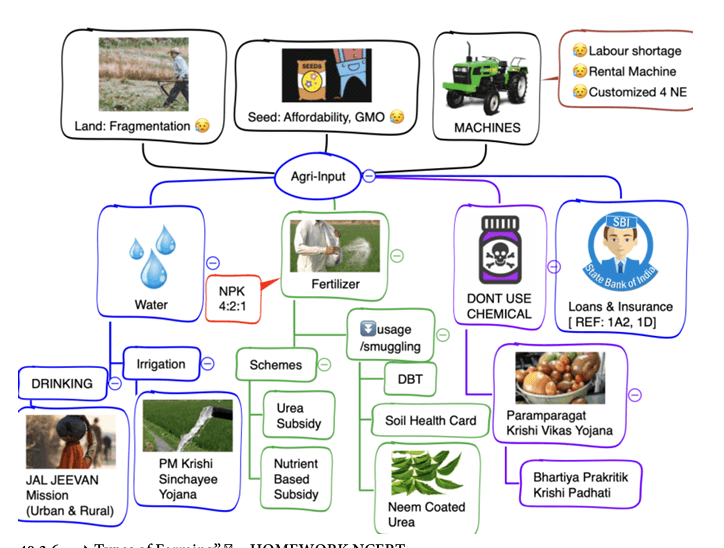
🌱 40.4 Agri-Input: Seeds (बीज)
1. Introduction: The Foundation of Yield
- Yield Definition: The amount of crop produced in a given acre of land.
- Seed Replacement Rate (SRR): For the best yield, Hybrid seeds must be replaced every year, and Non-hybrid seeds every three years.
- Government Policy: India has a low Seed Replacement Rate due to high costs. Therefore, the government allows 100% FDI (Foreign Direct Investment) via the automatic route in seed development. 💰
2. Key Seed Concepts
- Seed Village Concept: A group of farmers in a village are trained to produce seeds of various crops to fulfill the demand of their own and neighboring villages. 🏘️
- Seed Bank / Seed Vault: A depository to preserve genetic diversity and supply seeds during natural calamities.
- Global Seed Vault: Located in Svalbard, Norway (Arctic region). ❄️
- SATHI Portal: Stands for Seed Authentication, Traceability & Holistic Inventory Portal. It is a centralized online system by the Ministry of Agriculture to ensure farmers get quality seeds. 🛡️
3. The Green Revolution & Biofortification
- Green Revolution: Started in the mid-1960s using HYV (High Yielding Variety) hybrid seeds.
- Phase 1: Focused on Wheat and Rice in affluent states like Punjab and Haryana.
- Phase 2: Expanded to more states and more crop varieties. 🌾
- Biofortification: The process of increasing the nutritional quality of food crops.
- CR Dhan 310: A rice variety with higher Protein and Zinc.
- Golden Rice: Developed to provide Vitamin A. 🍚
4. Hybrid vs. Landraces
- Hybrid Crops: Created artificially by scientists in laboratories.
- Landraces: Naturally occurring variants of commonly cultivated crops. They are climate-resilient and often contain better quality nutrients. 🌿
5. Intellectual Property Rights (IPR) & "Pepsi vs. Farmers"
- Indian Patents Act 1970: Does NOT give patents for seeds/plant varieties.
- PPV&FR Act 2001: Stands for Protection of Plant Varieties and Farmers' Rights Act. It grants IPR (Intellectual Property Rights) to breeders and researchers.
- The Case: Pepsi sued Gujarat farmers for growing their FC5 potato variety (used for Lays) after the contract expired. Pepsi later withdrew the case, and the government canceled the registration of the variety. 🥔🚫
6. Genetically Modified (GM) Crops
- Definition: Transgenic seeds developed by transferring selected genes from one organism to another (e.g., Soil bacteria genes into Cotton).
- Regulation: The GEAC (Genetic Engineering Appraisal Committee) under the Ministry of Environment recommends approval, but the Ministry gives the final permission.
- Status in India:
- Bt Cotton: The only GM crop (non-food) allowed for cultivation in India since 2002. 🧶
- GM Mustard: Approved by GEAC in 2022, but currently pending full clarity from the Environment Ministry.
- Terminator Gene Technology: Seeds that produce sterile offspring (farmer must buy new seeds every season). This is NOT allowed in India. 🚫🧬
💧 40.5 Agri-Input: Water (Irrigation: सिंचाई)
1. The Challenges of Water in India
- Resource Disparity: India has >17% of the world's population but only 4% of world's water resources. 🌍
- Rain Dependency: Over 50% of Indian agriculture depends on rainfall. Events like El-Nino lead to droughts and food inflation.
- Groundwater Use: India is the world leader in groundwater irrigation area (39 million hectares), followed by China and the USA.
2. Irrigation Water Productivity
- Definition: The ratio of crop output to the irrigation water applied.
- The Efficiency Gap:
- To produce 1 kg of rice, Indian farmers use 3,000–5,000 liters of water.
- Chinese farmers produce the same amount using only 350 liters. 😲
- Policy Issues: Highly subsidized electricity and MSP (Minimum Support Price) encourage farmers to grow water-intensive crops (Paddy, Sugarcane) even in water-stressed areas.
3. Future Outlook
- Water Insecurity: By 2050, India is expected to be a global hotspot for water scarcity.
- Doubling Income: To double farmer income, they must grow multiple crops annually, which is impossible without a stable water supply. 📉
4. Fertilizer-Water Synergy
- Urea-Gold: A new variety of Urea coated with Sulphur. It minimizes wastage and improves nutrient uptake.
- Fertigation: Adding liquid fertilizer directly into the irrigation water (via drip systems) to optimize application. 💉💧
Based on the handout provided, here are the detailed notes for Section 40.6: Jal Shakti Ministry & Water Schemes.
️♂️ ☔ 40.6 [Yearbook] Jal Shakti Ministry
The Ministry of Jal Shakti was formed by merging two existing departments to manage India's water resources holistically.
1. Structure of the Ministry
The Ministry consists of two primary departments:
- Department of Water Resources, River Development and Ganga Rejuvenation.
- Department of Drinking Water and Sanitation.
A. Department of Water Resources, River Development & Ganga Rejuvenation (40.6.1)
- Attached/Subordinate Offices:
- CWC (Central Water Commission): National Water Academy, Pune.
- GFCC (Ganga Flood Control Commission).
- Bansagar Control Board (for the Son River).
- CWPRS (Central Water and Power Research Station).
- Statutory Bodies (Created by Law):
- Betwa River Board and Brahmaputra Board.
- Water Dispute Tribunals: Under the ISWA (Inter-State Water Disputes Act), 1956.
- CGWA (Central Ground Water Authority): Formed under the EPA (Environment Protection Act), 1986.
- National Ganga Council: Chaired by the Prime Minister (replaced the NGRBA).
- Government Companies: WAPCOS (Water and Power Consultancy Services Ltd) and NPCC (National Projects Construction Corporation Ltd).
- Autonomous Bodies: National Institute of Hydrology, Krishna River Management Board, and Godavari River Management Board.
2. Major Water Schemes (40.6.2 - 40.6.11)
🚿 JJM (Jal Jeevan Mission) - Rural & Urban
- Rural (2019): Objective is "Har Ghar Jal" (Piped water supply) to all rural households by 2024.
- Subsumed the older NRDWP (National Rural Drinking Water Programme).
- Focuses on rainwater harvesting, groundwater recharge, and reuse of household wastewater.
- Urban (2021): To provide FHTC (Functional Household Tap Connections) to houses in all 4378 ULB (Urban Local Bodies). 🏙️
🚜 PMKSY (Pradhan Mantri Krishi Sinchai Yojana) - 2015
Administered by the Jal Shakti Ministry with a 4-pillar strategy:
- AIBP (Accelerated Irrigation Benefit Programme): Faster completion of national projects.
- Har Khet ko Pani: Canal network distribution to every farm.
- Watershed Development: Managed by the Ministry of Rural Development.
- PDMC (Per Drop More Crop): Focused on micro-irrigation (drips/sprinklers).
- Note: PDMC was shifted under RKVY (Rashtriya Krishi Vikas Yojana) in 2022-23.
- Funding: CSS (Centrally Sponsored Scheme) with 60:40 or 90:10 cost-sharing.
- Subsidy: 55% for Small & Marginal farmers; 45% for others. 💰
💧 ATAL JAL (Atal Bhujal Yojana) - 2019
- Funding: 50:50 ratio between the Union Government and the World Bank.
- Coverage: Not for all of India; only for 7 states facing extreme shortages (Gujarat, Haryana, Karnataka, MP, Maharashtra, Rajasthan, UP).
- Mechanism: Community-led groundwater management through Panchayats and "Water User Associations."
🌊 Namami Gange Yojana (2015)
- Status: A Central Sector Scheme (100% funded by the Union).
- Goal: To make the Ganga pollution-free through sewage treatment plants and awareness.
🏗️ Miscellaneous Schemes (40.6.11)
- DRIP (Dam Rehabilitation and Improvement Program): Uses the DHARMA portal to monitor dam safety.
- National Hydrology Project (2016): Uses Remote Sensing for flood forecasting.
- CWMI (Composite Water Management Index): Released by NITI Aayog to rank states on water management.
3. Key Observations & Terminology (40.6.14)
- Current Reality: Only 55% of India's sown area gets irrigation; 2/3rd of land faces drought threats.
- Fertigation: Mixing water-soluble fertilizers into a drip system. 💉
- Mulching: Covering bare soil with straw/chips to reduce evaporation. 🪵
- Micro-irrigation Challenges: High cost of purchase and damage by wild animals (elephants, boar).
🧪 40.7 Agri-Input: Fertilizer
1. The Big Three & Production (N-P-K)
- Definitions: Manure is natural decomposition; Fertilizer is artificial chemical.
- Nitrogen (N) - Urea: Made via the Haber process. Requires importing Natural Gas (Methane: CH₄).
- Statutory Pricing: Ministry of Chemicals and Fertilizers fixes the MRP (Maximum Retail Price) using the ECA (Essential Commodities Act), 1955.
- Funding: 100% Central Sector Scheme (State pays nothing). 2022 price = ₹242 per 45 kg bag.
- Phosphorus (P): 80-85% imported. ISRO (Indian Space Research Organisation) uses remote sensing to find potential rock phosphate mines.
- Potash (K): 100% imported (33% from Russia & Belarus - affected by the 2022 war). Government is promoting PDM (Potash Derived from Molasses) as a byproduct of sugar mills.
2. The NPK Ratio & Urea Overuse (40.7.1)
- Ideal Ratio: 4 : 2 : 1 | Reality (FY24): 10.9 : 4.1 : 1 (Heavy Urea overuse due to low cost).
- Results of Overuse:
- Soil & groundwater pollution.
- Smuggling to chemical industries (for dyes, ink, synthetic milk).
- Smuggling to Bangladesh and Nepal.
- Higher fiscal deficit due to the subsidy burden.
3. Key Schemes & Reforms
- NBS (Nutrient Based Subsidy) - 2010 (40.7.2): 100% Union-funded. Subsidy is based on the weight of nutrients (N, P, K, S) to promote non-Urea fertilizers. Challenge: Urea is NOT covered, so overuse continues.
- SHC (Soil Health Card) - 2015 (40.7.3): Core Scheme (not 100% funded by Union). Tests soil for 12 parameters (Macronutrients: NPK; Micronutrients: Zn, Fe, Cu, Mn, Bo; Secondary: Sulphur; Physical: pH, Electrical Conductivity, Organic Carbon). Issued every 3 years.
- Soil Testing Machines (40.7.4): Bhu-Vision / Krishi-RASTAA tests 12 parameters in just 30 minutes!
- Neem Coating of Urea - 2015 (40.7.5): Mandatory. Prevents diversion to industries, slows dissolution (improves N-absorption and yield), and reduces pest attacks.
- DBT (Direct Benefit Transfer) - 2018 (40.7.6): Companies get subsidy only after the retailer sells to the farmer via PoS (Point of Sale) devices using Aadhaar/Kisan Credit Card for verification.
- Nano-Urea (40.7.8): Developed by IFFCO (Indian Farmers Fertiliser Cooperative). A 500 ml bottle (₹240) replaces a 90 kg bag of solid urea! 🧴
- Nano-DAP (40.7.9): High in Phosphorus. Launched by IFFCO in 2023 at ₹600 for 500 ml.
- PMKSK (Pradhan Mantri Kisan Samridhi Kendra) - 2022 (40.7.10): Converts retail shops into "One-Stop Shops" for seeds, fertilizers, and testing.
- One Nation One Fertiliser (PMBJP) (40.7.11): Stands for Pradhanmantri Bhartiya Janurvarak Pariyojna. Mandates a single brand name (BHARAT UREA, BHARAT DAP) and a uniform logo for companies receiving subsidies. Makes smuggling easy to spot.
- PM-PRANAM - Budget 2023 (40.7.12): To reduce chemical fertilizer use. If a state saves on the Union's fertilizer subsidy bill, the Union gives 50% of the saved money as a grant back to that state.
🐞 40.8 Agri-Input: Pesticides & Weedicides
- Definition: Chemicals used for killing or controlling pests and weeds respectively.
- The Problem: India loses ~25% of crops due to pests, weeds, and diseases. 📉
- Global Context: India's per-hectare pesticide consumption is significantly lower than the first world.
- Strategy: IPM (Integrated Pest Management):
- Aims for "economically tolerable" levels of pests rather than 100% eradication.
- Why? Pests are important for biodiversity protection and the food chain balance. 🕸️
- Safety: Raising awareness about Endosulfan to prevent contamination in food, water, and human bodies.
- Legislation: Pesticides Management Bill, 2020 was introduced to regulate trade, storage, and use of pesticides. 🛡️
☣️ 40.9 & 40.10 Agri-Inputs: PKVY & Organic/Natural Farming
1. Organic Farming (Section 40.9)
- Definition: Farming that avoids synthetic fertilizers and pesticides. It relies on:
- Crop rotation and residues.
- Manures (Cow dung, etc.). 🐄
- Biofertilizers and Biopesticides.
2. PKVY (Paramparagat Krishi Vikas Yojana) - 2015 (Section 40.10)
- Boss: Ministry of Agriculture and Farmers Welfare.
- Funding: CSS (Centrally Sponsored Scheme). It is NOT 100% paid by the Union (sharing ratio: 60:40 or 90:10).
- Mechanism: Farmers form a group of 50 (a cluster). Beneficiaries get ₹20,000 per acre for 3 years.
- Economic Benefits:
- Organic products command higher prices in developed countries → More exports → Lower CAD (Current Account Deficit).
- Lower fertilizer subsidy bill for the government → Lower Fiscal Deficit. 💰
- Certification: PGS (Participatory Guarantee Scheme) certifies that products are organic.
- Digital Tool: Jaivik Kheti webportal connects organic buyers and sellers.
- Success Story: Sikkim became the first 100% organic state in 2015. 🏔️
3. BPKP (Bhartiya Prakritik Krishi Padhati) - 2021
- Status: A sub-scheme of PKVY.
- Focus: Natural Farming using cow dung-urine manure and biomass recycling. It strictly excludes all synthetic chemical inputs.
- Financial Support: ₹12,200 per hectare every 3 years.
- Top States (by area): Andhra Pradesh (100k ha) and Madhya Pradesh (99k ha). 📈
4. ZBNF (Zero Budget Natural Farming) (40.10.1)
- Meaning: Farming without loans and without spending money on inputs (seeds/fertilizers).
- Pioneer: Practice started in Karnataka by Subhash Palekar.
- Key Techniques/Keywords:
- Jiwamrita: Microbial culture.
- Bijamrita: Seed treatment solution.
- Biopesticides: Agniastra, Brahmastra, and Neemastra (made from cow urine). 🐄
- Waaphasa: Providing water outside the plant's canopy.
- Budget 2022 Highlights: Chemical-free natural farming promoted in 5-km wide corridors along River Ganga. 🌊
5. Limitations & Challenges (40.10.2)
- Lower Yield: Production per acre is lower than chemical-based farming.
- Case Study (Sri Lanka): Forced a sudden shift to organic → Crop yield dropped → Food supply crashed → High Food Inflation → Economic crisis. 🇱🇰🚫
- Shelf Life: Organic produce often has a shorter shelf life and looks less "attractive" (color/texture) to consumers.
- Off-season crops: Extremely difficult to grow without chemical assistance.
6. Sustainability (40.10.4 - 40.10.5)
- Composite Index of Agricultural Sustainability: Developed by ICAR (Indian Council of Agricultural Research) using 51 indicators.
- India is "moderately sustainable" (Value: 0.49).
- Best States: Mizoram, Kerala. Worst: Rajasthan.
- 100 Million Farmers: A multistakeholder platform by the WEF (World Economic Forum) to transition to net-zero food systems by 2030. 🌍
Expanded Full Forms Used:
- PKVY: Paramparagat Krishi Vikas Yojana
- BPKP: Bhartiya Prakritik Krishi Padhati
- ZBNF: Zero Budget Natural Farming
- CAD: Current Account Deficit
- CSS: Centrally Sponsored Scheme
- PGS: Participatory Guarantee Scheme
- WEF: World Economic Forum
- ICAR: Indian Council of Agricultural Research
- SDG: Sustainable Development Goals
Here are the detailed notes for Section 40.11 (Agri-Input: Farm Mechanization) and Section 40.12 (Agri-Input: Finance/Credit) based on the handout.
🚜 40.11 Agri-Input: Farm Mechanization
1. Definition & Significance
- Definition: Increased usage of combine harvesters, tractors, reapers, and mechanical pickers.
- Significance:
- Increases productivity of land and labor (more work output per unit of time).
- Provides employment to rural youth in repair and maintenance. 🛠️
- Economic Context: After the MNREGA (Mahatma Gandhi National Rural Employment Guarantee Act) provided a wage floor, labor became scarce and expensive. Farmers in Punjab and Haryana shifted to machines to reduce costs.
2. Technological Progress Concepts
- Labour Augmenting: Allows each laborer to be more productive (e.g., James Hargreaves' Spinning Jenny).
- Capital Augmenting: Allows capital assets/machinery to be more productive (e.g., replacing wooden ploughs with steel ploughs). 🪵➡️⚔️
3. Challenges in India
- Production vs. Utilization: India is the largest tractor manufacturer (1/3rd of global production), but farm mechanization utilization is only 40% (compared to 95% in the USA and 75% in Brazil). 🚜📈
- Fragmented Land: Small farms cannot afford or use large machines.
- Solution: SMAM (Sub-Mission on Agricultural Mechanisation): Launched in 2017 under the Green Revolution - Krishonnati Yojana. It sets up renting centers for small farmers.
- FARMS App: Farm Machinery Solutions mobile app for renting equipment.
4. The Drone Revolution 🚁
- Kisan Drones: Used for crop assessment, digitization of land records, and spraying fertilizers/pesticides.
- Subsidies:
- Agri-graduates: 50% subsidy (up to ₹5 lakh).
- SC/ST/Women/Small Farmers: 50% subsidy.
- Namo Drone Didi: A sub-scheme of DAY-NRLM (Deendayal Antyodaya Yojana - National Rural Livelihoods Mission).
- Gives drones to 14,500 Women SHGs (Self Help Groups).
- Funding: Union pays 80%; SHG pays 20%.
- Provides a "package" (drone, battery, camera, training, and 1-year warranty).
💳 40.12 Agri-Input: Finance / Credit
1. The Debt Problem
- Indebtedness: Economic Survey 2016 found an inverse relation between land size and debt (Small/marginal farmers are more indebted). 📉
- Agri Loan Targets: Budget 2022 set the target at ₹18 Lakh Crore.
- Regional Gap: Central India has 30% of farmland but gets <15% of interest subvention benefits.
2. Key Lending Reforms
- PSL (Priority Sector Lending) Norms: Set by the RBI (Reserve Bank of India) to ensure banks lend a portion of their funds to agriculture.
- KCC (Kisan Credit Card): Over 7 crore users.
- MISS (Modified Interest Subvention Scheme):
- Standard loan at 9% interest.
- Govt help (2%) + Prompt repayment discount (3%) = Effective interest rate of 4%. 📉💸
- KRP (Kisan Rin Portal) - 2023: A digital portal by the Ministry of Agriculture to release subsidies faster to banks.
3. Warehousing & Distress Sales 🏢
- Distress Sale: When farmers sell crops at low prices immediately after harvest because they need money and have no storage.
- NWR (Negotiable Warehouse Receipts): Issued by WDRA (Warehousing Development and Regulatory Authority).
- Farmers store crops in registered warehouses.
- They get an NWR, which they can pledge at a bank for a loan or trade on e-NAM (Electronic National Agriculture Market).
- e-Kisan Upaj Nidhi (2024): Reduces the "Warehouse Security Deposit" for farmers from 3% to 1%.
4. Storage Infrastructure
- World’s Largest Grain Storage Programme: Managed by the Ministry of Cooperation via NCDC (National Cooperative Development Corporation).
- Goal: Reach 100% storage capacity by 2047.
- Mechanism: PACS (Primary Agricultural Credit Societies) build warehouses; FCI (Food Corporation of India) pays them rent.
- Flospan: Mobile Storage Units developed with the UN-WFP (United Nations - World Food Programme). 🚛📦
- Smart Warehouses: Use sensors to monitor temperature, humidity, and rodents
🔥 40.13 Agri-Output: Stubble Burning (पराली)
1. The Problem: Why do farmers burn crops?
- Timing: During Sept-October, farmers in Punjab, Haryana, and UP need to clear paddy (rice) stubble quickly to sow wheat for the next season. 🌾➡️🚜
- Result:
- Thick Smog: Major air pollution and PM 2.5 (Particulate Matter) in Delhi.
- Soil Damage: Loss of soil organic carbon and fertility.
- Legal: Under the NGT (National Green Tribunal), burning is a crime under Section 188 of the IPC (Indian Penal Code) and the Air Act 1981. ⚖️
2. Solutions & Technology 🛠️
- In-situ (On-site) Management:
- Machines: 'Happy Seeder', Rotary Slasher, and Zero Till Seed Drill help in wheat sowing without removing the paddy straw.
- Funding: Budget-2018 gave 100% funding to Punjab, Haryana, and Delhi for these machines.
- Ex-situ (Off-site) Management:
- Biomass Pellets: Budget 2022 announced using 5-7% biomass pellets in Thermal Power Plants. 🏭
- Biochar: Using residue as fuel for brick kilns and hotels.
- Crop Selection: Promote crops with lower Lignocellulosic content (like Potato or Soybean) as they create less pollution when residues are handled.
- Pollution Hierarchy (Highest to Lowest): Sugarcane > Maize > Cotton > Rice > Wheat. 📊
📢 40.14 Budget Announcements (2024 - 2026)
1. Budget 2024 Highlights
- Coop Societies: Vision of ‘Sahakar Se Samriddhi’. Computerisation of 63,000 PACS (Primary Agricultural Credit Societies). 💻
- PM-PRANAM: Stands for Programme for Restoration, Awareness, Nourishment and Amelioration of Mother Earth. Encourages states to use Nano Urea and organic fertilizers.
- Organic Farming: Training 1 crore farmers and setting up 10,000 Bhartiya Prakritik Kheti Bio-Input Resource Centres. 🌿
- Horticulture: Atmanirbhar Clean Plant Program for disease-free planting material. 🍎
- Agri Startup: Agriculture Accelerator Fund to encourage rural entrepreneurship.
- Shree Anna (Millets): Focus on Kuttu, Ramdana, Kangni, Kutki, Kodo, Cheena, and Sama. Funding for IIMR (Indian Institute of Millet Research), Hyderabad under ICAR (Indian Council of Agricultural Research). 🥣
2. Budget 2025 - Specific Projects 📍
- Makhana (Fox Nuts): A Makhana Board for Bihar. (Makhana got GI - Geographical Indication status in 2022).
- Infrastructure: Western Koshi Canal Project (Bihar) and Urea Plant at Namrup (Assam).
- PMDKY (Prime Minister Dhan-Dhaanya Krishi Yojana):
- Target: 100 backward districts.
- Funding: ₹24,000 crore over 6 years.
- Focus: Productivity, diversification, and post-harvest storage. Inspired by the ADP (Aspirational Districts Programme) of NITI Aayog. 🎯
3. Budget 2026 - Regional Focus 🗺️
- Coastal Areas: Focus on Sandalwood, Cocoa, Cashew, and Coconut (India is the #1 producer).
- North East (NE): Focus on Agar trees (used for perfumes and Agarbatti/incense). 🪵✨
- Hilly Regions: Focus on nuts like Almonds and Walnuts.
✍️ Final Practice Questions (PYQs)
Q1. The substitution of steel for wooden ploughs in agricultural production is an example of: (UPSC-Pre-2015) (a) labour-augmenting (b) capital-augmenting (c) capital-reducing (d) None of the above. Answer: (b)
Q2. Private investment in Indian agriculture is mostly on labour saving mechanization. This could be a response to: (UPSC-CDS-2015-II) (a) rising productivity of agricultural sector (b) rising inequality in agriculture (c) rising wages and tighter labour market (d) debt write-off by the Government Answer: (c)
Q3. Find correct statement(s) about chemical fertilizers in India (UPSC-Prelims-2020):
- Retail price of chemical fertilizers is market-driven and not administered by the Govt.
- Ammonia, an input of urea, is produced from natural gas.
- Sulphur, a raw material for phosphoric acid fertilizer, is a by-product of oil refineries. Answer: (b) 2 and 3 only.
Q4. Find wrong about Jal Jeevan Mission? (CAPF-2025) (a) It was established in the year 2016. (b) It aims to improve quality of life in rural areas. (c) It is to provide functional tap water connections to every rural household. Answer: (a) (It was established in 2019).
—🎓🌾
✍️ Practice Questions (PYQs & MCQs)
Q1. Why is there a decrease in per capita cultivated land in India? (UPSC-CDS-2012)
- Low per capita income.
- Rapid rate of increase of population.
- Practice of dividing land equally among the heirs.
- Use of traditional techniques of ploughing. Answer: (b) 2 and 3.
Q2. Which best describes the concept of 'Small Farmer Large Field'? (UPSC-Prelims-2023) (a) Resettlement of people uprooted by war. (b) Many marginal farmers in an area organize themselves into groups and synchronize selected agricultural operations. (c) Contract farming where land is surrendered to a corporate body. (d) Company extending loans and technical knowledge to small farmers. Answer: (b).
Q3. Which best describes the main objective of 'Seed Village Concept'? (UPSC-Prelims-2015) (a) Discouraging farmers from buying seeds. (b) Involving farmers for training in quality seed production to make them available at affordable cost. (c) Earmarking villages for certified seeds only. (d) Identifying entrepreneurs to set up seed companies. Answer: (b).
Q4. Why does Govt promote 'Neem-coated Urea'? (UPSC-Prelims-2016) (a) Neem oil increases nitrogen fixation. (b) Neem coating slows down the rate of dissolution of urea in the soil. (c) Nitrous oxide is not released at all. (d) It is a combination of weedicide and fertilizer. Answer: (b).
Q5. Find the wrong statement about Jal Jeevan Mission? (CAPF-2025) (a) Established in 2016. (b) Aims to improve quality of life in rural areas. (c) Provide functional tap water connections to every rural household. (d) It is a centrally sponsored scheme. Answer: (a) It was established in 2019.
Q6. The substitution of steel for wooden ploughs is an example of: (UPSC-Prelims-2015) (a) labour-augmenting (b) capital-augmenting (c) capital-reducing (d) None of the above. Answer: (b) capital-augmenting technological progress.
