A1) Balance of Payment (BoP
A1) **Balance of Payment (BoP
📑 Table of Contents: Pillar #3A
**30. ⛽️ Pillar#3A: Balance of Payment
- 30.1 Academic Disclaimer
- 30.1.1 Types of Economies
- 30.1.2 Circular Flow of Income & Import Export
- 30.1.3 Benefits of Intl. Trade
- 30.1.4 Entry into international business - modes/types
- 30.1.5 Documents related to Import/export
- 30.1.6 Docx related to Loans - Bill of Exchange
- 30.1.7 Docx related to Loans - others
- 30.1.8 BoP Dataspan
- 30.1.9 Note on AI use
- 30.2 BoP - Meaning / Definition
- 30.3 RBI’s (Actual/Real) Method of Classifying BoP (505)
- 30.4 Current Account: Visible & Invisible (506)
- 30.5 Balance of Trade (BoT) (506)
- 30.5.1 Import-Export Related Rankings (507)
- 30.5.2 Agri Exports (508)
- 30.5.3 Service Sector & GCCs (509)
- 30.5.4 Remittance: World Bank Report (509)
- 30.6 Import of Oil (511)
- 30.6.1 HELP vs NELP Policies (511)
- 30.6.2 India’s Strategic Oil Reserves (512)
- 30.7 Import of Gold (514)
- 30.7.2 Sovereign Gold Bond & Monetization Scheme (515)
- 30.9 Lab Grown Diamonds (LGD) & GI Tags (517)
- 30.10 Foreign Trade Policy (FTP-2023) (519)
- 30.12 Export Improvement Schemes (RoDTEP, etc.) (523)
- 30.13 Sea Routes & Trade Disruptions (Red Sea/Hormuz) (524)
⛽️ Topic 30: Balance of Payment (BoP) Overview
What is BoP? 📘 It is a systematic record of all economic transactions between the residents of a country and the non-residents (rest of the world) during a specific period (usually a year).
- Who prepares it? Central Banks (RBI for India) based on the IMF’s BPM-6 manual.
- Currency: Figures are expressed in US Dollars ($).
- Key Rule: World’s NET Balance of Payment is always ZERO (because one country’s debit is another’s credit). ⚖️
🎓 Topic 30.1: Academic Disclaimer & International Business Basics
30.1.1 Types of Economies 🌍
- Closed Economy: No import, no export, no FDI. Total isolation (rare, e.g., North Korea in theory). 🚪🚫
- Open Economy: Engaged in 3 types of linkages:
- Output Market: Import/Export of goods and services. 🚢
- Financial Market: FDI/FPI/Loans. 🏦
- Labour Market: Migration/Remittances. 👷♂️
30.1.2 Circular Flow & Trade 🔄
- Imports = Leakage: Money flows out of the Indian economy to the overseas sector. 💸📉
- Exports = Injection: Money flows into the Indian economy from the overseas sector. 💰📈
30.1.3 Benefits of Intl. Trade 🌟
- To Govt: Jobs, GDP growth, efficient resource use, earning of Forex.
- To Companies: Higher profits, way to escape intense domestic competition, increased capacity utilization.
- To Customers: More choices, better quality, lower prices.
30.1.4 Entry Modes into International Business 🏢
| Type | Meaning / Example | Challenges |
|---|---|---|
| Import/Export | Simplest form of entry. | Protectionism, Exchange rate risks. |
| Contract Mfg | Tata making iPhones for Apple. 📱 | Quality control issues. |
| Franchising | Dominos (USA) ⮕ Jubilant Foodworks (India). 🍕 | Brand piracy risk. |
| Licensing | Pepsi ⮕ Varun Beverages. 🥤 | Leak of trade secrets. |
| Joint Venture | Hero (India) + Honda (Japan). 🏍️ | Clash of egos/ideas. |
| WOS | Standard Chartered (UK) ⮕ SCB (India). 🏦 | Political/Diplomatic instability. |
30.1.5 Essential Trade Documents 📄
- Indent: An order for goods (Importer agreeing to Exporter's price).
- IEC Code: Indian exporters must get this from the DGFT (Commerce Ministry).
- Certificate of Origin: Proves where a product was made (Crucial for 0% tax under FTAs). 📜
- End-User Certificate (EUC): Guarantee that materials (like fighter jets) won't be sold to terrorists/third parties. 🛡️
- Demurrages: Penalty fees paid to port owners (like Adani) for delays in loading/unloading. ⚓
30.1.6 & 30.1.7 Loans and Guarantees 🏦🤝
- Bill of Exchange: A document where the exporter orders the importer to pay a specific amount by a deadline.
- Letter of Credit (LoC): A bank (e.g., PNB) guarantees the foreign bank (e.g., HSBC) that if the Indian importer doesn't pay for the goods, PNB will pay. (Used in the Nirav Modi case). 💎🔓
- Export Credit Insurance: ECGC provides insurance to the exporter to protect against payment defaults.
📦 Balance of Payment & Trade Dynamics (Part 2)
30.2 BoP: Meaning & Definition 🌍📖
- The Concept: BoP is a systematic record of all economic transactions between the residents of a country (you, me, Indian firms) and non-residents (foreigners, foreign firms) for a specific period (usually a year). 📅
- Standardization: Central Banks (RBI) prepare this record following the IMF’s BPM-6 manual.
- Currency: All transactions are converted and expressed in US Dollars ($) for international comparison. 💵
- The Zero Rule: Since one country's spending (debit) is another's income (credit), the World’s Net Balance of Payment is ZERO. ⚖️
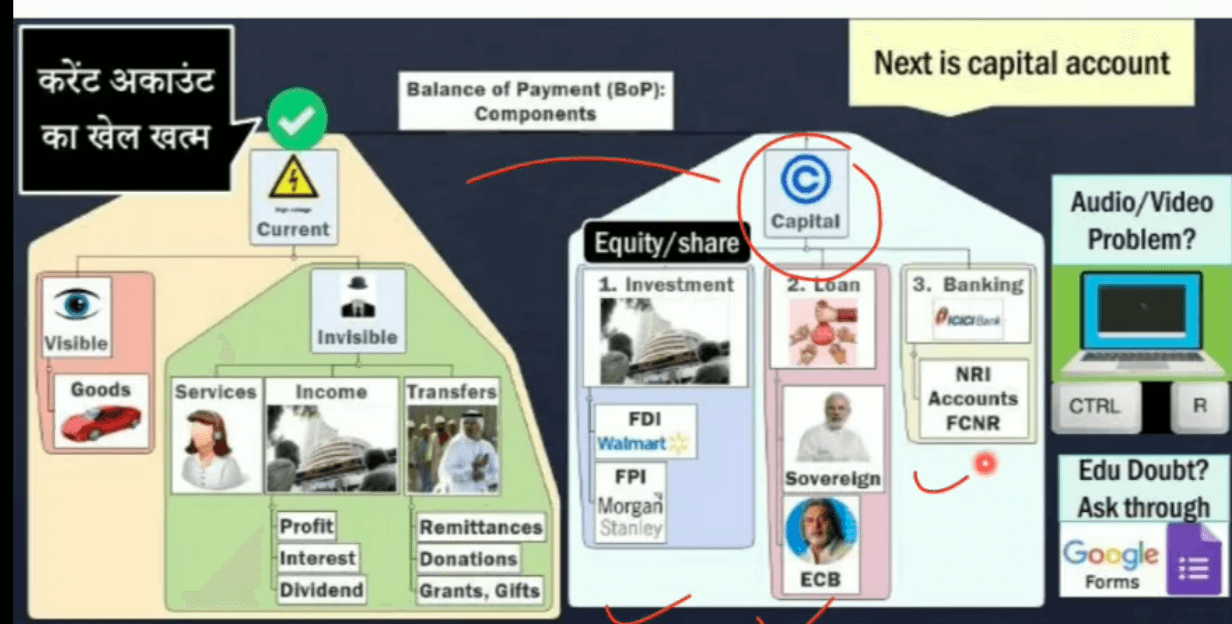
- Classification: BoP is split into two major accounts:
- Current Account : Deals with daily/recurring items (trade, gifts). 🛒
- Capital Account : Deals with assets and liabilities (FDI, loans). 🏗️
30.3 RBI’s Actual Method of Classification 🏛️🗂️
The RBI classifies BoP slightly differently in practice than textbooks do.
| 💳 Current Account | 🏗️ Capital & Financial Account |
|---|---|
| Goods and Services: Visible & Invisible trade. | Direct Investment (FDI): Long-term equity. |
| Primary Income: Wages paid to workers, dividends, and interest. | Portfolio Investment (FPI): Short-term market money. |
| Secondary Income: Remittances from NRIs, gifts, and donations. | Loans: External Commercial Borrowings (ECB). |
| Non-resident Deposits: NRI bank accounts. | |
| Forex Reserves: RBI's dollar stash. |
30.4 Current Account: Visible vs Invisible 🛍️👻
The Current Account measures the "flow" of income.
1. Visible (Merchandise) 🚢📦
- Trade in physical Goods (e.g., Oil, Gold, Machinery).
- India's Status: Always a TRADE DEFICIT (Imports > Exports). 📉
2. Invisible (Services & Income) 👻💻
- Services: IT, Travel, Transport. (India has a SURPLUS here! 📈).
- Primary Income: Profit/Dividends/Interest going out or coming in.
- Secondary Income (Transfers): Remittances (money sent by NRIs).
💡 Notable Trends:
- Current Account Surplus: Rare for India! It happened only in 2001-04 (Pre-global crisis) and 2020-21 (Corona year—imports crashed more than exports). 🦠🚀
- Average CAD: India's Current Account Deficit (CAD) usually averages around -2.2% of GDP.
⚖️ 30.5 Balance of Trade (BoT:
Definition: Balance of Trade is the difference between the total value of a country's exports and its imports. 🚢🛳️
- NCERT Definition: Focuses ONLY on the export and import of Goods (Visible items). 📦
- IMF Definition: Includes the export and import of Goods AND Services (Visible + Invisible). 📦💻
- India’s Status:
- In Goods: We have a Trade Deficit (Imports > Exports). 📉
- In Services: We have a Trade Surplus (Exports > Imports). 📈
- Combined: Usually, the massive deficit in goods outweighs the surplus in services, leading to an overall Trade Deficit.
📐 Specialized Terms of Trade (ToT)
"Terms of Trade" helps us understand how much import we can buy for every unit of export. It's about the "purchasing power" of our exports. 💰⚖️
30.1.1 Net Terms of Trade (NTT / Commodity ToT) 💵
This measures the Value ($) relationship.
- Formula:
- Meaning for India: Usually less than 100 (< 100). 📉
- The Logic: Dollar-wise, we are importing more expensive stuff (like high-tech machinery/oil) and exporting cheaper stuff (refined petro, engg goods). We pay more than we earn. 💸
30.1.2 Gross (Barter) Terms of Trade (GTT) 🏋️♂️
This measures the Physical Quantity (KG/Ton) relationship.
- Formula:
- Meaning for India: Usually less than 100 (< 100). 📉
- The Logic: In terms of "weight," we export way more than we import. For example, India exports millions of tons of Rice and Iron Ore 🌾🚜, but we import much lighter (but more expensive) items like Gold or Electronic Chips. 🪙💻
- Note: This is good in physical terms but shows we are a commodity exporter.
30.1.3 Income Terms of Trade (ITT) 📈
- Formula:
- Significance: This is the most relevant indicator for Developing Countries like India. 🇮🇳
- Why? It tells us our actual capacity to import goods based on the total income earned from exports. It combines price (NTT) and quantity (QIE).)**.
🚢 30.2 & 30.5.1: India’s Top Import-Export Rankings (ES26)
India's share in world trade has seen a significant jump, especially in the services sector. 📈
- Goods Exports Share: 1.0% (2005) ⮕ 1.8% (2024).
- Services Exports Share: 2.0% (2005) ⮕ 4.3% (2024).
📊 The Trade "Top 5" List (Goods & Services)
| Rank | Goods (Import) 📥 | Goods (Export) 📤 | Services (Import) 📥 | Services (Export) 📤 |
|---|---|---|---|---|
| 1 | Petroleum (Crude) ⛽ | Petro Products ⛽ | Biz Services 💼 | IT Services 💻 |
| 2 | Gold 🪙 | Engg Goods ⚙️ | Travel ✈️ | Biz Services 💼 |
| 3 | Electronics 📱 | Gems & Jewellery 💎 | Transport 🚢 | Travel ✈️ |
| 4 | Machinery 🏗️ | Chemicals 🧪 | Fin. Services 🏦 | Transport 🚢 |
| 5 | Coal/Coke 🧱 | Pharma 💊 | IPR/Royalty 📜 | Fin. Services 🏦 |
🌍 Nations: Who do we deal with?
| 💰 Trade SURPLUS (We earn more) | 📉 Trade DEFICIT (We spend more) |
|---|---|
| 1. USA 🇺🇸 (Largest Surplus) | 1. China 🇨🇳 (Largest Deficit) |
| 2. UK 🇬🇧 | 2. Russia 🇷🇺 |
| 3. Bangladesh 🇧🇩 | 3. UAE 🇦🇪 |
| 4. Netherlands 🇳🇱 | 4. South Korea 🇰🇷 |
| 5. UAE 🇦🇪 | 5. Hong Kong 🇭🇰 |
🌾 30.5.2 Agri Exports: The Farm Powerhouse
India is now the world’s second-largest agricultural producer by value. 👨🌾🚜
- Growth: Global share in agri exports rose from 1.1% (2000) ⮕ 2.2% (2024).
- 🏆 Major Agri Exports:
- Rice (India is a global leader). 🍚
- Fish (Marine products). 🐟
- Buffalo Meat. 🥩
- Spices (The land of spices!). 🌶️
- Oil Meals & Sugar. 🍭
💻 30.5.3 Service Sector: Global Capacity Centres (GCC)
India's service export growth is heavily driven by GCCs (also called "Captive Centres" or GICs). 🏢🌍
- What are they? These are centers set up by MNCs in India to handle their internal operations like Product Development, Software, R&D, Banking, and Semiconductors. 🔬💻
- Historical Fact: Texas Instruments (1985) was the first to set up a GCC in Bengaluru.
- Scale (2023): 1600+ GCCs in India employing 32 lakh people, mostly high-end engineers and scientists. 👷♀️🧠
- Future (Budget-2025): The government plans to develop GCCs in Tier 2 cities (Population 50,000 to 99,999). 🏗️🏘️
📈 30.3 Reports / Indices Related to Export & Remittance
This section serves as a tracking mechanism for how India and its states are performing in the global market. 📊🌍
🏗️ 30.4 Export Preparedness Index (EPI) - by NITI Aayog
NITI Aayog (निर्यात तैयारी सूचकांक) releases this index to create "competitive federalism" among Indian states. 🏆🇮🇳
- Objective: To rank Indian states based on their export potential and performance. 📈
- Key Pillars (What do they measure?):
- Policy: State govt’s export-related rules. 📜
- Infrastructure: Availability of industrial clusters. 🏗️
- Transport Connectivity: How easily can goods reach ports? 🛣️🚢
- Ease of Doing Business: Lowering "Red Tape." 📉📑
- Top Performers: 🥇
- Overall, Coastal States perform the best because of direct port access (e.g., Tamil Nadu, Maharashtra, Gujarat, Karnataka). 🌊⚓
- Sub-rankings: States are divided into categories—Coastal, Landlocked, Himalayan, and UTs/City-States.
- Note: Himalayan states like Uttarakhand often top their specific category. 🏔️
💻 30.4.1 Global Survey on Digital and Sustainable Trade Facilitation
This is an international survey conducted by UNESCAP (United Nations Economic and Social Commission for Asia Pacific). 🌐🏢
- Focus: It tracks how much countries are moving toward Paperless Trade. 📄🚫
- Score Criteria: It gives a percentage score based on:
- Transparency: Are rules easy to find? 🔍
- Formalities: Reducing paperwork. 📉
- Institutional Cooperation: Do different agencies talk to each other? 🤝
- Cross-Border Paperless Trade: Electronic exchange of trade data. 📧
- India's Status: India has seen a significant improvement in this score due to initiatives like SWIFT and ICEGATE. ✅
🌡️ 30.4.2 Report: Goods Trade Barometer Index
Released by the World Trade Organization (WTO). (More details in Pillar #3B). 🌍⚖️
- Function: It is a "Leading Indicator." It tells us whether world trade is going to grow or shrink in the near future. 🔮📈
- The "100" Rule:
- Score > 100: World trade is expanding (Good news! 😍).
- Score < 100: World trade is shrinking/slowing down (Bad news! 😟).
- Current Trend: As of the latest data (Dec 2022), the value was 96.1%, indicating a slight slowdown in global goods trade. 📉💨
💸 30.5.4 Remittance: World Bank’s Remittance Report
India is the Remittance Superpower! 🇮🇳💪
- The Streak: Since 2008, India has received the largest amount of remittances in the world.
- Current Ranking (2025 Projection): 1. India 🇮🇳, 2. Mexico 🇲🇽, 3. China 🇨🇳.
- Economy Impact: Remittance is the 2nd largest contributor to India's Current Account income (after Services Export). 💻🥇
- Poverty Link: The World Bank notes that remittances have a direct impact on poverty removal for many households. (धन प्रेषण से गरीबी उन्मूलन में मदद मिलती है). 📉🏘️
🛢️ 30.5.5 The "Oil-Remittance" Connection (ES24)
There is a Positive Relationship between Crude Oil prices and Indian Remittances. 📈⛽
- The Logic:
- Crude oil prices ⬆️
- More profit for Oil companies in the Middle East ⬆️
- More demand for Indian workers to build/operate infrastructure ⬆️
- More remittance flows back to India! ⬆️💰
✈️ 30.5.6 & 30.5.7 Visa Types & Trump's Remittance Tax (2025)
| Visa / Act | Nation | Description |
|---|---|---|
| H-1B | USA 🇺🇸 | Temporary (non-immigrant) visa for "Specialty Occupations" (IT, Doctors). Trump imposed a $100,000 fee on employers. |
| Green Card | USA 🇺🇸 | Gives Permanent Residency. |
| EB5 (Trump's Gold Card) | USA 🇺🇸 | Invest $1 million to get a fast-track residency visa. 💰🏦 |
| USA Hire Act | USA 🇺🇸 | Discourages American companies from outsourcing. Imposes excise tax on such firms. 📉🏢 |
| Golden Card | UAE 🇦🇪 | Given to investors and celebrities (Bollywood stars). 🌟 |
| Remittance Tax | USA 🇺🇸 | Proposed 3.5% tax on money sent out of the USA (starting Jan 2026). This may push NRIs to use illegal Hawala/Bitcoin channels. 🚫💸 |
🌍 30.4.3 & 30.4.4 Indian Migrants: Destinations & Reports
The Shift in Migration (ES23): 🔄
- BEFORE: Mostly Gulf nations for low-skilled/informal jobs.
- NOWADAYS: Increasing migration to USA, UK, East Asia for high-skilled professional jobs. 👨⚕️👩🔬
- Top 3 Remittance Sources for India:
- USA (27.7%) 🇺🇸
- UAE (19.2%) 🇦🇪
- UK (10.8%) 🇬🇧
Key Reports: 📑
- Migration and Development Brief: Released by World Bank. 🏦
- Global Migration Report: Released by IOM (International Organization for Migration - UN related). 🌐
🇮🇳 30.5.8 Pravasi Bharatiya Diwas (PBD)
Celebrated to mark the contribution of the overseas Indian community. 🤝✨
- Historical Date: 9th January (The day Gandhi-ji returned from South Africa in 1915). 🏛️
- Origin: Started in 2003 (Vajpayee Govt).
- Reform (2015): PM Modi converted it into a "Biennial" event (every second year). 📅⏳
- 2025 Event: Held in Bhubaneswar, Odisha.
- Theme: "Diaspora's Contribution to a Viksit Bharat". 🚀🇮🇳
🛢️ 30.6 Balance of Payment: Import of Oil
The Heavy Burden: Crude oil is India's #1 import item.
- Price Trends: Prices have fluctuated wildly—from 69 (avg) for 2025. 📉📈
- The Goal: The Govt aims to reduce oil import dependency by boosting domestic production. 🏗️🇮🇳
🏗️ 30.4.5 & 30.6.1 Oil Exploration Policies: NELP to HELP
The government shifted its strategy to attract private players and reduce "Inspector Raj."
| Feature | 🏚️ NELP (Old - 1997) | 🚀 HELP (New - 2016) |
|---|---|---|
| Full Form | New Exploration Licensing Policy | Hydrocarbon Exploration & Licensing Policy |
| Licensing | Separate license for each item (Oil, Gas). 📄📄 | Uniform License: One license for all items (Oil, Gas, Shale, etc.). 📄✅ |
| Profit Model | Production Sharing (PSC): Govt gets a share of the Profit. 💰 | Revenue Sharing: Govt gets a share of Gross Sales, regardless of profit. 📈✅ |
| Issue/Fix | Companies lied about costs to show "low profit." 🤥 | Companies can't hide "Gross Revenue." Easier to monitor. 🕵️♂️ |
| OALP | Not available. | Open Acreage Licensing Policy: Pick your own blocks year-round. 🗺️🖱️ |
🏰 30.6.2 & 30.6.3 Strategic Oil Reserves
The Objective: Buy oil when prices are low and store it for emergencies (War/Disruptions). 🛡️🛢️
- Locations: Visakhapatnam (AP), Mangalore, and Padur (Karnataka).
- Storage Type: Underground Rock Caverns.
- Benefits: More secure (Safe from airstrikes), cheaper, and eco-friendly. 🏔️✅
- 2024 Update: Since the Govt doesn't have enough money to fill all tanks, it decided to rent out/lease 1 million tonnes of storage capacity to private companies. 🤝🏢
🌍 30.1.1 & 30.4.7 Crude Theory & OPEC Politics
- OPEC (Organization of the petroleum Exporting countries) (1961): A "Cartel" of **14 nations (Saudi, UAE, etc.). HQ: Vienna, Austria. 🇦🇹
- Cartel: An association that colludes to keep prices high. 🤝💰
- BRENT Index: Measures oil prices mainly in North West Europe. 🌊
- WTI (West Texas Intermediate): Measures USA oil prices. (Used for WTI contracts). 🇺🇸
- Types of Oil:
- Sweet Crude: Low Sulphur (Better/Easier to refine). 🍯
- Sour Crude: High Sulphur. 🍋
🇷🇺 30.4.9 to 30.6.6 The Russian Oil Saga & Shadow Fleets
Since the Ukraine war, global oil dynamics have changed for India:
- G7 Price Cap ($60): Western powers tried to stop Russia from earning war money. India rejected this cap. 🇮🇳💪
- Shadow Fleet: Russia uses "ghost ships" (tankers with secret owners) registered in places like Greece to evade sanctions. 🚢👻
- The Discount: India bought Russian oil at "deep discounts," but high insurance and shipping costs meant we only saved approx $2 per barrel. 📉💵
- Future Shift (30.6.6): India will buy 10% of its annual LPG from the USA starting in 2025 to diversify suppliers and appease trade relations with Trump. 🇺🇸🤝
🪙 30.7 Balance of Payment: Import of Gold
The "Gold Fever" Problem:
- The Cause (2010-2014): India faced high inflation (8-12%). Bank interest was low, so people got a "Negative Real Interest Rate" on their savings. 📉💸
- The Reaction: To protect their wealth, households shifted their money from banks to Gold. 🏠➡️🪙
- The Impact:
- Increased Gold Consumption ⬆️
- Higher Trade Deficit & Current Account Deficit (CAD) ⬆️ 📉
- Indian Rupee got weaker ⬇️ 🇮🇳
- Storage for black money and tax evasion. 🕵️♂️💰
- India's Rank: 2nd largest consumer of gold in the world (After China 🇨🇳).
🏛️ 30.7.1 to 30.7.3 Gold Schemes & Regulatory Moves
1. 80:20 Scheme (2013-14) ⚖️
- The Rule: RBI mandated that 20% of all imported gold must be exported back (as jewelry). 💍🚢
- Purpose: To force exporters to earn foreign exchange to pay for the gold they imported.
- Status: Stopped in 2014 as the "gold craze" cooled down.
2. Gold Monetization Scheme (GMS - 2015) 🏦🪙
- Objective: To bring "idle gold" lying in Indian lockers into the economy. 🔓
- How it works: You deposit your gold (Min 30g) in a bank for 1 to 15 years.
- What happens to the gold? It goes to MMTC (Metals and Minerals Trading Corp) ➡️ Sold to jewelers or minted into coins. 💍🔨
- 🚀 2025 Update: The Finance Ministry discontinued Medium & Long-term deposits because skyrocketing gold prices made it too expensive/loss-making for the government to pay back. 🛑💸
3. Indian (Sovereign) Gold Coins (2015) 🇮🇳🪙
- The Catch: These are NOT Fiat Money and NOT Legal Tender. 🚫💵
- Why? They aren't issued under the Coinage Act and don't have Rupee markings. They only show "Gold Grams."
- Benefit: Guaranteed purity and easy to resell. ✅✨
📊 30.8 Gold Related GK & Global Data
| Category | Leading Names 🌍 |
|---|---|
| Mines | Nevada (USA), Muruntau (Uzbekistan). ⛏️ |
| Producers | China 🇨🇳, Australia 🇦🇺, Russia 🇷🇺. |
| Exporters | Switzerland 🇨🇭 (Highest by value). |
| Central Bank Reserves | USA 🇺🇸, Germany 🇩🇪, Italy 🇮🇹. |
📈 30.8.1 Reason for Gold/Silver Price Hikes
Why does the price go up? 🚀💸
- Weak Stock Market: Investors shift money from Sensex to Gold. 📉➡️🪙
- Geopolitical Uncertainty: War in Ukraine, Gaza, or Iran makes gold a "Safe Haven." ⚔️🛡️
- High Inflation: Gold preserves purchasing power when paper money loses value. 🌬️💵
💎 30.9 Lab Grown Diamonds (LGD:
As natural diamond mining becomes more difficult and ethically complex, India is shifting toward Lab Grown Diamonds (LGD). 🔬🧱
| Aspect | 🌍 NATURAL | 🧪 LAB GROWN |
|---|---|---|
| Formation | Earth’s mantle (High temp/pressure). 🌋 | Laboratory using advanced tech. 🔬 |
| Production Time | Billions of years. ⏳ | Weeks. 🚀 |
| Properties | Pure carbon; very hard. | Same as natural diamonds. ✅ |
| Cost | Very Expensive. 💸 | Less expensive than Natural. 📉 |
| Ethics | Issues: Deforestation, Child labour. 🧒❌ | More ethical and Sustainable. 🌱 |
- ⚡ Budget-2023 Promotion: The government is providing tax cuts and subsidies for LGD seeds/machinery and research grants to IITs. 🏛️💻
🏷️ 30.9.1 to 30.9.3 Geographical Indication (GI Tag)
What is it? A GI tag is a sign used on products that have a specific geographical origin and possess qualities or a reputation due to that origin. 📍✨
- First GI Tag in India: Darjeeling Tea (West Bengal). ☕🍵
- The Benefit: It adds a "premium" feel, preventing fake products and helping farmers/artisans fetch higher prices in the international market. 📈💰
- Validity: Once granted, a GI tag is valid for 10 years (can be renewed). ⏳🔄
- Nodal Agencies: 🏛️
- International: WIPO (World Intellectual Property Organization), HQ @ Geneva. 🌍
- Indian: Commerce Ministry ⮕ Controller General of Patents, Designs and Trademarks ⮕ GI Registry in Chennai. 🏢⚓
- Branding: 🎨
- Logo: "Invaluable Treasures of Incredible India." (विदेशी ग्राहकों में चाहत बढ़ाने के लिए).
- New Brand (2026): "Bharat GI" launched as a national umbrella brand (e.g., for Coorg Coffee). ☕🇮🇳
🛍️ 30.4.11 Unity Malls: Selling GI & Handicraft
The Concept (Budget-2023): The Union provides interest-free loans to States to set up a "Unity Mall" in their state capital or best tourist city. 🏛️🤝
- Purpose: To sell ODOP (One District One Product) items, GI products, and handicrafts.
- Key Feature: Even products from other states will be sold at the Unity Mall to promote national integration and tourism. 🗺️💼
🏗️ 30.5 Balance of Payment ⮕ Exports ⮕ SEZ(special Economic zone)
What is an SEZ? 🌏 A Special Economic Zone is a specifically demarcated area of India deemed as "Foreign Territory" for the purpose of Tax laws and Trade laws.
- earlier it was called as (EPZ export processing zone).
- Kandla Asia's first EPZ in Gujrat
- example: Kandla, DLF cybercity , Vishakhapatnam
💰 Tax Comparison: SEZ vs. Ordinary Area
| Tax Type | 🏙️ Ordinary Area | 🏗️ SEZ Area |
|---|---|---|
| Manufacturing (Excise/GST) | YES 🧾 | NO (N/A) ❌ |
| Import/Export (Customs) | YES 🚢 | NO (N/A) ❌ |
| Profit (Corporation Tax) | YES 💰 | NO (Tax Holiday) 🏖️ |
🎿 30.9.4 SEZ Sunset Clause & Tax Holidays
- Section 10AA (Income Tax Act): Provides a "Tax Holiday" for SEZ firms. 🏖️
- The Sunset Clause: This relief is only for a specific time period (e.g., "X" years). It is not for eternity. ⏳🚫
- The Problem: When the tax holiday ends in one SEZ, many entrepreneurs shut down and move to a new SEZ with a new name just to restart the holiday. 🏃♂️💨
🎁 30.9.5 Benefits Given to SEZs
- Single Window Clearance: One-stop shop for all licenses and permissions. 🖱️✅
- Infrastructure: The Government bears the cost of roads, sewage, water treatment, and weighing stations within the SEZ. 🏗️🛣️
- Regulation: Regulated under the SEZ Policy (2000) and the Special Economic Zone Act, 2005. 📜⚖️
🚀 30.5.1 The Evolution: SEZ ⮕ DESH Hubs
The Problem with SEZ: 🛑
- SEZ units are strictly for exports. They cannot easily sell to the local Indian market.
- Entrepreneurs complained about "Inspector Raj" and rigid rules.
The Solution: DESH Bill, 2022 (Development Enterprise and Services Hub) 🏢🇮🇳
- Origin: Based on the Baba Kalyani Committee (2018) recommendations.
- Key Changes:
- Dual Focus: DESH hubs will produce for both the domestic market and the export market. 🏠🚢
- Easier Exit: Norms for voluntary liquidation or closing down are simplified. 🚪🔓
- Digital First: Promotion of e-initiatives and single-window clearance for fire/pollution safety. 💻🔥
🚢 30.10 Foreign Trade Policy (FTP): The Big Picture
The FTP is the government's strategic roadmap to boost exports and integrate India into the global supply chain. 🌏🏗️
- The Goal: To reach **1 Trillion Goods + $1 Trillion Services) by 2030. 💰🚀
- Nodal Agency: DGFT (Director General of Foreign Trade) under the Ministry of Commerce. 🏛️📂
- Current Context: India crossed $400 billion in goods exports in 2022. The 2023 policy replaces the old 2015-20 policy and is "open-ended" (no fixed expiry date). 📉➡️📈
🏗️ 30.11 The 4 Pillars of FTP-2023
The policy is built on four core pillars designed to move India from an "Incentive-based" to a "Remission-based" export regime. 🏛️⚖️
**1️⃣ Pillar 1: Tax Remission (Tax Back!) 💸🏗️
The philosophy is that "Taxes should not be exported." The govt refunds the taxes/duties paid on inputs used for exports.
- RODTEP (Remission of Duties/Taxes on Exported Products): Provides refunds for taxes not covered by GST (like electricity duty, mandi tax, fuel VAT). ⚡🌽
- EPCG (Export Promotion Capital Goods): Import Machinery for 0% Customs duty if you fulfill an export obligation (6x the duty saved). ⚙️📦
- Advance Authorisation (AAS): 0% duty on import of Raw Materials (chemicals, oil, etc.) needed for manufacturing export items. 🧪🧪
- Note: AAS is for raw materials; RODTEP is for broader input taxes like fuel/electricity.
**2️⃣ Pillar 2: Ease of Doing Business 🖱️✅
- Process Re-engineering: Shifting from manual "Inspector Raj" to Automation and paperless online environments. 📄➡️💻
- Reduction in Fees: Cutting application fees for MSMEs to encourage small exporters. 📉MSME
**3️⃣ Pillar 3: Emerging Areas (The Future) 🚀💻
- SCOMET & Dual Use: Focus on exporting high-end items like Special Chemicals, Organisms, Materials, Equipment, and Technologies. 🤖📡
- Dual-Use: Items that can be used for both civilian and military purposes (e.g., Night vision scanners, drones). ⚔️🏗️
- E-Commerce Exports: Integration of courier/postal exports with the ICEGATE portal. 📦🌍
- Benefit: Helping rural artisans and weavers sell products globally via online platforms. 🧶💻
**4️⃣ Pillar 4: Collaboration (Stakeholders) 🤝🏘️
- Districts as Export Hubs (DEH) & ODOP: Identifying a unique product from every district for export. 🗺️🍎
- DEPCs: District Export Promotion Committees have been set up in 739 districts. 🏛️📈
- Towns of Export Excellence (TEE): 39 existing towns + 4 new ones (Faridabad, Mirzapur, Moradabad, Varanasi). These towns get funding for infra like warehouses and testing labs. 🏗️🏘️
- Merchanting Trade: Buying from Country A and selling to Country B without the goods entering India. 🕵️♂️🌍
- Hub: GIFT City (IFSC) in Gujarat will be the center for this. 🏙️🏦
- Niryat Bandhu Scheme: Mentoring new/potential exporters through counseling and orientation with the help of IIFT. 👨🏫💼
📝 E-Governance & Reforms
- SWIFT (Single Window Interface): Developed by CBIC to allow importers/exporters to submit all documents in one place (E-Sanchit, Turant). 🖱️🚪
- Stakeholder Consultation (2025): New reform making it compulsory for the govt to consult industry experts before changing Trade Policy. . 🤝🛡️
📈 30.12: Export Improvement Mission
To reach the $2 Trillion target, the government has launched several digital and financial missions in Budget-2025. 🏗️💰
1️⃣ Export Promotion Mission (Budget-2025) 🚀
- Jointly managed by: Ministries of Commerce, MSME, and Finance. 🤝🏛️
- Focus Areas:
- Faster loan approvals for exporters. 🏦✅
- Factoring for MSME: Helping small businesses get immediate cash against their invoices. 🧾💸
- Tackling Non-Tariff Barriers: Helping Indian firms deal with strict foreign rules (e.g., EU banning Indian ketchup due to pesticide issues). 🧪🍅
2️⃣ BharatTradeNet (BTN) Portal 🌐📑
- Function: A single portal for (1) submitting import-export documents and (2) accessing loan facilities. 📂🏦
- Integration: It will connect with ULIP (Unified Logistics Interface Platform) to track cargo and transport facilities. 🚢🚛
3️⃣ Trade Connect e-Platform 🖱️🌍
- Nodal Agency: DGFT (Directorate General of Foreign Trade).
- Objective: To help Indian exporters find buyers in newer nations/markets. (e.g., selling Parle-G in Tanzania). 🍪🇹🇿
🧾 30.5.2 : Tax Credits & Logistics
1. MEIS/SEIS ⮕ RoDTEP (The Big Shift) 🔄⚖️
The government replaced old tax incentive schemes with a WTO-compatible version.
| Scheme | 🏚️ MEIS (Old) | 🚀 RoDTEP (New) |
|---|---|---|
| Full Form | Merchandise Exports from India Scheme | Remission of Duties/Taxes on Exported Products |
| Tax Credit | Used for paying Customs Duty. | Covers local taxes (Electricity, Mandi, Fuel). ⚡⛽ |
| WTO Status | No, WTO ordered to stop it because it was a "subsidy." ❌ | Yes, it is considered a "refund" of taxes, not a subsidy. ✅ |
2. ⚓️ Authorised Economic Operator (AEO)
- Status by: CBIC (Central Board of Indirect Taxes and Customs). 🏛️
- Criteria: Min 3 years experience, no bankruptcy, no fraud/smuggling. 🛡️✅
- Benefits: Faster cargo clearance at ports and fewer physical checks by customs. 🚢💨
✈️ 30.5.5 Krishi Udan Scheme v 2.0 (Civil Aviation, 2020)
Helping farmers "fly" their perishable products to global markets. 🚁🍏
- Focus Areas: Hilly areas, North-Eastern states, and tribal areas. 🏔️🏔️
- The "Flying" Fruits:
- Gauwahati: King Chillies, Burmese Grapes & Assamese Lemon. 🌶️🍇🍋
- Tripura: Jackfruit. 🍈
- Darbhanga (Bihar): Litchi. 🍒
🌊 30.13 Sea Routes & Trade Disruptions (2023-25)
Global trade has faced major "Choke Point" issues recently. 🛑🚢
| 🗺️ Sea Route | ⚠️ Trade Disruption Factor | 📉 Impact |
|---|---|---|
| Red Sea 🇾🇪 | Attacks by Houthi militia. 🛡️💥 | Affects 40% of global trade. High shipping costs/delays for Basmati rice. 🍚🚢 |
| Strait of Hormuz 🇮🇷 | Attacks by Iranian Navy. ⚓️⚔️ | Affects 21% of global petroleum trade. ⛽🛢️ |
| Panama Canal 🇵🇦 | Water scarcity caused by El Niño (Drought). ☀️📉 | Affects 5% of global maritime trade; ships have to carry less load. 🚢🌊 |
PYQS
Q1. The balance of payments of a country is a systematic record of: (Pre-2013) (a) All import & export transactions of a country during a given period of time, normally a year. (b) Goods exported from a country during a year. (c) Economic transaction between the government of one country to another. (d) Capital movements from one country to another.
Q2. Which of the following does not form part of the current account of BoP? (UPSC-CDS-2014-II) (a) Export and import of goods (b) Export and import of services (c) Income receipts and payments (d) Capital receipts and payments
Q3. With reference to Balance of Payments, which of the following constitutes/constitute the Current Account? (Asked in UPSC-Pre-2014)
- Balance of trade.
- Foreign assets.
- Balance of invisibles.
- Special Drawing Rights. Answer codes: (a) 1 only (b) 2 and 3 (c) 1 and 3 only (d) 1, 2 and 4
Q4. Find correct statement(s) about international trade of India at present? (Prelims-2020)
- India’s merchandise exports are less than its merchandise imports.
- India suffers from an overall trade/current account deficit.
- India’s exports of services are more than its imports of services. Ans Codes: (a) 1 and 2 only (b) 2 and 3 only (c) 3 only (d) 1, 2 and 3
Q5. Among the following, which one of the following is the largest exporter of rice in the world in the last five years? (Pre-2019) (a) China (b) India (c) Myanmar (d) Vietnam
Q6. Among the agricultural commodities imported by India, which one accounts for the highest imports in terms of value in the last five years? (Pre-2019) (a) Spices (b) Fresh fruits (c) Pulses (d) Vegetable oils
Q7. Since 2014-15, India has consistently run trade surplus with which one among the following countries? (UPSC-CDS-2020-ii) (a) China (b) Saudi Arabia (c) USA (d) Germany
Q8. Consider the following statements regarding South Asian trade: (Prelims-2020)
- The value of Indo-Sri Lanka trade has consistently increased in the last decade.
- In the last five years, Nepal has been the largest trading partner of India in South Asia. Codes: (a) 1 only (b) 2 only (c) Both 1 and 2 (d) Neither 1 nor 2
Q9. India's share in global services export in 2023 was approximately: (a) 1.8% (b) 4.3% (c) 10.2% (d) 2.2%
Q10. The first company to set up a Global Capacity Centre (GCC) in India was: (Asked in CDS Exam) (a) Google (b) Microsoft (c) Texas Instruments (d) IBM
Q11. The "Export Preparedness Index" (EPI) for Indian states is released by: (a) Ministry of Commerce (b) NITI Aayog (c) Export Inspection Council (d) RBI
Q12. Which category of states consistently performs best in the Export Preparedness Index? (a) Himalayan States (b) Landlocked States (c) Coastal States (d) North Eastern States
Q13. The "Goods Trade Barometer Index," which signals changes in world trade growth, is released by: (a) World Bank (b) WTO (c) IMF (d) UNCTAD
Q14. The "Global Survey on Digital and Sustainable Trade Facilitation" is an initiative of: (a) UNESCAP (b) WTO (c) World Economic Forum (d) G20
Q15. Which organization releases the "Migration and Development Brief"? (a) IMF (b) World Bank (c) WTO (d) IOM
Q16. As per Economic Survey, which country is the largest source of remittances for India? (ES23) (a) UAE (b) USA (c) Saudi Arabia (d) UK
Q17. The Pravasi Bharatiya Diwas is celebrated on January 9th to commemorate: (a) The passing of the PIO Act. (b) The return of Mahatma Gandhi from South Africa. (c) The first NRI summit.
Q18. Trump’s proposed "Remittance Tax" (2025) aims to impose a tax of ___ on outward remittances from the USA. (a) 5% (b) 3.5% (c) 1% (d) 10%
Q19. Term ‘West Texas Intermediate’ refers to _ _ (Prelims-2020) (a) Crude oil (b) Bullion (c) Rare earth elements (d) Uranium
Q20. Which policy introduced the "Open Acreage Licensing Policy" (OALP) for oil exploration? (a) NELP (b) HELP (c) SEZ Policy (d) Foreign Trade Policy
Q21. Qatar recently withdrew its membership from which international organization? (a) WTO (b) OPEC (c) UNESCAP (d) IMF
Q22. What is/are the purpose/purposes of Government's 'Sovereign Gold Bond Scheme' and 'Gold Monetization Scheme’? (Asked in UPSC-Pre-2016) 1.To bring the idle gold lying with Indian households into the economy. 2) To promote FDI in gold & jewellery sector. (3) To reduce India's dependence on gold imports. Answer codes: (a) 1 only (b) 2 and 3 (c) 1 and 3 only (d) 1, 2 and 3
Q23. Consider the following statements: [Pre23-SET-A-Q086] Statement-I: Switzerland is one of the leading exporters of gold in terms of value. Statement-II: Switzerland has the second largest gold reserves in the world. Which one is correct? (a) I is correct, II is explanation (b) I & II correct, II not explanation (c) I correct, II incorrect (d) I incorrect, II correct.
Q24. Main objectives of Gold Monetization Scheme is _ _ _ . (IEnggS-2018)
- To monetize gold holdings in the country 2. To increase export of gold from the country
- To reduce India’s import bill 4. To meet the targets of reduction in fiscal deficit Answer Codes: (a) 1 and 4 only (b) 2 and 4 only (c) 2 and 3 only (d) 1 and 3 only
Q25. ‘Kandhamal Haldi’, which received GI tag is indigenous to _ _ _ _. (CAPF-2019) (a) North Bengal (b) Southern Odisha (c) Sangli, Maharashtra (d) Alleppey, Kerala
Q26. Who is the international nodal agency for Geographical Indications (GI)? (a) WTO (b) WIPO (Geneva) (c) World Bank (d) UNESCO
Q27. Where is the Geographical Indications Registry of India located? (a) New Delhi (b) Mumbai (c) Chennai (d) Bengaluru
Q28. Asia's first Special Economic Zone (EPZ) was set up in 1965 at: (a) Mumbai (b) Kandla, Gujarat (c) Chennai (d) Visakhapatnam
Q29. Find Correct (GPSC-2025):
- The first SEZ policy in India was announced in 2000.
- The objective was to increase foreign investment. 3. The SEZ Act was passed in 2010. Code: (A) 1 and 2 only (B) 2 and 3 only (C) 1 and 3 only (D) 1, 2 and 3
Q30. The "Sunset Clause" in the context of SEZ refers to: (a) Daily closing time. (b) The expiry of tax-holiday benefits after a specific period. (c) Exit norms for labor.
Q31. Which of the following is NOT one of the pillars of India's 'Foreign Trade Policy-2023’? (CAPF-2024) (a) Enlarging MFN (b) Export promotion through collaboration (c) Ease of doing biz (d) Emerging areas
Q32. Find wrong about Districts as Export Hubs (DEH) (CDS-2025-ii) (a) DEH was launched in August 2019. (b) DEH is to boost exports of only selected districts of the country. (c) India's Foreign Trade Policy 2023 reiterated the role of DEH. (d) DEH aims to promote exports by financial and infrastructural support.
Q33. "Merchanting Trade" involves: (a) Selling to tourists. (b) Buying from one country and selling to another without bringing goods to India.
Q34. The "RoDTEP" scheme was introduced to replace the MEIS scheme because: (a) MEIS was expensive. (b) MEIS was found to be WTO-non-compliant (prohibited subsidy).
Q35. The "Strait of Hormuz" is primarily associated with the transport of: (a) Electronics (b) Petroleum/Crude Oil (c) Agricultural goods (d) Gold
Q36. The status of "Authorised Economic Operator" (AEO) is granted by which body? (a) NITI Aayog (b) CBIC (Customs Board) (c) DGFT (d) SEBI
🗝️ Answer Key Table
| Q | Ans | Q | Ans | Q | Ans |
|---|---|---|---|---|---|
| 1 | (a) | 13 | (b) | 25 | (b) |
| 2 | (d) | 14 | (a) | 26 | (b) |
| 3 | (c) | 15 | (b) | 27 | (c) |
| 4 | (d) | 16 | (b) | 28 | (b) |
| 5 | (b) | 17 | (b) | 29 | (a) |
| 6 | (d) | 18 | (b) | 30 | (b) |
| 7 | (c) | 19 | (a) | 31 | (a) |
| 8 | (d) | 20 | (b) | 32 | (b) |
| 9 | (b) | 21 | (b) | 33 | (b) |
| 10 | (c) | 22 | (c) | 34 | (b) |
| 11 | (b) | 23 | (c) | 35 | (b) |
| 12 | (c) | 24 | (d) | 36 | (b) |
