C1 & C2 SHAREMARKET
C1 & C2 SHAREMARKET
PART 1: Pillar#1C1 (Share market Debt/Bonds)
- 15.12 Capital (पूंजी) - Types
- 15.12.1 Capital / Funding Arrangement: Types
- 15.12.2 Trade Credit, Account Receivable & Payable (Short Term)
- 15.12.3 Lease Financing (Medium Term)
- 15.12.4 Retained Earnings (Long Term)
- 15.13 Securities (प्रतिभूति)
- 15.14 Financial / Securities Market
- 15.15 Debt Instruments (ऋण उपकरण)
- 15.15.1 Short-Term Debt Instruments (< 1 year) (MONEY MARKET)
- 15.15.1 General Characteristics
- 15.15.2 Short-term Instruments by Government
- 15.15.3 WMA, Overdraft, and SDF (Loans for Govts)
- 15.15.7 Certificate of Deposit (CD)
- 15.15.8 Additional Short-Term Instruments
- 15.15.9 Tri-party Repo
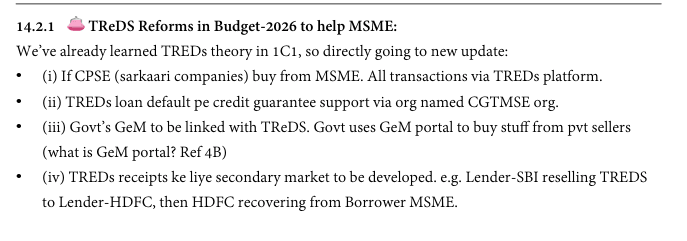
- 15.16 Factoring & TReDS (Short-term Debt)
- 15.17 Interest Rate Benchmarks
- 15.18 Long Term Debt Instruments (CAPITAL MARKET)
- 15.18.1 Historical/Colonial Era Govt Borrowing
- 15.18.2 Modern Government Borrowing
- 15.18.3 Global Bond Indices & Indian G-Sec Inclusion
- 15.19 Bonds for Special Purpose (Govt/RBI)
- 15.19.1 Addressing Negative Real Interest
- 15.19.2-15.19.3 IIB vs. CIB
- 15.19.4 Sovereign Gold Bond (SGB)
- 15.20 Long-Term Corporate Debt & Hybrid Instruments
- 15.21 Bonds Types: Based on Issuer
- 15.21.1 ULB (Urban Local Bodies) / Municipal Bonds
- 15.21.2 Global Bonds
- 15.21.3 Bond Types Based on Currency (Masala, Maharaja, etc.)
- 15.21.4 Surety Bonds
- 15.21.5 Sovereign Green Bonds
- 15.21.6 Greenium
- 15.21.7 Status of Green Bonds in India (2025 Update)
- 15.22 Special Purpose Bonds: Miscellaneous
- 15.23 Electoral Bonds (2017–2024)
- 15.24 Miscellaneous Bond Types
- 15.25 Buffer Funds for Bond Repayment
- 15.25.1 DRR (Debenture Redemption Reserve)
- 15.25.2 CSF (Consolidated Sinking Fund)
PART 2: Pillar#1C2 (Shares / SENSEX / Mutual Fund / etc.)
- 16. Equity Instruments
- 16.11.1 Private Equity (PE) and Venture Capital (VC)
- 16.11.2 Share Types: Preference vs. Ordinary Shares
- 16.11.3 Shares for Employees / VIPs
- 16.11.4 Share Types: Based on Risk / Quality
- 16.12 Account Types & Goodwill
- 16.12.1 Goodwill
- 16.13 Ratios / Numbers to Compare Companies
- 16.13.1-16.13.3 Valuation & Market Capitalization
- 16.13.5-16.13.7 Market Froth, Bubbles & Volatility
- 16.13.8 P/E Ratio and EPS
- 16.14 Methods of Issuing Shares
- 16.14.1 Share Price
- 16.14.3 IPO vs. FPO
- 16.14.5 Issuing Shares to Specific Groups
- 16.14.6 Grey Market & "When-Listed" Platform
- 16.14.7-16.14.13 Corporate Actions (OFS, Pledging, Bonus, Split, etc.)
- 16.15 Stock Exchanges / Secondary Market
- 16.15.1 Social Stock Exchange (SSE)
- 16.15.4 DEMAT Account and Depositories
- 16.15.5 ASBA (Application Supported by Blocked Amount)
- 16.16 Central Counterparties (CCPs), Novation & ESMA
- 16.17 Investors ke Types (Types of Investors)
- 16.18 SENSEX & Other Notable Indices
- 16.19 Indian Share Market Trends (2020-2024)
- 16.20 Market Theories
- 16.21 Efficient Market Hypothesis / theory (EMH)
- 16.21.1 Random walk theory
- 16.22 ALPHA AND BETA VALUES
- 16.22.1 Beta Value to monitor price volatility
- 16.22.2 Alpha value to compare performance of Mutual Funds
- 16.22.4 Types of Analysis – Fundamental vs Technical
- 16.22.5 DEMAT Portfolio: Meaning, Types, Diversification
- 16.23 SECURITIES AND EXCHANGE BOARD OF INDIA (SEBI)
- 16.24 SEBI’s Leadership & Recent Reforms
- 16.25 SEBI Investor Charter & Market Deepening
- 16.26 SEBI Reforms for Investor Confidence
- 16.27 Server Crash Protection & Short Selling
- 16.28 & 16.29 G-Sec Trading for Retail Investors
- 16.30 Investment Funds (Mutual Funds)
- 16.31 Hedge Funds, REITs, and InvITs
- 16.32 CPSE-Exchange Traded Funds (ETF)
- 16.33 Index-ETF: Passive vs. Active Investing
- 16.34 Bitcoin, Overseas, and Gold ETFs
- 16.35 Alternative Investment Funds (AIF)
- 16.36 Forward / Future Contracts & Options
- 16.37 Over-financialisation & Sachetisation
- 16.38 Derivatives & Swaps
- 16.39 Participatory Notes (P-Notes)
- 16.40 Tax on Investment / Financial Assets
- 16.41 Commodity Market & Gold Exchanges
- 16.42 & 16.43 FSDC, FSB, and FATF
- 16.45 Company Types
- 16.46 Statutory Bodies under MCA (Ministry of Corporate Affairs)
- 16.47 Takeover Related Terms
🏛 Pillar#1C1: Share market Debt/Bonds
💰 15.12 Capital (पूंजी) - Types
Capital is the financial resource required to meet the needs of a company.
| Type | Description | Examples |
|---|---|---|
| Fixed Capital (स्थायी) | 🏗️ Money needed for long-term assets. | Purchase of land, machinery, buildings, furniture. |
| Working Capital (कार्यकारी) | ⚙️ Money needed for day-to-day operations. | Purchase of raw materials, paying salaries, rent, advertising. |
📊 15.12.1 Capital / Funding Arrangement: Types
Companies can arrange funding based on:
- Period: Long-term, Medium-term, Short-term.
- Ownership: Owner's Funds (Equity), Borrowed Funds (Debt).
- Source: Internal (Retained Earnings), External (Banks, Public)

🤝 15.12.2 Trade Credit, Account Receivable & Payable (Short Term)
- Trade Credit: A short-term arrangement where a supplier allows a buyer (e.g., a retailer) to take goods on credit and pay later.
- Accounts Receivable: 资产 (Asset) For the seller, the money they are due to receive from the buyer.
- Accounts Payable: 负债 (Liability) For the buyer, the money they owe to the seller.
🏢 15.12.3 Lease Financing (Medium Term)
- An arrangement where one party (the lessor, e.g., WIPRO) gives an asset (e.g., servers) for use to another party (the lessee, e.g., Unacademy) on rent for a specific period.
- The lessee gets to use the asset without owning it, and the lessor often bears the risk of the asset becoming obsolete.
🏦 15.12.4 Retained Earnings (Long Term)
- The portion of a company's profit that is not distributed to shareholders as dividends but is reinvested back into the business. Also known as "re-invested earnings."
📜 15.13 Securities (प्रतिभूति)
A 'Security' is a tradable financial document that represents a certain monetary value.
| Feature | ✅ Equity: Share Certificate | 💲 Debt: Bond / Debenture |
|---|---|---|
| Holder's Status | Owner / Proprietor (मालिक) | Creditor (लेनदार) |
| Return | Dividend (only if the company makes a profit) | Interest (fixed payment, irrespective of profit) |
| Claim on Liquidation | Last Claim (Residual Claimants) | First Claim (paid before shareholders) |
| Attractiveness | High during a boom period (potential for high profits/dividends) | High during a slowdown period (provides a stable, fixed income) |
📈 15.14 Financial / Securities Market
The financial market is a platform where the buying and selling of securities like shares, bonds, and currencies take place. It doesn't need a physical location.
Market Subtypes
- ⏳ Based on Tenure (अवधि):
- Money Market (मुद्रा बाजार): For short-term securities with a maturity of < 1 year.
- Capital Market (पूंजी बाजार): For medium and long-term securities with a maturity of > 1 year.
- 🆕 Based on Freshness (प्राथमिक / द्वितीयक):
- Primary Market: Where new securities are issued for the first time. It connects companies/governments directly with investors.
- Secondary Market: Where existing, previously-issued securities are bought and sold (e.g., Bombay Stock Exchange). It provides liquidity.
- 🤝 Based on Settlement (निपटान):
- Spot Market: Securities are bought and sold for immediate delivery and payment (e.g., T+1 settlement).
- Future Market: A contract is made today to buy or sell a security at a specific future date and price.


💵 15.15 Debt Instruments (ऋण उपकरण)
Debt instruments are assets that require a fixed payment to the holder, usually with interest. They are essentially loans.
📉 15.15.1 Short-Term Debt Instruments (< 1 year) (MONEY MARKET )
These are traded in the Money Market and are also called Near Money because they are highly liquid.
| Issued By | Instrument Name | Key Features |
|---|---|---|
| Union Govt. | Treasury Bills (T-Bills) | Unsecured, sold at a discount to face value. No T-Bills issued by State Govts. |
| Union Govt. | Cash Management Bills (CMB) | Similar to T-Bills but for very short-term cash needs (e.g., 91 days). |
| RBI (for Govt.) | Ways and Means Advances (WMA) | Short-term loan (3 months) from RBI to Govt to manage temporary cash flow mismatches. Interest rate is the Repo Rate. |
| RBI (for States) | Special Drawing Facility (SDF) | Short-term loan from RBI to State Govts against their G-Sec collateral. Interest is Repo - 1%. |
| Banks | Certificate of Deposit (CD) | Unsecured, negotiable instrument issued by banks to raise money. |
| Companies | Commercial Paper (CP) | Unsecured, short-term promissory note issued by corporates. |
| Companies | Commercial Bill | A bill of exchange used to finance the credit sales of firms. |
| Inter-bank | Call Money / Notice Money | Unsecured loans between banks for very short periods. Call Money (1 day), Notice Money (2-14 days). |
| Various | Collateralized Borrowing and Lending Obligation (CBLO) | A collateralized instrument for short-term loans, facilitated by CCIL. |
15.15 Debt Instruments (Short-Term)
Debt instruments represent a creditor relationship. Bondholders have the first claim during liquidation and receive assured interest regardless of the company's profit.
15.15.1 General Characteristics
- Tenure: Less than 1 year.
- Nature: Usually unsecured (not backed by assets) and negotiable/transferable (can be sold to 3rd parties).
- Mechanism: Usually sold at a discount and repurchased at Face Value. The difference is the interest earned.
- Rediscounting: The process of selling these bills before maturity at a discount.
- Near Money: These are highly liquid assets that can be readily converted into cash.
15.15.2 Short-term Instruments by Government
| Instrument | Union (Central) Govt | State Govt |
|---|---|---|
| T-Bills | 14, 91, 182, 364 days | Stopped since 2001 |
| CMB (Cash Mgmt Bill) | 91 days | N/A |
| WMA & Overdraft | Available (from RBI) | Available (from RBI) |
| SDF | N/A | Available (Special Drawing Facility) |
| Long Term (>1yr) | G-Sec | SDL-Bonds (State Dev. Loans) |
15.15.3 WMA, Overdraft, and SDF (Loans for Govts)
- WMA (Ways and Means Advances):
- Short-term loans (3 months) to bridge temporary mismatches in receipts and payments.
- Interest Rate: Repo Rate.
- Quota: Union (~₹1.20 lakh cr); States (Combined ~₹60,118 cr).
- Overdraft:
- Taken when the WMA quota is exhausted.
- Interest Rate: Repo + (2–5)%.
- SDF (Special Drawing Facility):
- States take this loan from RBI against the collateral of Union G-Secs/T-bills.
- Interest Rate: Repo - 1%.
15.15.7 Certificate of Deposit (CD)
- Issuer: Commercial Banks.
- Nature: Unsecured, negotiable, short-term debt instruments.
- Context: Banks issue these in the money market when they face high loan demand but have low deposits or when Repo loans from the RBI become too expensive.
15.15.8 Additional Short-Term Instruments
- Commercial Paper (CP): Unsecured promissory notes issued by Companies.
- Commercial Bill: Issued by Merchants.
- Call Money: Inter-bank borrowing for ONE DAY.
- Notice Money: Inter-bank borrowing for 2 to 14 days.
- CBLO (Collateralized Borrowing and Lending Obligation): Facilitated by CCIL for financial institutions to get short-term loans.
- ICD (Inter Corporate Deposits): Unsecured short-term loans made by one company to another.
15.15.9 Tri-party Repo
- Involves three parties: Borrower, Lender, and a Tri-Party Agent (e.g., NSE or BSE).
- The agent facilitates collateral custody and repayment for a commission.
- Crucial Note: Unlike normal Repo, Tri-party Repo is not a tool of RBI monetary policy.
Key Terms for Revision:
- Negotiable Instrument: A signed document promising money to a specified person at a specified time.
- Gilt-Edged: High-grade government securities with zero default risk.
15.16 Factoring & TReDS (Short-term Debt)
- Factoring: A process where an MSME pledges its unpaid invoices (accounts receivable) to a "Factor" (Bank/NBFC) for immediate cash.
- Bill Discounting: MSME collects money from the buyer and pays the Factor.
- Factoring: The Factor directly collects money from the buyer.
- Factoring Regulation (Amendment) Act, 2021:
- Before: Only 7 specialized NBFCs could do factoring.
- After: All NBFCs registered with RBI are allowed (over 9,000 players), increasing credit access for MSMEs.
- TReDS (Trade Receivables Electronic Discounting System): An online platform (like Quickr for invoices) to connect MSMEs with Factors. Example: RXIL (owned by SIDBI & NSE).
15.17 Interest Rate Benchmarks
- LIBOR: London Inter-bank Offered Rate. Banned/phased out globally due to manipulation scams.
- MIBOR: Mumbai Inter-bank Offered Rate (the Indian version).
- SORR (Secured Overnight Rupee Rate): Proposed by the Ramanathan Subramanian Committee (2024) to replace MIBOR as a more transparent, secured benchmark.
Based on pages 11 and 12 of the provided document, here are the short notes for Section 15.18: Long Term Debt Instruments:
15.18 Long Term Debt Instruments (CAPITAL MARKET )**
- Definition: Debt instruments with a tenure of 1 year or more.
15.18.1 Historical/Colonial Era Govt Borrowing
- Coupon Bonds: These contain detachable coupons used to claim interest. The interest rate on a bond is therefore commonly called the "coupon rate".
- Zero Coupon Bonds (ZID): Sold at a discount and repurchased at face value. They do not pay periodic interest (Zero Interest Debentures).
- Bearer Bonds: Anonymous instruments not linked to identity (PAN, Aadhar, or Passport). Whoever physically holds the bond can claim the interest and principal. Usually issued during wartime.
15.18.2 Modern Government Borrowing
- Examples: Government Securities (G-Sec), Dated Securities, Sovereign Bonds, and Kisan Vikas Patra.
- Gilt-Edged Securities (उच्च दर्जेकी प्रतिभूतिया): So-called because repayment is guaranteed by the Government. They carry the lowest risk, but consequently offer lower interest rates.
- Global Credit Ratings:
- Agencies like Fitch, Moody’s, and Standard & Poor’s provide ratings.
- AAA is the highest/safest rating (e.g., US Treasury Bonds).
- India’s Rating: ~"BAA", which signifies a moderate risk of default. Critics argue these agencies are biased against emerging economies like India and China.
15.18.3 Global Bond Indices & Indian G-Sec Inclusion
A bond market index is a reporting tool used to track the performance of the bond market.
| Index Name | Status of Indian G-Sec |
|---|---|
| JPMorgan GBI-EM | Included from 2024 |
| Bloomberg EM Index | Included from 2025 |
- Benefits of Inclusion:
- Foreign Investor Confidence: Encourages more global capital to flow into Indian government securities.
- Increased Liquidity: A higher number of investors makes it easier to buy and sell bonds in the secondary market.
Quick Revision Tip:
- Gilt-Edged = Zero default risk (Govt backed).
- Zero-Coupon = Profit comes from the purchase discount, not periodic interest.
- Index Inclusion = Major milestone for 2024/2025 to attract USD into India.
15.19 Bonds for Special Purpose (Govt/RBI)**
1. Addressing Negative Real Interest (Section 15.19.1)
- Formula: Real Interest Rate = Nominal Interest Inflation.
- Problem: If inflation is higher than bank interest (Negative Real Interest), people stop saving in banks and buy gold or real estate. This increases gold imports and hurts the economy.
2. IIB vs. CIB (Section 15.19.2 - 15.19.3)
- Inflation-Indexed Bonds (IIB): Protects the investor from inflation.
- CIB (Capital Indexed Bonds): An older version (1997) that only protected the Principal amount from inflation.
- IIB (2013): Protects both Principal and Interest. It uses the Consumer Price Index (CPI) as the inflation benchmark.
3. Sovereign Gold Bond (SGB) (Section 15.19.4)
- Issuer: RBI on behalf of the Government (started in 2015).
- Denomination: Units of gold grams (Min 1g; Max 4kg for individuals/20kg for trusts).
- Returns:
- Fixed annual interest (approx. 2.5–2.75%).
- Cash equivalent of the prevailing gold price at maturity.
- Tenure: 8 years.
- Benefit: Reduces the demand for physical gold and the national import bill.
- Update (2025): The government may stop issuing SGBs because the sharp rise in gold prices has significantly increased the government's liability to repay investors.
15.20 Long-Term Corporate Debt & Hybrid Instruments**
1. Corporate Debt Types
- Junk Bonds: High-risk bonds (rated BB to D). Companies with poor credit (e.g., IL&FS) must offer very high interest to attract investors.
- Redeemable vs. Irredeemable:
- Redeemable: Principal is returned at a fixed maturity date.
- Irredeemable (AT1 Bonds): Only interest is paid; no fixed date for principal return (perpetual). Usually issued by banks to meet BASEL-III capital rules.
- Secured vs. Unsecured: Secured bonds have a specific asset pledged as collateral.
- Non-convertible (NCD): Traditional bonds that cannot be changed into company shares.
2. Hybrid / Mezzanine Financing (Section 15.20.1)
- Concept: Contains elements of both debt (loans) and equity (shares).
- Instrument: OFCD (Optionally Fully Convertible Debentures). The lender has the option to convert the bond into company shares.
- Interest: Usually lower than traditional bonds because the "option to convert" is an added benefit.
3. Sahara Refund Case (Section 15.20.2)
- SEBI ordered Sahara to refund ₹23,000 crore because they issued OFCDs to the public without taking mandatory SEBI permission.
4. FCCB (Foreign Currency Convertible Bonds) (Section 15.20.3)
- Issued in a foreign currency (e.g., USD).
- Investors have the option to convert the bond into shares at a pre-determined exchange rate (e.g., $1 = ₹45).
5. CoCo Bonds (Section 15.20.4)
- Contingent Convertible Bonds: A mix of AT1 and OFCD.
- The "Trigger": If the bank's capital falls below a certain level, the bond is automatically converted into shares or written off entirely (investor loses money).
Quick Revision Tip:
- SGB = Not physical gold, but cash linked to gold price.
- IIB = Protects against CPI inflation.
- Hybrid/OFCD = Debt that might become Equity.
- Junk Bonds = High interest for high risk.
15.21 Bonds Types: Based on Issuer**
15.21.1 ULB (Urban Local Bodies) / Municipal Bonds
- 1996: Ahmedabad was the first ULB to raise funds via municipal bonds (₹100 cr) without a state government guarantee.
- 1997: Bengaluru issued municipal bonds worth ₹125 cr.
- 2020: Lucknow issued the first municipal bond from North India.
- 2021: Ghaziabad issued India's first-ever Green Municipal Bond (via private placement).
- 2023: Indore became the first civic body to launch municipal green bonds for retail investors (aam aadmi) to fund a solar plant.
- 2024: Ahmedabad issued its second green bond.
- budget 2026: if ULBs ( urban local bodies ) issue Municipal Bonds, union to give them bonous of rs 100-200 cr.
15.21.2 Global Bonds
- BRICS Bond (2014): Launched by the New Development Bank (NDB) to mobilize money for infrastructure. Denominated in US Dollars.
- Bond-i (World Bank, 2018): The world’s first bond created and managed using Blockchain technology. Issued in Australian Dollars, earning it the nickname "Kangaroo Bond."
- Evergrande Crisis: A major Chinese real estate developer that faced a crisis after failing to repay its bonds, impacting global financial markets.
15.21.3 Bond Types Based on Currency (Masala, Maharaja, etc.)
| Bond Name | Borrowing From | In Currency | Issuer |
|---|---|---|---|
| Masala Bonds | Outside India | Rupee (₹) | Indian (or non-Indian) entities. |
| Maharaja Bonds | India | Rupee (₹) | Non-Indian entities. |
| Panda Bonds | China | Yuan/Renminbi | Non-Chinese entities. |
| Dim Sum Bonds | Hong Kong | Yuan/Renminbi | Non-Chinese entities. |
| Kangaroo Bonds | Australia | Australian Dollar | Non-Australian entities. |
| Formosa Bond | Taiwan | Non-TWD (e.g., USD) | Non-Taiwanese entities. |
- Masala Bonds Focus: Rupee-denominated bonds issued abroad. The investor bears the currency risk, not the Indian borrower.
- First launched by IFC (World Bank arm).
- 2019: Kerala (KIIFB) became the first Indian state to issue Masala Bonds at the London Stock Exchange.
15.21.4 Surety Bonds
- Concept: An insurance-based alternative to bank guarantees for infrastructure/highway builders.
- Regulation: Allowed in Budget 2022; regulated by IRDAI.
15.21.5 Sovereign Green Bonds
- Sale: RBI sells them via the E-Kuber platform.
- Proceeds: Go to the Consolidated Fund of India (CFI).
- Usage (Green Projects): Renewable energy (Solar/Wind), EVs, LED bulbs, water/waste management, and green buildings.
- Exclusions: Cannot be used for Nuclear power, hydropower > 25 MW, or "sin" industries (weapons, tobacco, alcohol, gambling).
- Review: Projects are reviewed by the Green Finance Working Committee (GFWC), headed by the Chief Economic Advisor (CEA).
15.21.6 Greenium
- Definition: The difference in yield between a green bond and a traditional bond. It refers to investors being willing to accept a lower interest rate because the funds are going toward sustainable/green projects.
15.21.7 Status of Green Bonds in India (2025 Update)
- Flop in 2025: In Jan 2025, ~70% of a ₹10,000 crore Sovereign Green Bond issue went unsold.
- Reasons:
- Investors were skeptical of the profitability of Indian Railways (the recipient for electric trains).
- Lack of transparency/accountability (Impact data for 2023 was not released by Feb 2025).
- Low liquidity in the secondary market.
Quick Revision Tip:
- ULB Bonds = City-level borrowing (Ahmedabad was 1st).
- Masala Bond = Borrowing in ₹ from a Foreign Market.
- Greenium = Yield sacrifice for the environment.
- Surety Bond = Insurance instead of Bank Guarantee. Based on the provided documents (Pages 209–214), here are the short notes for Sections 15.22 to 15.25:
15.22 Special Purpose Bonds: Miscellaneous**
- Green Bonds: For renewable energy/pollution control. First issued by World Bank (2007); in India by Yes Bank (2015).
- Blue Bonds: Sub-type of green bonds for marine/fisheries projects (e.g., Seychelles in 2018).
- ESG Bonds: Focused on Environment, Social, and Governance track records.
- Catastrophe Bond: If a natural disaster occurs, the principal is not returned to the investor; it is used for disaster management.
- Consol Bonds: Perpetual bonds with no maturity date. Proposed for post-Corona economic revival.
- Elephant Bonds (Proposed): Suggested by the Surjit Bhalla Committee. People declaring black money would invest a portion in these for 25-year infrastructure projects to avoid penalties.
- Social/Skill Impact Bonds:
- Women’s Livelihood Bonds: Issued by SIDBI with World Bank/UN to loan to women entrepreneurs.
- Skill Impact Bond: By NSDC for skilling 50,000 youth.
- NABARD Social Bonds (2023): India’s first AAA-rated Rupee social bond; funds the Jeevan Mission (drinking water).
- ZCZP (Zero Coupon Zero Principal):
- Issued by NGOs/NPOs on the Social Stock Exchange.
- Repays neither principal nor interest. It acts like a transparent donation.
- Min issue size: ₹50 lakh; Min application: ₹10,000.
15.23 Electoral Bonds (2017–2024)**
- Launched: Budget 2017; only SBI could issue them in multiples of ₹1,000 to ₹1 crore.
- Validity: 15 days from purchase.
- Eligibility: Only Indian citizens or companies. Donations to parties with 1% or more votes in the last Lok Sabha/Vidhan Sabha elections.
- SC Ban (Feb 2024): The Supreme Court declared them unconstitutional because:
- They promote corruption & quid pro quo (businessman-minister deals).
- They violate Voters’ Right to Information (Article 19(1)(a)).
- Donors’ privacy is not more important than the voters' right to know.
- Electoral Trusts (2013): A different scheme (launched by UPA) where companies donate to a trust, which then distributes funds. It is not yet banned but also provides some anonymity.
15.24 Miscellaneous Bond Types**
- Market Linked Debentures (MLDs): Interest is not fixed; it is linked to a market index like SENSEX, gold prices, or G-Sec yields.
- Bond Yield: (Covered in Pillar #1A2: Operation Twist).
- Yield Inversion: When short-term interest rates are higher than long-term rates (usually a sign of upcoming recession).
- Negative Yield: Investors pay the government to keep their money safe (rare, outdated).
15.25 Buffer Funds for Bond Repayment**
15.25.1 DRR (Debenture Redemption Reserve)
- Purpose: A legal requirement under the Companies Act for companies to create a buffer fund from their profits to ensure they can pay back bondholders.
- 2019 Reform (Ease of Doing Business):
- Exempted (0% Buffer): Banks, NBFCs, and Public Listed companies (like Reliance).
- Unlisted Companies: Must maintain a 10% buffer (reduced from 25%).
15.25.2 CSF (Consolidated Sinking Fund)
- Purpose: A buffer fund maintained by State Governments to repay their long-term loans.
- Management: It is managed by the RBI.
- Note: During the Corona crisis, the RBI relaxed rules to help States use this fund for immediate needs.
Quick Revision Tip:
- SC Ban 2024 = Electoral Bonds (Transparency issue).
- ZCZP = Social Stock Exchange (NGO donation).
- DRR = Buffer fund for corporate bonds.
- Greenium = Yield sacrifice for green impact.
📉 Pillar#1C2: Shares / SENSEX / Mutual Fund/ etc.
💹 16. Equity Instruments
Equity holders are the owners or proprietors of a company.
- If the company makes a profit, they receive a dividend.
- During liquidation (company shutdown), they have the last claim on assets after all creditors are paid.
💰 16.11.1 Private Equity (PE) and Venture Capital (VC)
- Private Equity (PE) Fund: An investment fund where wealthy individuals and institutions invest in private, unlisted companies.
- Venture Capital (VC) Fund: A subtype of a PE fund that specifically invests in early-stage startup companies.
- Angel Investors: Wealthy individuals who provide capital for startups, often in exchange for equity. Their investment can be driven by passion, hobby, or profit motive.
- Corporate Strategic Investor: A company that invests in a startup with the strategic goal of acquiring its technology or the company itself later on.

⚖️ 16.11.2 Share Types: Preference vs. Ordinary Shares
| Feature | ⭐ Preference Share | 👤 Ordinary (Equity) Share |
|---|---|---|
| Rate of Dividend | Fixed payout rate (e.g., 10%). | Fluctuates based on the company's profit. |
| Right to Dividend | Paid before ordinary shareholders. | Paid after preference shareholders. |
| Liquidation Rights | Get their money back BEFORE ordinary shareholders. | Get their money back AFTER preference shareholders. |
| Voting Rights | ❌ No voting rights in company decisions. | ✅ Have voting rights. |
| Convertibility | Can sometimes be converted into ordinary shares. | Cannot be converted. |
| Issuance | Not mandatory for a company to issue. | Registered companies must issue equity shares. |
| Risk to Investor | Lower risk. | Higher risk. |
🎁 16.11.3 Shares for Employees / VIPs
- ESOP (Employee Stock Ownership Plan): A plan that gives employees the right to buy company shares at a pre-determined, often discounted, price. It's a reward for loyalty and performance.
- Equity Warrants: A security that gives the holder the right (but not the obligation) to buy company shares at a specific price on a future date.
- Sweet Equity: Shares issued at a discount or for non-cash consideration to directors or employees for their valuable contributions (like providing intellectual property).
🛡️ 16.11.4 Share Types: Based on Risk / Quality
- Penny Stocks: Shares of small companies that trade for a very low price. They are highly speculative and risky.
- Blue Chip Stocks: Shares of large, well-established, and financially sound companies with a history of reliable performance (e.g., Reliance, TCS).
- Multi-bagger Share: A share that gives returns that are several times its initial cost. For example, a share price climbing from ₹300 to ₹1000 (a 233% return) in a short period.
- Cyclical / Seasonal Shares: Shares of companies whose performance is tied to the business or economic cycle (e.g., automobile shares during festival seasons).
📂 16.12 Account Types & Goodwill
- Personal Account: Related to natural persons (e.g., Mark Zuckerberg) or artificial legal persons (e.g., Meta Inc.).
- Real Account: Related to assets.
- Tangible: Buildings, vehicles, machines.
- Intangible: Goodwill, patents, copyrights.
- Nominal Account: Related to income, expenses, gains, and losses (e.g., salaries, rent, revenue).
✨ 16.12.1 Goodwill
Goodwill is an intangible asset that represents the non-physical assets of a company, such as brand reputation, customer base, and proprietary technology.
- Example: When a company (e.g., Byju's) acquires another company (e.g., Whitehat) for a price higher than the fair market value of its net assets, the excess amount is recorded as goodwill.
📊 16.13 Ratios / Numbers to Compare Companies
📏 16.13.1-16.13.3 Valuation & Market Capitalization
- Valuation: The process of determining the economic worth of a company.
- Unicorn Startup: A privately held startup company with a valuation of over $1 billion.
- Market Capitalization (Market Cap): The total market value of a publicly traded company's outstanding shares.
📊 Full Market Cap vs. Free-Float Market Cap
In the share market, "Market Capitalization" is calculated in two ways:
1. Full Market Capitalization (Total Market Cap)
This is what is mentioned in your handout. It represents the total value of all shares issued by the company.
- Formula:
- Includes: Shares held by promoters, the government, strategic investors, and the general public.
2. Free-Float Market Capitalization 🎈
This represents only the value of shares that are actively available for trading in the stock market.
- Concept: It excludes "locked-in" shares that are not likely to come for sale in the normal course of trading (like those held by promoters or the government).
- Formula:
- Excludes:
- Shares held by Promoters/Founders.
- Government holdings (in PSUs).
- Strategic holdings (shares held by companies that won't sell them).
- Employee Welfare Trusts.
💡 Why is Free-Float Important?
- Index Calculation: Major indices like the SENSEX (BSE) and NIFTY 50 (NSE) use the Free-Float Method to calculate their values. This ensures that the index reflects only the investible opportunity available to the public.
- Market Sentiment: It gives a better picture of market liquidity. A high free-float means a large number of shares are available for the public to buy and sell, making the stock less prone to manipulation.
- SEBI Rule: SEBI generally requires listed companies to have a minimum public shareholding (Free-Float) of 25% to ensure enough liquidity for retail investors.
- Company Categories by Market Cap:
- Large Cap: Top 100 companies (e.g., Reliance, Infosys). Low risk, high liquidity.
- Mid Cap: Companies ranked 101-250. Medium risk, medium liquidity.
- Small Cap: Companies ranked below 250. High risk, low liquidity.
🫧 16.13.5-16.13.7 Market Froth, Bubbles & Volatility
- Market Froth & Asset Bubble: A situation where the price of an asset (like stocks or real estate) rises to an unsustainable level, driven by speculative demand rather than underlying fundamentals. This can lead to a sudden collapse or "bubble burst."
- Historical Example: Tulip Mania in the 1600s.
- Volatility: The degree of variation in the price of a security over time. High volatility means rapid price changes.
- VIX (Volatility Index): An indicator that measures the market's expectation of volatility.
📉 16.13.8 P/E Ratio and EPS
- EPS (Earnings Per Share): A measure of a company's profitability.
- A higher EPS indicates a stronger, more profitable company.
- P/E (Price-to-Earnings) Ratio: Compares a company's share price to its earnings per share.
- A high P/E ratio can suggest that a stock is expensive/overvalued, while a low P/E ratio can suggest it is cheap/undervalued.
📜 16.14 Methods of Issuing Shares
🏷️ 16.14.1 Share Price
- Face Value (Par Value): The nominal value of a share as stated in the company's certificate.
- Premium Value: When a share is sold for a price higher than its face value.
- Discount Value: When a share is sold for a price lower than its face value.
🔔 16.14.3 IPO vs. FPO
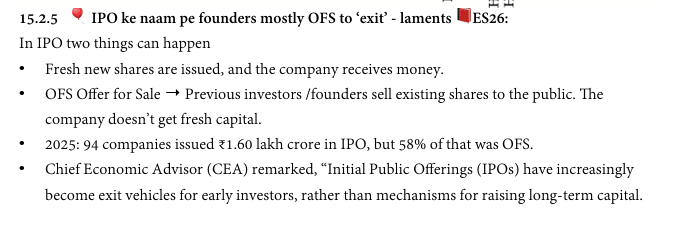
- IPO (Initial Public Offering): The first time a private company offers its shares to the public to raise capital. This happens in the primary market.
- FPO (Follow-on Public Offer): When an already listed company issues additional shares to the public to raise more capital.


👥 16.14.5 Issuing Shares to Specific Groups
- Rights Issue: Offering new shares to existing shareholders first, usually at a discount.
- QIP (Qualified Institutional Placement): Issuing shares only to Qualified Institutional Buyers (QIBs) like mutual funds and insurance companies.
- Private Placement: Selling shares to a select group of investors rather than the public.
🌑 16.14.6 Grey Market & "When-Listed" Platform
- Grey Market / Kerb Trading: The unofficial, unregulated trading of shares before they are officially listed on a stock exchange.
- "When-Listed" Platform: A proposed SEBI platform to allow investors to trade IPO-allotted shares before their official listing, aiming to reduce grey market activity.
🛠️ 16.14.7-16.14.13 Corporate Actions
- Offer for Sale (OFS): A method where promoters (owners) of a listed company sell their own shares to the public.
- Share Pledging: When promoters use their shares as collateral to borrow money.
- Equity Dilution: The reduction in the ownership percentage of existing shareholders when new shares are issued.
- Bonus Shares: Free additional shares given to existing shareholders. This increases the total number of shares but the total value of the investment remains the same, as the per-share price adjusts downwards.
- Share Splitting: Dividing existing shares into multiple new shares (e.g., one ₹3000 share becomes two ₹1500 shares). This increases liquidity by making shares more affordable, but the total market cap remains unchanged.
- Share Buyback: A company buys back its own shares from the marketplace, reducing the number of outstanding shares.
🏛️ 16.15 Stock Exchanges / Secondary Market
A stock exchange (or bourse) is a marketplace where previously issued securities (shares, bonds) are traded between investors.
- Oldest Exchanges: Amsterdam (World, 1602), Bombay Stock Exchange (Asia, 1875).
- Significance:
- 💧 Provides Liquidity: Allows investors to easily buy and sell assets.
- 💲 Facilitates Price Discovery: Determines the fair market price of securities through supply and demand.
- 🚀 Contributes to Economic Growth: Allows capital to be reallocated from old ventures to new ones.
🤝**16.15.1 Social Stock Exchange (SSE)
An exchange or platform for listing social enterprises and non-profit organizations (NPOs), helping them raise capital from the public for projects related to social welfare, development, and environmental sustainability.
📂 **16.15.4 DEMAT Account and Depositories
- DEMAT (Dematerialization): The process of converting physical share certificates into an electronic format.
- Depository: An organization that holds securities in electronic form (e.g., NSDL, CDSL).
- Depository Participant (DP): An agent of the depository (like a bank or broker) through which investors open a DEMAT account.
🔒 **16.15.5 ASBA (Application Supported by Blocked Amount)
A system for applying to IPOs. The application money is blocked in the investor's bank account but is only debited if shares are allotted. This ensures that investors earn interest on the blocked amount and only serious applicants participate.:
16.16 Central Counterparties (CCPs), Novation & ESMA**
1. What is a CCP?
- Role: A Central Counterparty (CCP) acts as a specialized intermediary between buyers and sellers in the financial market (G-Secs, shares, bonds, derivatives, etc.).
- Purpose: To prevent system failure. If a seller runs away with the money or a buyer fails to pay, the CCP takes responsibility to honor the agreement.
2. The Concept of "Novation"
- Definition: The process where the CCP legally steps into a trade.
- How it works: The CCP becomes the seller to every buyer and the buyer to every seller simultaneously.
- Impact: It guarantees the settlement of the trade even if one of the original parties defaults.
3. CCP Examples in India (Section 16.16.1)
- CCIL: Clearing Corporation of India (mainly for G-Secs/Forex).
- NSCCL: NSE Clearing Ltd.
- ICCL: Indian Clearing Corporation Ltd (BSE).
- MCXCCL: Multi Commodity Exchange Clearing.
4. Who Regulates CCPs in India? (Section 16.16.2)
The regulator depends on the type of transaction being cleared:
| Matter | Regulator | Act Used |
|---|---|---|
| Money transfer / Settlement | RBI | Payment and Settlement Systems Act, 2007 |
| Foreign Currency Transactions | RBI | FEMA Act, 1999 |
| Shares, Bonds, Commodities | SEBI | SEBI Act, 1992 & SCRA, 1956 |
5. The ESMA Controversy
- ESMA: European Securities and Markets Authority.
- The Issue: ESMA (the European regulator) threatened to cancel the licenses/registrations of Indian CCPs because they want more oversight over them. This creates hurdles for European banks/investors trading in Indian markets via Indian CCPs.
Quick Revision Tip:
- Novation = The "Step-in" process by the CCP.
- Settlement/Forex = RBI.
- Shares/Commodities = SEBI.
16.17 Investors ke Types (Types of Investors)**
1. Based on Buying Capacity (Section 16.17.1)
- QIB (Qualified Institutional Buyers): Large institutions with financial expertise and muscle (e.g., Mutual Funds, Insurance companies, Foreign Venture Capital Funds).
- Anchor Investors: A sub-type of QIBs who are offered shares before the IPO launch to build market confidence.
- Retail Investor: Any individual investor who is not a QIB. Underwriters usually keep a specific quota for this category.
2. Based on Buying Behavior (Section 16.17.2)
- Bull (तेजड़िया): Optimist who expects prices to rise. Like a bull, he "tosses his victim up" in the air.
- Bear (मंदड़िया): Pessimist who expects prices to fall. Like a bear, he "presses his victim down" to the ground.
- STAG: Buys shares in the primary market (IPO) and sells them immediately in the secondary market for quick profit.
- Jobber (आढ़ती): Professional who buys/sells using their own money (unlike brokers who use client money).
3. The Disposition Effect (Section 16.17.3)
- Definition: The tendency of investors to sell winning stocks too early (to book profit) but hold losing stocks too long (hoping for a miracle).
- Example: Selling Zomato quickly when it's in profit but refusing to exit Paytm even when it's in deep loss.
4. Style of Trading (Duration & Risk) (Section 16.17.4)
- Margin Trading: Buying more shares than one can afford by borrowing money from the broker. High risk of debt.
- Day / Intra-day Trading: Buying and selling shares within the same day.
- Swing Trader: Holds shares for a few days or weeks to profit from price fluctuations.
- Long-term Investor: Holds shares for more than 1 year.
- Block Deal: A single transaction of high value (₹5 crore or more), usually done by big institutions.
- Contra Trading: Investing against the crowd (e.g., buying cinema stocks when everyone else is selling them during a lockdown).
5. Retail vs. Proprietary Traders (Section 16.17.5)
| Feature | Retail | Proprietary (Prop) Traders |
|---|---|---|
| Objective | Personal Profit | Firm’s Profit |
| Capital | Self | Company's own capital |
| Scale | Small / Solo mode | Large / Systematic (e.g., Edelweiss) |
Quick Revision Tip:
- Anchor Investor = Confidence builder (pre-IPO).
- Stag = IPO flipper.
- Disposition Effect = Selling winners, keeping losers.
16.18 SENSEX & Other Notable Indices**
1. Key Market Indices
- SENSEX (Sensitive Index): The weighted average of the Free Float Market Capitalization (FFMC) of 30 companies selected by the Bombay Stock Exchange (BSE).
- NIFTY: The index of the National Stock Exchange (NSE), representing 50 companies.
- Nikkei: The index for the Tokyo Stock Exchange (Japan), representing 225 companies.
- Note for Prelims: NIFTY is regulated by SEBI, not the RBI.
2. Market Volatility: SENSEX Movements
| SENSEX Goes UP (Bullish) | SENSEX Goes DOWN (Bearish) |
|---|---|
| Monetary Policy: RBI’s soft/easy policy (cheap loans consumers spend more higher company profits). | Monetary Policy: Tight monetary policy (high interest rates less spending). |
| Stability: Peace, economic boom, political stability. | Instability: War, recession, political instability. |
| Investment: Government increases FDI limits. | Investment: Government reduces FDI limits. |
| Corporate: Mergers, acquisitions, new product launches, or environmental clearances. | Scandals: CEO/MD arrests, FIRs, court fines, or media exposing scams. |
3. Force Majeure (अभेद्य शक्ति)
- Origin: French for "superior force."
- Definition: Unexpected external circumstances (e.g., Acts of God, natural disasters, epidemics, war, terror attacks) that prevent a party from fulfilling a contract.
- Legal Impact: In such cases, courts may not punish a party for "dishonoring" (not completing) a contract.
- Real-world Example: During the COVID-19 pandemic, Singapore construction firms invoked Force Majeure because labor crunches and entry restrictions meant they could not finish building homes/offices on time.
16.19 : Indian Share Market Trends (2020-2024)**
1. Global Standing (Jan 2024)
- Rank: India is the 4th largest equity market globally ($5.3 Trillion). around 4% of world market cap.
- Global Top 5: (1) USA, (2) China, (3) Japan, (4) India, (5) Hong Kong.
- Growth Drivers:
- Strict regulation in China causing capital flight to India.
- Stable domestic political environment.
- Strong GDP growth.
2. Market Timeline & Volatility (Key Shocks)
- 2020: Massive foreign exit due to COVID-19.
- 2021: Boom in IT/Pharma due to global Quantitative Easing ($ infusion).
- 2022: Shock from Ukraine War and US Fed-Tapering (tightening money).
- 2023: Domestic shock from Adani-Hindenburg report.
- 2024 (Late): Foreigners exiting due to Yen Carry Trade issues, Israel-Gaza conflict, and over-valuation of Indian shares.
- 2025: India remains fastest growing major economy (7% GDP growth), Stable inflation and Robust corporate earnings.
- 2026:
3. Resilience & FPI (Foreign Portfolio Investment)
- Definition: Foreigners holding up to 10% stake in an Indian company.
- Shift in Impact:
- 2020: \rightarrow$ 23% fall in Nifty.
- 2026: \rightarrow$ 16-17% in Nifty.
- it is an 15 year low due to global uncertainty and capital shift
- The "India Resilient" Factor: The market no longer crashes when foreigners leave because Domestic Investors (Retail individuals + Mutual Funds) are now buying the shares being sold by foreigners.
4. US Market Risks (As per Economic Survey 2025)
- Bubble Concerns: American share prices have risen 20% (2023-24) without a proportional rise in consumer income.
- Subprime 2.0?: Complex investment products in Data Centers and Solar sectors are reminiscent of the 2007 financial crisis.
- Growth Concerns: Potential slowdown in sales for giants like Tesla and Apple.
- Here is a clear, exam-ready answer on US Market Risk (as per Economic Survey 2025–26) 👇
**US Market Risks (Economic Survey 2025–26)
⚠️ 1. Policy Uncertainty (Major Risk) • Economic Survey highlights uncertain US policies (tariffs, trade rules) • Sudden changes in US decisions create global instability
👉 Example: • US imposed high tariffs on imports (including India) 
➡️ Impact: • Disrupts global trade • Creates uncertainty in stock markets
📊 2. High Interest Rates in US • US Federal Reserve maintained high interest rates ➡️Impact on India: • Foreign investors shift money to US (safe returns) • Causes FPI outflows from India  💵 3. Strong US Dollar • Due to high interest rates, US dollar strengthens ➡️ Impact: • Indian rupee weakens • Capital flows move from emerging markets to US • Stock market becomes volatile  🌐 4. Trade Wars & Protectionism • US adopting protectionist policies (tariffs, trade conflicts) ➡️ Impact: • Global demand slows • Indian exports affected • Negative impact on stock market ⚡ 5. Global Financial Cycle Dependence • Economic Survey says: 👉 FPI flows depend heavily on US financial conditions ➡️ Impact: • When US economy changes → Indian market affected • Causes market volatility  🛢️ 6. Inflation & Energy Shocks (US-led global impact) • Rising oil prices and inflation linked to global conflicts ➡️ Impact: • Increases costs worldwide • Creates uncertainty in financial markets  Conclusion (Best for exam ⭐) 👉 As per Economic Survey 2025–26, US market risks include • Policy uncertainty & tariffs • High interest rates • Strong dollar • Trade protectionism
👉 These risks affect India through: ✔️ Capital outflows (FPI) ✔️ Exchange rate volatility ✔️ Stock market fluctuations ➡️ Hence, US remains a major external risk factor for the Indian stock market.
5. India-US Market Correlation (The "Granger Causality" Tool)
The Economic Survey used statistical tools to find how the two markets interact:
- One-Way Dependency: If the US market falls, India falls (happened 21/22 times).
- Diversification: If India falls, the US market often goes up (foreigners move money back to the US).
- Why?: American investment in India is much higher than Indian investment in the US.
6. Warning for "New" Investors
- Psychology: Millions of young Indians entered the market after the 2020 Corona crash.
- The Risk: These investors have only seen a "Bull Market" (rising prices). A significant global correction in 2025 could severely damage their sentiment and spending habits because they haven't experienced a "Bear Market" (crash) yet.
Key Terms to Remember:
- Yen Carry Trade: Borrowing cheap Yen to invest in India (now reversing).
- Quantitative Easing: Injecting money into the economy.
- Fed-Tapering: Reducing the money supply to control inflation.
16.20 MARKET THEORIES
16.21 Efficient Market Hypothesis / theory (EMH)
- Financial markets are efficient in processing information and pricing securities. So one investor CANNOT always KEEP earning more profits than the average trend in market.
- Gist: The market will behave as it must. Studying a company’s chart or balance sheet doesn't guarantee an edge. While one trade might go right, others may go wrong, and over time, profits will likely align with the market average.
16.21.1 Random walk theory
- Share prices move unpredictably.
- Therefore, a company’s past share prices or charts should not be used to predict future prices.
- It is considered impossible to consistently "beat" or defeat the share market.
16.22 ALPHA AND BETA VALUES
16.22.1 Beta Value to monitor price volatility or risk of an asset
Beta () is an indicator used to monitor price-volatility or the risk of an asset relative to the market (e.g., SENSEX).
| Value | Meaning |
|---|---|
| > 1 | The share moves faster than the market in both directions. High reward and high risk. Common in Tech, Startups, and Small-cap companies. |
| < 1 | This company moves slower than SENSEX. Characterized by low risk and low return. |
| = 1 | This company’s share moves parallel to SENSEX. |
| = 0 | Uncorrelated to the market. Its value changes independently of SENSEX movements (e.g., a Mona Lisa painting). |
| less than 0 | Negatively correlated. The asset moves in the opposite direction of SENSEX (e.g., Gold/Bonds; people often shift money from gold to shares when SENSEX rises). |
- MCQ Note: In finance, "beta" refers to a numeric value that measures the fluctuations of a stock in response to changes in the overall stock market.
16.22.2 Alpha value to compare performance of Mutual Funds
This indicator is primarily used to compare a Mutual Fund or Hedge Fund manager’s performance against a benchmark like SENSEX.
| Value | Meaning |
|---|---|
| Alpha > 0 | The MF provides a better profit than the benchmark. (e.g., if SENSEX grew 10% and the MF grew 12%, it has an Alpha of 2%). |
| Alpha = 0 | The MF performs the same as SENSEX. |
| Alpha < 0 | The MF provides less return than SENSEX. |
16.22.3 FAQ: Alpha vs Beta similarity / correlation / difference
- Alpha Usage: Mainly to compare the performance of Mutual Funds.
- Beta Usage: Mainly to find the volatility/risk of a specific share.
16.22.4 Types of Analysis – Fundamental vs Technical
| Feature | Fundamental Analysis | Technical Analysis |
|---|---|---|
| Investor studies what? | Company’s profit, loss, balance sheet, and new product launches. | Share price charts, graphs, and mathematical indicators (e.g., SMA, RSI, MACD). |
| Suitable for | Long-term investors (holding longer than 1 year). | Intraday Traders (buy/sell within a day) or Swing Traders (days/weeks). |
16.22.5 DEMAT Portfolio: Meaning, Types, Portfolio Diversification
- Portfolio: A collection of assets (shares, bonds, ETF, REITs, etc.) held by an investor.
- Types (depending on risk): Conservative, Balanced, and Growth/Aggressive.
- Diversification:
- Low diversity: Risk is high if a specific sector (e.g., automobile) slows down.
- High diversity: Spreading investments across various companies and sectors (e.g., SBI, Airtel, ONGC, Maruti) to reduce risk.
16.23 SECURITIES AND EXCHANGE BOARD OF INDIA (SEBI)
1. Basic Profile
- HQ: Mumbai.
- Legal Status: Established in 1988 (Executive Order) became a Statutory Body in 1992 (SEBI Act).
- Powers: Can order search and seizure, attachment of properties, arrest, and detention.
2. Governance & Composition
- Board: Chairman + 1 (RBI) + 2 (Union Govt) + 5 (Union Govt appointees).
- Chairman: Tenure of 5 years or 65 years of age (reappointment allowed).
- Selection: Done by the Financial Sector Regulatory Appointments Search Committee (FSRASC), headed by the Cabinet Secretary.
3. Regulatory Scope (What SEBI Regulates)
- Processes: Issuing Bonds, Shares, IPOs, ETFs, REITs, and InvITs.
- Places: Stock Exchanges, Depositories, and Commodity Exchanges.
- Persons: Investors, Brokers, Fund Managers, and Public Limited Companies.
- Collective Investment Schemes (CIS): Specifically those with a corpus of ₹100 crore or more.
4. Grievance Redressal & Education
- Appeals: Against SEBI go to the Securities Appellate Tribunal (SAT) then the Supreme Court. (Note: SAT also hears appeals against IRDAI and PFRDA).
- SCORES: Online portal for investor complaints (Version 2.0 aims for resolution within 21 days).
- SMARTs: Program for investor education.
- Saarthi App: Mobile app for investor awareness.
16.24 SEBI’s Leadership & Recent Reforms
1. Leadership Timeline
- 10th Chief: Madhabi Puri Buch (2022–2025). First woman chief; ex-ICICI banker.
- 11th Chief: Tuhin Kanta Pandey (IAS). Tenure starts in 2025 for 3 years.
2. Securities Market Code (Section 16.24.1)
- Goal: Budget 2021 proposed a single new law to simplify the regulatory framework.
- Consolidation: It will merge four major acts:
- SEBI Act, 1992.
- Depositories Act, 1996.
- Securities Contracts (Regulation) Act, 1956 (SCRA).
- Government Securities Act, 2007.
Quick Revision Tip:
- Statutory Status: 1992.
- Appeals: SAT.
- CIS Limit: ₹100 cr+.
- Securities Code: Merges 4 old laws into 1. Based on pages 29–36 of the provided document, here are the short notes for sections 16.25 to 16.29:
16.25 SEBI Investor Charter & Market Deepening**
- Investor Charter (2021): A commitment document by SEBI to protect investors and specify their rights across all financial products (Shares, Bonds, etc.).
- Why Protect Investors?: Scams erode savings (mental health risks), and duped investors shift money to unproductive assets like gold/real estate (increasing import bills and black money).
- Participation Goals:
- PSUs: Strive for minimum 25% public shareholding in Govt Companies.
- Private: SEBI aims for 35% minimum public holding.
- Current Status (ES25): Market has deepened. Investors grew from 4.9 crore (2020) to 13.2 crore (2024).
- The Debt Market Problem: India’s corporate bond market is only 18% of GDP (vs Korea's 80%). Regulatory restrictions prevent insurance/pension funds from investing in lower-rated bonds (below AA).
16.26 SEBI Reforms for Investor Confidence**
- Circuit Breaker: System to stop trading for "y" minutes if price fluctuations exceed "x%," preventing price rigging (scams like Harshad Mehta/Ketan Parekh).
- Settlement Cycles:
- T+1: Settlement within 1 working day (started 2022).
- T+0: Instantaneous/instant settlement (Launched October 2024).
- Illegal Trading:
- Dabba Trading: Trading in unofficial books outside stock exchanges. Illegal.
- Insider Trading: Trading based on confidential company info (illegal).
- Front Running: A fund manager buying shares for themselves just before their fund makes a massive purchase. Illegal.
- Algo Trading & Co-Location: Using computers for high-speed trading. Co-location means placing the trader's server inside the stock exchange to get data in 0.00001 seconds.
- IPF (Investor Protection Fund): Covers non-speculative losses (e.g., broker default). Max protection: ₹25 lakh per investor.
16.27 Server Crash Protection & Short Selling**
- BCP & DRS: Market institutions must have a Business Continuity Plan and Disaster Recovery Sites to move operations if the primary server fails.
- IRRA Portal: A safety net portal for investors to cancel or close trades during technical glitches/server errors.
- Adani-Hindenburg (2023): Resulted in a "Flash Crash" (sudden huge fall in share price). Justice A M Sapre panel investigated.
- Short Selling: An investor borrows a share, sells it at a high price, and hopes to buy it back later at a lower price to return it—profiting from a falling market.
- Finfluencers: Influencers giving financial advice. SEBI punishes those providing misleading advice on behalf of scamsters.
16.28 G-Sec Trading: Retail Direct Scheme (RDG) 🏛️
Historically, only "Big Players" (Banks/Institutions) could buy Government Bonds. To allow the "Common Man" (Retail Investor) to lend money directly to the Government and earn interest, the RBI launched this structural reform.
1. The Retail Direct Scheme (Launched 2021)
This initiative allows individual investors to bypass intermediaries (like Mutual Funds) and buy Government Securities directly from the source.
- The RDG Account: Retail investors can open a Retail Direct Gilt (RDG) account.
- The Hub: This account is opened and maintained on the E-Kuber platform (RBI's Core Banking Solution).
- Cost Efficiency: There is ₹ ZERO application fee and no management fee. This makes it cheaper than G-Sec Mutual Funds which charge an "Expense Ratio."
- Key Benefit: It provides a safe, sovereign-backed investment option with zero default risk (Gilt-Edged).
2. Eligible Instruments (What can you buy?)
Through the RDG account, a retail investor can access:
- Treasury Bills (T-Bills): Short-term debt of the Union Govt (<1 year).
- Dated G-Secs: Long-term debt of the Union Govt (>1 year).
- State Development Loans (SDLs): Bonds issued by State Governments.
- Sovereign Gold Bonds (SGBs): Govt. bonds linked to the market price of gold.
3. Market Access (Primary vs. Secondary)
The scheme provides access to two types of market entries:
- Primary Market: Participating in government auctions to buy "fresh" bonds directly when they are first issued.
- Secondary Market (NDS-OM): Using the Negotiated Dealing System-Order Matching (NDS-OM). This is RBI’s electronic, anonymous system where investors can buy/sell existing bonds from other investors (providing liquidity).
4. Recent Structural Updates (2024)
- T+0 Settlement (Oct 2024): Settlement is now instantaneous. When you buy or sell a G-Sec, the money/security is transferred on the same day (T+0), moving away from the older T+1 (next day) cycle.
- Investor Protection Fund (IPF): To protect retail investors against non-speculative losses (like a broker default), there is a safety net.
- Max Protection: ₹25 Lakh per investor.
💡 Quick Revision Tip (Exam Keywords)
| Feature | Detail |
|---|---|
| Account Name | Retail Direct Gilt (RDG) Account. |
| Platform | E-Kuber (RBI's platform). |
| Fees | Zero (Free of cost). |
| Settlement | T+0 (Instant) as of Oct 2024. |
| Safety Net | IPF (Max ₹25 Lakh). |
| Risk Level | Zero Default Risk (Gilt-Edged). |
🎯 Practice MCQ (Based on Notes)
Q: Under the RBI Retail Direct Scheme, a retail investor can open an account on which platform? (a) SEBI SCORES (b) RBI E-Kuber (c) NSE Prime (d) BSE StAR MF
Answer: (b) RBI E-Kuber
16.29 G-Sec Trading for Retail Investors 🏛️
Historically, the Government Securities (G-Sec) market was dominated by "Institutional Players" (Banks, Insurance Companies, and Mutual Funds). To democratize this and allow common citizens to invest, the RBI launched specific initiatives.
1. RBI Retail Direct Scheme (Launched 2021)
This is a "one-stop" solution to facilitate investment in Government Securities by individual investors.
- RDG Account: Retail investors can open a Retail Direct Gilt (RDG) account directly with the RBI.
- Platform: It operates through the E-Kuber platform (RBI’s Core Banking Solution).
- Cost: There is ZERO fee for opening the account and ZERO commission for buying securities.
- Eligible Instruments:
- Treasury Bills (T-Bills): Short-term (91, 182, 364 days).
- Central Govt. Securities (G-Secs): Long-term dated securities.
- State Development Loans (SDLs): Bonds issued by State Governments.
- Sovereign Gold Bonds (SGBs): Gold-linked government debt.
2. NDS-OM (Negotiated Dealing System-Order Matching)
This is the technical "engine" behind the secondary market for G-Secs.
- Nature: It is an electronic, screen-based, anonymous order-matching system.
- Function: It allows retail investors to trade (buy/sell) their existing G-Secs with other participants, providing liquidity.
- Anonymity: Buyers and sellers do not know each other's identity, preventing price manipulation.
3. Key Market Dynamics
To understand how G-Sec trading works, three technical terms are crucial:
- Bid-Ask Spread:
- Definition: The difference between the highest price a buyer is willing to pay (Bid) and the lowest price a seller is willing to accept (Ask).
- Exam Logic: High Spread = Low Liquidity (meaning it's harder/more expensive to trade).
- Arbitrage:
- Making a profit by taking advantage of price differences for the same asset in different locations (e.g., buying Gold in Mumbai and selling it instantly in Delhi if the price is higher there).
- Yen Carry Trade (2024 Context):
- Investors borrow money from Japan at near-zero interest rates to invest in high-yield markets like India.
- The 2024 Shock: When Japan raised interest rates, investors panicked and sold their Indian assets (including G-Secs and Shares) to repay their Japanese loans, causing a fall in the Indian market (SENSEX/NIFTY).
💡 Quick Revision Box (Exam-Ready)
| Term | Meaning |
|---|---|
| RDG Account | Direct account with RBI to buy Govt Bonds. |
| E-Kuber | The platform where RDG accounts are managed. |
| NDS-OM | The "Stock Exchange" for Government Bonds. |
| Bid-Ask Spread | High spread means the market is "dry" (illiquid). |
| Arbitrage | Profit from "buying low here and selling high there." |
| Carry Trade | Borrowing in a cheap currency to invest in a dearer one. |
🎯 Potential MCQ Practice
Q: Which of the following is correct regarding the RBI Retail Direct Scheme?
- It allows individuals to invest in both G-Secs and Private Corporate Bonds.
- It requires a mandatory fee for account maintenance.
- Investors can participate in both Primary and Secondary markets for G-Secs.
Answer: Only 3 is correct. (1 is wrong because it's only for Govt. Securities; 2 is wrong because it's free).
펀드 16.30 Investment Funds
16.30 Mutual Funds (MF) for the "Aam-Aadmi"
1. Core Concept
- What is it?: An Asset Management Company (AMC-NBFC) that pools savings from retail investors and issues "Units."
- Management: A Fund Manager invests this pool into various securities (shares, bonds, etc.) to build a portfolio.
- Returns: Dividends or interest generated are distributed to investors in proportion to their units.
- Costs: Investors pay an Entry Load (joining fee) and an Exit Load (fee when leaving). These are regulated by SEBI.
- Side-pocketing: SEBI allowed MFs to separate "toxic" or stressed assets (like IL&FS) from their main portfolio to protect the remaining value for investors.
2. Types of Mutual Funds (Section 16.30.1)
| Type of MF | Invests Money In |
|---|---|
| Equity-MF | Primarily Shares. |
| Debt-MF | Bonds, G-Secs, T-Bills (Fixed income instruments). |
| Hybrid-MF | Mix of both Shares and Bonds. |
| Multi-asset | Mix of Shares, Bonds, and Gold. |
| OPEN ENDED | |
| COSE ENDED | |
3. Structural Classification (Section 16.30.2)
| Feature | Open-ended | Close-ended |
|---|---|---|
| Fund Size | Unlimited; anyone can join anytime. | Fixed (e.g., ₹50 cr); no new money once filled. |
| Subscription | Whenever the client wants. | Only during the initial offer period. |
| Maturity | None. | Fixed maturity period (e.g., 5 years). |
4. Investment Methods (Section 16.30.3 & 16.30.5)
- Lumpsum (One-off): Investing the entire amount in a single transaction.
- SIP (Systematic Investment Plan): Investing small, fixed amounts at regular intervals (e.g., monthly).
- ELSS (Equity Linked Savings Scheme): A sub-type of MF where money is locked for 3 years. It is popular because it offers Income Tax benefits.
- ULIP (Unit Linked Insurance Policy): A hybrid product where a portion of the money goes into an MF and the rest goes toward an insurance premium.
5. Specialized Funds (Section 16.30.4)
- ESG Mutual Funds: Invest in companies with high Environmental, Social, and Governance standards.
- Shariya Mutual Funds: Invest only in companies compliant with Islamic Shariya law (No alcohol, pork, or gambling-related businesses).
6. Risk-o-meter (Section 16.30.6)
- SEBI requires all MFs to disclose the risk level of their schemes monthly.
- Categories: 6 levels ranging from Low to Very High Risk (the "Very High Risk" category was added in October 2020).
Quick Revision Tip:
- ELSS = 3-year lock-in + Tax benefit.
- Side-pocketing = Separating bad/toxic loans.
- SIP = Regular small installments.
16.31 Hedge Funds, REITs, and InvITs (For the "Rich-Aadmi")**
- Hedge Fund: A high-risk, high-return fund meant for HNI (High Net Worth Individuals).
- SEBI Norm: Minimum investment per person is ₹1 crore.
- Strategy: Managers use aggressive tactics like Arbitrage, Leverage, Short Selling, and F&O trading.
- REITs (Real Estate Investment Trusts): Funds that invest in rent-generating real estate projects. Investors earn from rent/sale.
- InvITs (Infrastructure Investment Trusts): Funds that invest in infrastructure projects like highways, airports, or gas grids. Investors earn from toll collection or service fees.
- Sovereign Wealth Fund: State-owned investment funds (e.g., Abu Dhabi's ADIA) that park surplus national funds into profitable global assets (like Reliance Jio).

Exchange Traded Funds (ETF
An Exchange Traded Fund (ETF) is a marketable financial security that tracks a specific index (like SENSEX or NIFTY), a commodity (like Gold), or a basket of assets, but is bought and sold like a common stock on a stock exchange.
Key Characteristics (Broken Down)
- Basket of Assets: Unlike a single company share, an ETF represents a "bundle" or "packet" of multiple assets (e.g., a CPSE-ETF bundles shares of ONGC, GAIL, etc.).
- Traded Like Shares: This is the most important feature. Unlike a regular Mutual Fund (where you buy units from the fund house), an ETF is traded on the stock exchange throughout the day.
- Passive Management: Most ETFs are "Passive Funds." This means they mechanically invest in companies in the exact same proportion as a stock index (e.g., a NIFTY-ETF will hold the same 50 stocks as the NIFTY index).
- Unit System: A fund manager creates a large pool of assets and divides them into small, affordable "Units" (typically priced at ₹10 or ₹100) for the public to buy.
Comparison for Clarity (UPSC Logic)
- Mutual Fund: You buy/sell at the end of the day based on the Net Asset Value (NAV).
- ETF: You buy/sell anytime during market hours at the current market price, just like a TATA or RELIANCE share.
Types mentioned in your notes:
- Index-ETF: Tracks indices like SENSEX/NIFTY.
- CPSE-ETF: Tracks Public Sector Enterprises (used for Disinvestment).
- Gold-ETF: Tracks the price of physical gold.
- Bitcoin-ETF: Tracks cryptocurrency (approved in USA, not yet in India).
16.32 CPSE-Exchange Traded Funds (ETF)**
- Purpose: A tool used by the Government for Disinvestment (selling shares of Central Public Sector Enterprises).
- Mechanism: The government bundles shares of various CPSEs (e.g., ONGC, GAIL) and gives them to a fund manager who issues ETF units to the public (typically at ₹10 per unit).
- BHARAT-22: A specific CPSE-ETF containing shares of 22 companies, including PSBs and UTI.
- Bharat Bond ETF (2019): Similar to a CPSE-ETF, but it holds bonds (debt) of government companies instead of shares.
- Comparison: Unlike normal Mutual Funds, CPSE-ETFs have a fixed portfolio (it won't change) and charge lower fees.
16.33 Index-ETF: Passive vs. Active Investing**
- Index-ETF: A Passive Fund that mechanically invests in companies in the exact same proportion as a stock index (like SENSEX or NIFTY).
- Comparison:
- Management: Index-ETFs are passive (no "brain" applied); Mutual Funds are active (manager decides where to invest).
- Fees: Index-ETFs have lower fees because they require less management.
- Liquidity: Index-ETFs generally have higher/easier liquidity.
16.34 Bitcoin, Overseas, and Gold ETFs**
- Bitcoin ETF: Approved in the USA (2024) but not yet approved in India.
- Pros: No anonymity (easier to tax), easier to retrieve than a lost crypto-wallet password, and reduces price volatility.
- Overseas ETF (2024 Ban): RBI/SEBI imposed a temporary ban on Indian Mutual Funds investing in overseas ETFs because they reached the ** currency exchange rate).
- Gold-ETF: Units representing physical gold kept in safekeeping. They are traded on the stock exchange like shares.
16.35 Alternative Investment Funds (AIF)**
SEBI classifies AIFs into three technical categories:
- Category I: Funds with a positive effect on the economy (e.g., Venture Capital, Angel Funds, Social Venture Funds, Infrastructure Funds). SEBI has relaxed norms for these.
- Category II: Funds that don't fit in Cat I or III (e.g., Private Equity or Debt Funds).
- Category III: Funds that undertake excessive risk for high short-term returns (e.g., Hedge Funds, PIPE Funds). SEBI has stricter norms for these to avoid destabilizing the market.

16.36 Forward / Future Contracts & Options**

- Forward / Future Contract: An agreement to buy or sell an asset at a specific price and quantity on a future date.
- Hedging: The act of taking a counteracting transaction (like buying an "Option") to avoid risk of loss if the market moves against your contract.
- Options (Call/Put): A type of "insurance" for future contracts.
- Call Option: Benefit if price rises.
- Put Option: Benefit if price falls.

Quick Revision Tip:
- Hedge Fund Min: ₹1 Crore.
- AIF Cat-I: Venture Capital (Good for economy).
- T-0 Settlement: Instant (started Oct 2024).
- Index-ETF: Passive (follows SENSEX/NIFTY).
16.37 Over-financialisation & Sachetisation**
1. Sachetisation (सेचेटीकरण)
- Definition: Making high-value financial products available in small, affordable "sachets" so even low-income individuals can buy them (like ₹1 shampoo packets).
- In Share Market: Allowing small retail investors to trade in F&O (Futures & Options) with very small capital.
- SEBI’s Concern: 9 out of 10 individual traders lose money in the F&O market. SEBI warns that sachetisation of risky trading is dangerous for the poor who gamble based on "finfluencer" tips.
2. Real Sector vs. Financial Sector
- Real Sector: Production of physical goods and services (Agri, Manufacturing, Services).
- Financial Sector: Claims on those real goods (Banks, Share market, Insurance).
- Over-financialisation: When the financial sector becomes disproportionately large compared to the real economy.
- India’s Data: Market Cap to GDP ratio rose from 77% (2018) to 140% (May 2024).2026: 130%
3. The Bell-Shaped Relationship
- Small financial growth helps developing nations (e.g., Morocco, Gambia).
- Excessive financialisation hurts developed nations (e.g., Japan, USA) by draining talent from engineering to banking and creating "asset bubbles."

16.38 Derivatives & Swaps**
- Derivative: A contract whose value is derived from an underlying asset (like a share, bond, gold, or currency).
- Securitization: The process of creating derivatives (e.g., a bank taking home loan papers to create Mortgage-Backed Securities).
- SWAP: A derivative to exchange one asset/liability for another to reduce risk.
- Currency Swap: Exchanging currencies between two countries to protect against dollar volatility.
- CDS (Credit Default Swap): An instrument to protect a lender from a loan default by the borrower. The lender pays a premium to an "insurer" (like LIC) who pays the loss if the borrower defaults.
16.39 Participatory Notes (P-Notes)**
- Definition: Also known as Offshore Derivative Instruments (ODIs).
- Target User: Foreign investors who want to invest in the Indian market but don't want the hassle of registering with SEBI, getting a PAN card, or opening a local DEMAT account.
- How it works:
- A foreigner gives money to a SEBI-registered FII (Foreign Institutional Investor like Morgan Stanley or Goldman Sachs).
- The FII buys Indian shares and stores them in its own DEMAT account.
- The FII issues a P-Note to the foreigner, which gives them the dividends and capital gains from those shares.

Why P-Notes are Controversial/Harmful:
- Anonymity: The identity of the actual investor remains hidden from SEBI.
- Money Laundering: High risk of "Round Tripping" (black money sent abroad and brought back as "foreign" investment).
- Terror Finance: Disguised source of funds can be used for illegal activities.
- Tax Evasion: The government loses out on taxes because the transaction happens "offshore" (outside India).
- Current Regulation: SEBI has tightened rules. Only specific "Category-I" FPIs can issue them, and they must report the identity of the end-investor to SEBI.
Quick Revision Tip:
- P-Note = Investment without SEBI registration.
- F&O Losers = 90% (9 out of 10).
- Market Cap to GDP = 140% (A sign of over-financialisation).
- Novation = CCP process. \
16.40 Tax on Investment / Financial Assets**
- Tax Relief Given (Section 16.40.1):
- Bank FD: 5-year tax-saving FDs.
- Small Savings: PPF, EPF, Sukanya Samriddhi Yojana (SSY), NSC, SCSS.
- Pension/Insurance: ULIPs, NPS, EPFO.
- Bonds: Specific tax-free bonds (e.g., NHAI, IRFC, REC).
- Donations: PM-CARES, Army Welfare Fund, and ZCZP (Zero Coupon Zero Principal) bonds.
- Tax Relief NOT Given (Section 16.40.2): Savings account interest, Sovereign Green Bonds (currently), Shares, P-Notes, Mutual Funds, and Cryptocurrency (taxed at 30%).
16.41 Commodity Market & Gold Exchanges**
- FMC Merger: The Forward Market Commission (FMC) merged with SEBI in 2015 following the NSEL scam. SEBI is now the unified regulator.
- Gold Exchange (Budget 2021): SEBI regulates gold trading. Warehousing is handled by the WDRA (Warehousing Development and Regulatory Authority).
- EGR (Electronic Gold Receipts): Physical gold is deposited in warehouses, and electronic receipts are issued. These EGRs are traded on SEBI-regulated exchanges.
- IIBX: India’s first International Bullion Exchange set up at GIFT City, Gujarat.
16.42 & 16.43 FSDC, FSB, and FATF**
- FSDC (Financial Stability & Development Council): Established in 2010.
- Chairman: Union Finance Minister.
- Members: Heads of RBI, SEBI, IRDAI, PFRDA, and secretaries of Finance Ministry departments.
- Function: Financial stability, inter-regulatory coordination, and financial literacy.
- FSB (Financial Stability Board): A G20 brainchild based in Basel; monitors global financial systems.
- FATF (Financial Action Task Force): Based in Paris; focuses on combating Money Laundering and Terror Financing.
- FSAP (Financial Sector Assessment Program): A comprehensive survey of the financial sector conducted every 5 years jointly by the IMF and World Bank.
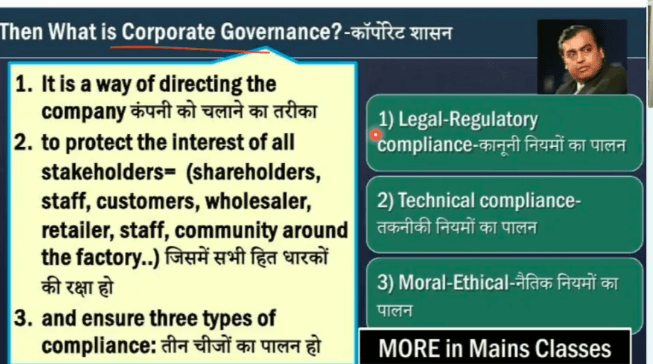
16.44 CORPORATE GOVERNANCE
16.45 Company Types
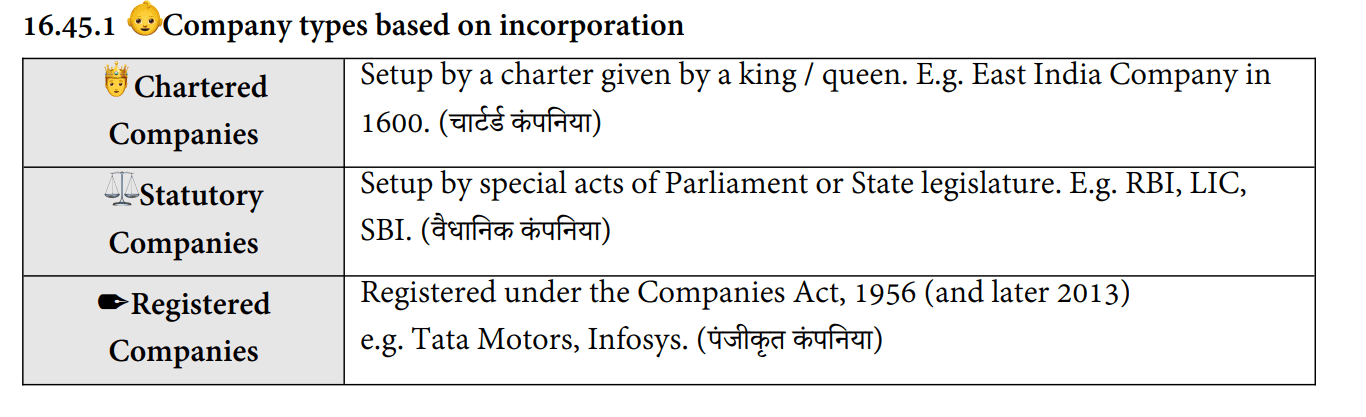

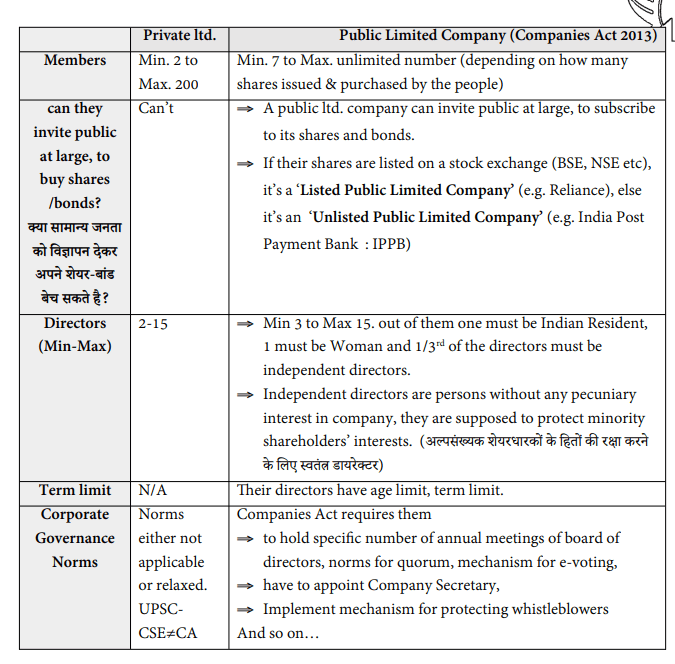
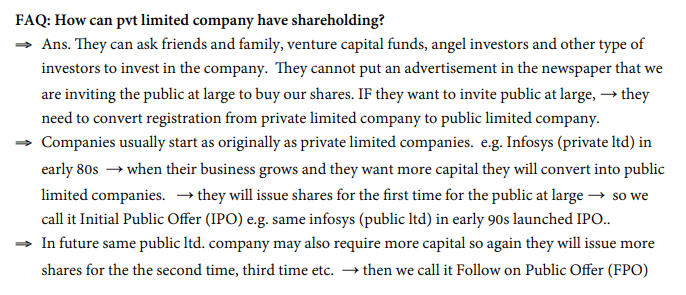
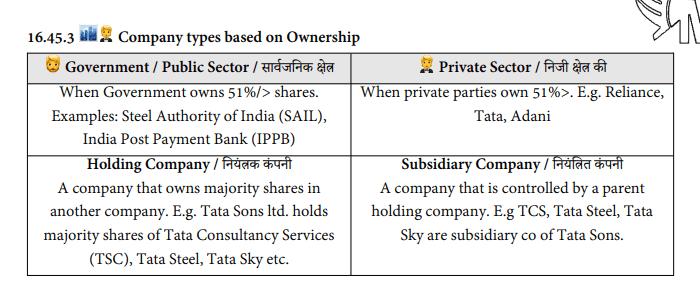
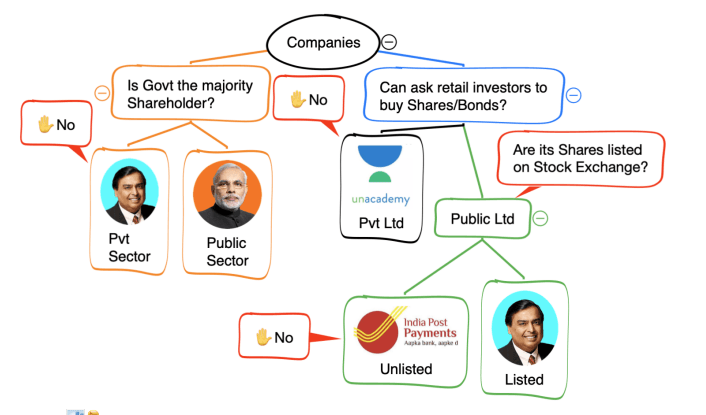
- 3) Misc Types:
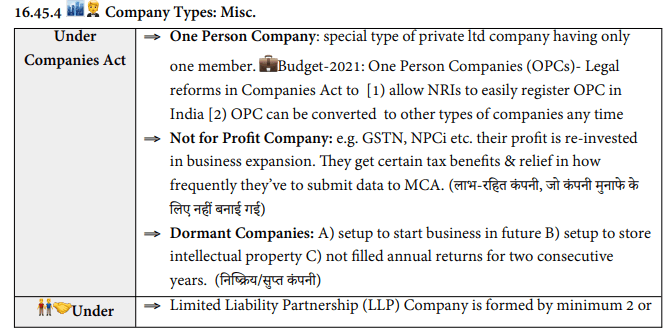
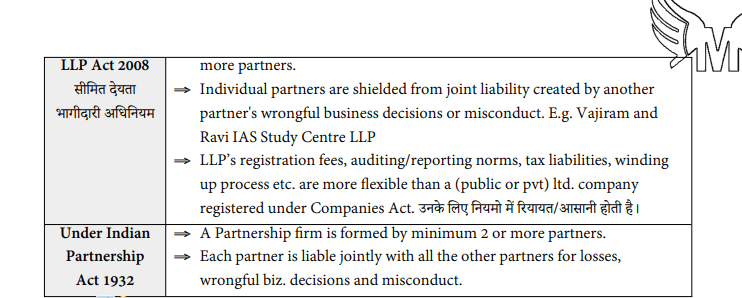

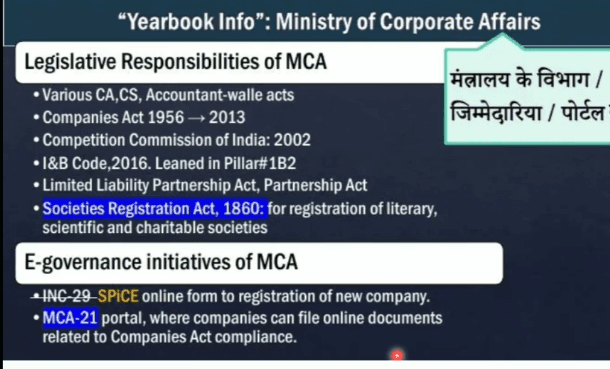
16.46 Statutory Bodies under MCA (Ministry of Corporate Affairs)**
- CCI (Competition Commission of India): Prevents anti-competitive practices (cartels/monopolies). Appeals go to NCLAT. under competition Act 2002 earlier it was MRTP ACT
- NCLT (National Company Law Tribunal): Handles insolvency, mergers, and boardroom battles.
- NFRA (National Financial Reporting Authority): Sets standards for auditors and CAs.
- IEPF (Investor Education & Protection Fund): Manages unclaimed dividends/shares. Secretary (MCA) is the ex-officio chairman.
- SFIO (Serious Fraud Investigation Office): Investigates white-collar financial crimes.
- CSR (Corporate Social Responsibility): Mandated by Companies Act 2013. Companies must spend 2% of average net profits (last 3 years) on social causes (education, health, etc.).
16.47 Takeover Related Terms**
- Friendly vs. Hostile Takeover: Friendly involves board approval; Hostile is done without consent (e.g., Elon Musk’s Twitter acquisition).
- LBO (Leverage Buy-Out): Buying a company using borrowed money (loans).
- Poison Pill: A defense strategy where a target company issues extra shares to existing shareholders to make the takeover more expensive/difficult for the buyer.
- De-Merger: Subdividing a large company into smaller, independent entities (e.g., ITC spinning off its Hotel business).
Quick Revision Tip:
- FSDC Chairman = Finance Minister.
- Crypto Tax = 30%.
- CSR Rule = 2% of profits.
- P-Note = Indirect/Offshore investment.
PART 1: Pillar#1C1 (Bonds/Debt Instruments)
Find Correct statements (Asked in UPSC-Pre-2018)
- The RBI manages and services Govt of India Securities, but not any State Govt Securities.
- Treasury bills are issued by Govt of India and there are no treasury bills issued by State Govts.
- Treasury bills offer are issued at a discount from the par value. Ans Codes: (a) 1 and 2 only (b) 3 only (c) 2 and 3 only (d) 1, 2 and 3
MCQ. In India, who can trade in Corporate Bonds and Govt Securities? (Pre'24-Set-C-Q53)
- Insurance Companies
- Pension Funds
- Retail Investors Codes: (a) 1 and 2 only (b) 2 and 3 only (c) 1 and 3 only (d) 1, 2 and 3
MCQ. Consider the following markets: [Pre'23-SET-A-Q025]
- Government Bond Market
- Call Money Market
- Treasury Bill Market
- Stock Market How many of the above are included in capital markets? (a) Only one (b) Only two (c) Only three (d) All four
MCQ. "Collateral Borrowing and Lending Obligations (CBLO)” are the instruments of _ _ _ . (Pre'24-Set-C-Q70) (a) Bond market (b) Forex market (c) Money market (d) Stock market
Which of the following is /are example (s) of ‘Near Money’? [UPSC-CDS-2016-I]
- Treasury Bill
- Credit Card
- Saving accounts
- Money Market Instruments Answer codes: (a) 1 only (b) 2 only (c) 1, 2 and 3 (d) 1, 3 and 4
Which defines ‘Hundi’ of the post-Harsha period? (UPSC-Prelims-2020) (a) An advisory issued by the king to his subordinates (b) A diary to be maintained for daily accounts (c) A bill of exchange (d) An order from the feudal lord to his subordinates
Find correct statement(s) (UPSC-Prelims-2020)
- ‘Commercial Paper’ is a short-term unsecured promissory note.
- ‘Certificate of Deposit’ is a long-term instrument issued by the Reserve Bank of India to a corporation.
- ‘Call Money’ is a short-term finance used for interbank transactions.
- ‘Zero-Coupon Bonds’ are the interest bearing short-term bonds issued by the Scheduled Commercial Banks to corporations. Codes: [a) 1 and 2 only [b) 4 only [c) 1 and 3 only [d) 2, 3 and 4 only
MCQ. Consider the following statements: (Pre'24-Set-C-Q41) St1: If the USA were to default on its debt, holders of US Treasury Bonds will not be able to exercise their claims to receive payment. st2: USA Government debt is not backed by any hard assets, but only by the faith of the Govt. Codes: (a) Both I & II are correct & II is the correct explanation for I (b) Both I & II are correct & II is not the correct explanation for I (c) I is correct but II is wrong (d) I is wrong but II is correct
MCQ. Find correct statements about Convertible Bonds (Prelims-2022)
- As there is an option to exchange bond for equity, Convertible Bonds pay a lower rate of interest.
- The option to convert to equity affords the bondholder a degree of indexation to rising consumer prices. Codes: (a) 1 only (b) 2 only (c) Both 1 and 2 (d) Neither 1 nor 2
Find correct statement about ‘IFC Masala Bonds' (UPSC-Pre-2016)
- The International Finance Corporation, which issues them, is an arm of the World Bank.
- They are rupee-denominated bonds & a source of debt financing for public & private sector. Answer Code: (a) 1 only (b) 2 only (c) Both 1 and 2 (d) Neither 1 nor 2
Which one of the following is a viable alternative to term-loans for raising debt finance by large publicly traded firms? (UPSC-IEnggS-2018) (a) Shares (b) Debentures (c) Asset loans (d) Gold loans
PART 2: Pillar#1C2 (Shares/Equities/Mutual Funds)
What does ‘Venture Capital’ mean? (Asked in UPSC-Pre-2014) A. A short-term capital provided to industries B. A long-term start-up capital provided to new entrepreneurs C. Funds provided to industries at times of incurring losses D. Funds provided for replacement and renovation of industries
An individual investor who invests in the e-project usually during an early stage is (UPSC-IES-2020) A) corporate strategic investor B) founder capital C) angel investor D) venture capital
MCQ. Goodwill Account is a/an _ _ _ (UPSC EPFO-2023) (a) Personal Account (b) Real Account (c) Nominal Account (d) Expense Account
MCQ. Consider the following statements: (Pre'24-Set-C-Q52)
- In India, NBFCs can access the Liquidity Adjustment Facility (LAF) window of RBI.
- In India, Foreign Institutional Investors can hold the G-Secs.
- In India, Stock Exchanges can offer separate trading platforms for debts. Codes: (a) 1 and 2 only (b) 3 only (c) 1, 2 and 3 (d) 2 and 3 only
MCQ. In the parlance of financial investment, ‘Bear’ denotes [UPSC-CDS-2012] (a) an investor, who feels that the price of a particular security is going to fall. (b) an investor, who expects the price of a particular share to rise. (c) a shareholder, who has an interest in a company, financially or otherwise. (d) any lender, whether by making a loan or buying a bond.
MCQ. Which of the following statements is/ are correct? [UPSC-CDS-2012-I]
- NIFTY is based upon 50 firms in India.
- NIFTY is governed and regulated by the Reserve Bank of India.
- NIFTY is the stock index of Bombay Stock Exchange. Answer Codes: (a) Only 1 (b) Only 2 (c) Only 3 (d) 1 and 3
MCQ. In the context of finance, the term ‘beta’ refers to _ _ [Prelims 23-SET-A-Q073] (a) the process of simultaneous buying and selling of an asset from different platforms (b) an investment strategy of a portfolio manager to balance risk versus reward (c) a type of systemic risk that arises where perfect hedging is not possible (d) a numeric value that measures the fluctuations of a stock to changes in the overall stock market
MCQ. Find correct statement(s): (Asked in Prelims-2021)
- Retail investors through demat account can invest in ‘Treasury Bills’ and ‘Government of India Debt Bonds’ in primary market.
- The ‘Negotiated Dealing System-Order Matching’ is a govt securities trading platform of the Reserve Bank of India.
- The ‘Central Depository Services Ltd.’ is jointly promoted by the Reserve Bank of India and the Bombay Stock Exchange.
Codes:
a) 1 Only
b) 1 and 2
c) 3 Only
d) 2 and 3


MCQ. Find wrong about Exchange Traded Fund (ETF) (CDS-2018-I) (a) It is a marketable security. (b) It experiences price changes throughout the day. (c) It typically has lower liquidity and higher fees than mutual fund shares. (d) An ETF does not have its net asset value calculated once at the end of every day.
Which one of the following terms is used in Economics to denote a technique for avoiding a risk by making a counteracting transaction? [UPSC-CDS-2016-I] (a) Dumping (b) Hedging (c) Discounting (d) Deflating
MCQ. Which are real sector in the economy? (Pre’2022) (1) Farmers harvesting their crops (2) Textile mills converting raw cotton into fabrics (3) A commercial bank lending money to a trading company (4) A corporate body issuing Rupee Denominated Bonds overseas Codes: (a) 1 and 2 only (b) 2, 3 and 4 only (c) 1, 3 and 4 only (d) 1, 2, 3 and 4
______ is issued by registered foreign portfolio investors to overseas investors who want to be part of the Indian stock market without registering themselves directly? (Pre-2019) (a) Certificate of Deposit (b) Commercial Paper (c) Promissory Note (d) Participatory Note
MCQ. Which of these are financial instruments? (Pre'24-Set-C-Q54)
- Exchange-Traded Funds (ETF)
- Motor vehicles
- Currency swap Codes: (a) 1 only (b) 2 and 3 only (c) 1, 2 and 3 (d) 1 and 3 only
MCQ. [CSP23-SET-A-Q021] Consider the following statements: Statement-I: Interest income from the deposits in Infrastructure Investment Trusts (InvITs) distributed to their investors is exempted from tax, but the dividend is taxable. Statement-II: InvITs are recognized as borrowers under the 'Securitization and Reconstruction of Financial Assets and Enforcement of Security Interest Act, 2002'. Codes: (a) Both I & II are correct & II is the correct explanation for I (b) Both I & II are correct & II is not the correct explanation for I (c) I is correct but II is wrong (d) I is wrong but II is correct
MCQ. Find correct about “Inflation-Indexed Bonds (IIBs)” in India (Prelims-2022)
- Government can reduce the coupon rates on its borrowing by way of IIBs.
- IIBs provide protection to the investors from uncertainty regarding inflation.
- The interest received as well as capital gains on IIBs are not taxable. Codes: (a) 1 and 2 only (b) 2 and 3 only (c) 1 and 3 only (d) 1, 2 and 3
MCQ. 'Financial Stability and Development Council': find correct statement(s): (Pre-2016)
- It is an organ of NITI Aayog.
- It is headed by the Union Finance Minister.
- It monitors macro-prudential supervision of the economy. Answer Codes: (a) 1 and 2 only (b) 3 only (c) 2 and 3 only (d) 1, 2 and 3
MCQ. Find correct about CSR: (Pre'24-Set-C-Q60)
- CSR rules specify that expenditures that benefit the company directly or its employees will not be considered as CSR activities.
- CSR rules do not specify minimum spending on CSR activities. Codes: (a) 1 only (b) 2 only (c) Both 1 and 2 (d) Neither 1 nor 2
MCQ: ‘NSE Prime', sometimes mentioned in news, denotes: (UPSC-EPFO-2023) (a) A high standard corporate governance initiative (b) Long-duration Sovereign Green Bonds (c) Concessions and tax-holidays for hi-tech startup companies (d) Special privileges for certain categories of Non-Banking Financial Institutions
